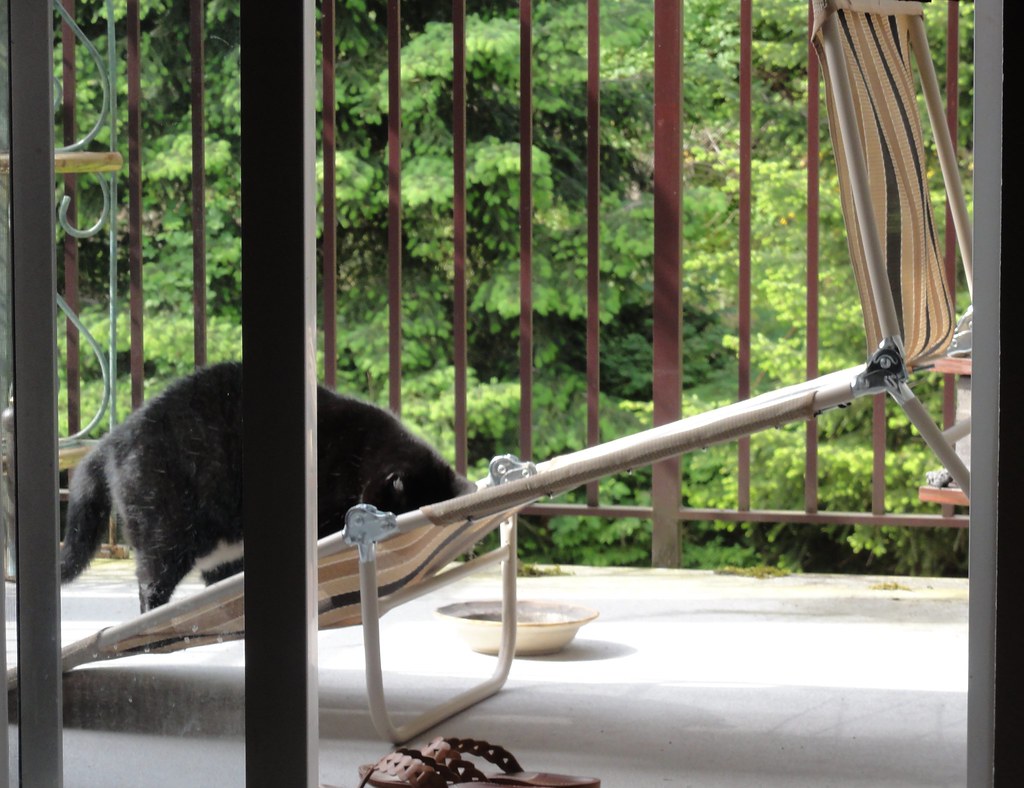
We've had occasional moments of summer, which means I'm forced to leave the sliding glass door open so that my felid can play Queen o' the Porch. So last weekend, there I was, trying to concentrate on me work, and I hears this clunk.
I looked outside in alarm, and in the next moment dove for the camera, because hilarity was about to ensue.
The important thing about leverage is, when you're on one end of a very long lounge chair, and there's nothing anchoring the other end, the end you're on goes clunk.
I waited for the freakout.
19 June, 2011
18 June, 2011
Cantina Quote o' The Week: Golda Meir
One cannot and must not try to erase the past merely because it does not fit the present.
-Golda Meir
I had a hard time choosing one quote from Golda Meir to highlight. She could be by turns witty, wry, or profound. Some of my favorite quotes regarding war come from here, and I'll just share one of many here:
A leader who doesn't hesitate before he sends his nation into battle is not fit to be a leader.She was Prime Minister of Israel during the Yom Kippur War. She spoke from experience.
Golda's one of those complex figures of history, neither perfect saint nor sinner. She had her flaws, among them her tendency to dismiss Palestinians and their concerns outright for far too long. But she was an iron-strong woman who fought like fury for her people, an incisive world leader who could call bullshit like no one else, and who never fell in love with war. Just one final quote, then, which demonstrates that last:
It is true we have won all our wars, but we have paid for them. We don't want victories anymore.Now if only more leaders could come to that conclusion, there might be no need for victories.
17 June, 2011
On Terry Pratchett and Escape Routes
This news brought tears to my eyes, because I adore Terry Pratchett and I never ever want the world to be without him:
Which one of us wants to live on beyond hope? Mind gone, life destroyed beyond recovery, each day one more endless slog of suffering and humiliation? Very few of us, I'd bet.
And because of Switzerland's compassionate laws and clinics like Dignitas, Terry Pratchett doesn't have to.
Does the news he's planning on ending his life shock and sadden me? Of course it does. I'll miss him terribly. He's changed my life in so many ways, given me so many precious memories curled up with a Discworld book. It hurts to lose him, hurts to know that the series will end far too soon, and that I won't have a chance to ever shake his hand and say a heartfelt "Thank you." But, people, he has Alzheimer's. It's already mauled his ability to write, and it will progress to the point where he can't write at all. It will steal his mind away, leaving a shell, and perhaps just enough awareness to know what's happening.
I am a writer. I have a damned good imagination, but I can't imagine many things worse.
And how much worse is it when there's no way out, no way to choose the moment, no way to cut out those awful bits at the end and go out on a high note? To live in fear that one day, you'll wake up and have nearly nothing of you left and know that it will only get worse and yet be forced to live through that nightmare for an unknown length of time? I can't speak for Terry, but I can speak for myself: that fear would consume me. It would poison all the good moments left. Much better to know there's an escape route. Much easier to live those last good days fully and happily when there's an exit available. Even if I can't bring myself to walk through that door - and really, until I've got my hand on the handle, how can I know if I'll have the emotional strength to turn it? - knowing it's there would be an enormous comfort.
I've often said we treat our pets better than people. We don't let them linger on in horrible pain, not if we're good and strong people who can do right by them. I've made more than one trip to the vet with a beloved pet when there was no hope of any more good days, or too few to justify all the bad ones. I've held them as they died. And it's hard. It's so hard. But it's the right thing to do.
Why shouldn't I be able to do that for my mother, who lives in dread of suffering and dying like her own mother did, mind gone and only a confused, agonized shell lingering on? Why shouldn't I be able to choose people to do the same for me?
People have this knee-jerk horror at the idea of someone taking their own life. They seem to believe no one should have that choice, and they give reasons. Some, I even agree with. This isn't a decision that should ever be made lightly: it needs to be understood that it's irreversible, and that some things are worth living through for a bit to see if they get better, because they so often do. This isn't a decision that should ever be forced on a person. But there are so many ways to ensure those things are suitably addressed, and they shouldn't stop us from allowing people who want it an escape route.
As for the other reasons, such as it's God's choice and not ours - well, those arguments are invalid. So are the slippery slope arguments used as camouflage for the religious ones. We're not going to see grandmas and grandpas bundled off wholesale just because assisted suicide is legal. There may be isolated incidents. You know what? There already are, and always will be, and demanding a perfect system with no errors is just another way of ensuring the escape route stays blocked off for everyone forever. So fuck that.
I hope, once those papers are signed, Terry Pratchett can breathe a sigh of relief and get on with living a lot more life before the time comes. I hope we don't lose him so soon. But at least he's got the escape route open. No matter when he chooses to go, at least it's his choice, not the disease and not society. He won't be trapped with no way out.
It's time other people got to have that same choice.
(Eric MacDonald on Pratchett and the Choosing to Die program is well worth reading.)
Those of us who read Eric MacDonald's beautiful blog know Dignitas. It's an amazing place, and I'm glad it's there. Because people need escape routes.Three and a half years ago, Terry Pratchett, the beloved author of the Discworld series, announced that he has early-onset Alzheimer's disease. Now he's made an even more startling announcement.
Pratchett, who has campaigned in his native United Kingdom for the right of assisted suicide, has begun the formal process of assisted suicide in Switzerland, one of the few countries in the world to legalize euthanasia. Specifically, this would take place at Dignitas, a clinic that provides qualified doctors and nurses to assist with the patients' suicides.
Which one of us wants to live on beyond hope? Mind gone, life destroyed beyond recovery, each day one more endless slog of suffering and humiliation? Very few of us, I'd bet.
And because of Switzerland's compassionate laws and clinics like Dignitas, Terry Pratchett doesn't have to.
Does the news he's planning on ending his life shock and sadden me? Of course it does. I'll miss him terribly. He's changed my life in so many ways, given me so many precious memories curled up with a Discworld book. It hurts to lose him, hurts to know that the series will end far too soon, and that I won't have a chance to ever shake his hand and say a heartfelt "Thank you." But, people, he has Alzheimer's. It's already mauled his ability to write, and it will progress to the point where he can't write at all. It will steal his mind away, leaving a shell, and perhaps just enough awareness to know what's happening.
I am a writer. I have a damned good imagination, but I can't imagine many things worse.
And how much worse is it when there's no way out, no way to choose the moment, no way to cut out those awful bits at the end and go out on a high note? To live in fear that one day, you'll wake up and have nearly nothing of you left and know that it will only get worse and yet be forced to live through that nightmare for an unknown length of time? I can't speak for Terry, but I can speak for myself: that fear would consume me. It would poison all the good moments left. Much better to know there's an escape route. Much easier to live those last good days fully and happily when there's an exit available. Even if I can't bring myself to walk through that door - and really, until I've got my hand on the handle, how can I know if I'll have the emotional strength to turn it? - knowing it's there would be an enormous comfort.
I've often said we treat our pets better than people. We don't let them linger on in horrible pain, not if we're good and strong people who can do right by them. I've made more than one trip to the vet with a beloved pet when there was no hope of any more good days, or too few to justify all the bad ones. I've held them as they died. And it's hard. It's so hard. But it's the right thing to do.
Why shouldn't I be able to do that for my mother, who lives in dread of suffering and dying like her own mother did, mind gone and only a confused, agonized shell lingering on? Why shouldn't I be able to choose people to do the same for me?
People have this knee-jerk horror at the idea of someone taking their own life. They seem to believe no one should have that choice, and they give reasons. Some, I even agree with. This isn't a decision that should ever be made lightly: it needs to be understood that it's irreversible, and that some things are worth living through for a bit to see if they get better, because they so often do. This isn't a decision that should ever be forced on a person. But there are so many ways to ensure those things are suitably addressed, and they shouldn't stop us from allowing people who want it an escape route.
As for the other reasons, such as it's God's choice and not ours - well, those arguments are invalid. So are the slippery slope arguments used as camouflage for the religious ones. We're not going to see grandmas and grandpas bundled off wholesale just because assisted suicide is legal. There may be isolated incidents. You know what? There already are, and always will be, and demanding a perfect system with no errors is just another way of ensuring the escape route stays blocked off for everyone forever. So fuck that.
I hope, once those papers are signed, Terry Pratchett can breathe a sigh of relief and get on with living a lot more life before the time comes. I hope we don't lose him so soon. But at least he's got the escape route open. No matter when he chooses to go, at least it's his choice, not the disease and not society. He won't be trapped with no way out.
It's time other people got to have that same choice.
(Eric MacDonald on Pratchett and the Choosing to Die program is well worth reading.)
16 June, 2011
Lying Liars and the Creationist Bastards Who Lead Field Trips
It's be a while since we've had the Smack-o-Matic off the woodshed wall. I shall now proceed to lift it down reverently, blow the dust from it, give it a loving polish, and proceed to administer it to some very deserving bottoms.
If you are one of those people prone to troll about "tone" and has to look for a fainting couch whenever a Gnu Atheist is the slightest bit mean to those poor ickle Christians, you'd best exit the cantina now. I have now prepared the Smack-o-Matic for maximum smackage, and I am about to be very Not Nice.
Check out this dastardly bunch of outrageous liars:
Lesse... we had not one but two buffoons from the Institute for Creation Research: Steve Austin and Bill Hoesch. Marcus Ross, formerly of that noxious bunch of anti-evolution fucktards who plague my beautiful city of Seattle, also known as the Discovery Institute. He's currently teaching at Liberty University, which is so anti-intellectual I'm not sure how anyone calls it a "university" without laughing themselves to death. John Whitmore, who's with Cedarville University in Ohio, stuffing liberal Christian students' heads with nonsense. Lest you be persuaded by the "liberal" part that there must be some sanity at that school, consider this factoid: "Cedarville’s official doctrinal statement declares, 'We believe in the literal six-day account of creation' and requires that all faculty 'must be born-again Christians' who 'agree with our doctrinal statement.'" Oh, yes, liberal. Liberal stupidity, perhaps.
The last, Tim Clarey, gets hardly a mention in the article, so I did a quickie on Google. All I can say is, Delta College in Michigan must be really fucking hard up for geology professors if they let the editor of "Proceedings of the Second Conference on Creation Geology" (.pdf) teach. Oh, but he's fun and stuff and he doesn't make you use the text book. I wonder why that is....
I have something against these arseholes. No, it's not because they're the kind of dumbshit Christian who tries to shoehorn 4.5 billion years of geology into 6,000 years and one really big flood (instead of "God did it!" at every turn, with creationist geologists, you hear "the Flood did it!" All. The. Time). They're welcome to be as stupid as they like. They can play with their Magic Sky Daddy and believe the Bible's really really real and true and totally accurate even in all those bits that are flat-out wrong or completely contradict other bits of the Bible. They're even welcome to come to conferences and present their "science" along with all of the supposed data they've amassed. Go on, give us a laugh. And if they've got real data, solid data, data that proves what they're saying beyond a reasonable doubt, bring it! It's science, baby.
Now, they haven't got that data and the chances they ever will are roughly on par with my waking up tomorrow and actually deciding that my day job is the best job in the whole universe, but still, let 'em try.
No, what I have against them is the fact that they're lying little shits who do their damnedest to snow everyone. They're deceptive ratfuckers who, when among the real scientists, pretend they're down with this millions-of-years stuff. They use the big geology words and sometimes even salt their bullshit with a little actual geology to disguise the taste of what they're serving up. Just check this out:
Just one more example shall suffice to show what two-faced ratfucking rat bastards these assholes are:
Is it just me, or is that an insult to both the geological profession and the Christian faith? I mean, seriously. Is there anyone they won't lie to?
That's the reason I have not refrained from using the naughty words in abundance when referring to this merry band of despicable fucktards. They don't even have the courage of their convictions. They can't stand up and say, "I believe this, and here's the evidence I've found that might support that believe if you squint a lot and drink some Drano and pretend that radiometric dating doesn't exist." They have to lie to us, and then they lie to believers who have no idea how science works but get a thrill up their leg when they think that their Bronze-Age beliefs are validated by actual scientists. And that offends me on so many levels I can't explore them all.
The writer of the article describing this atrocity thinks we should allow them to continue to infest conferences. And I say, "Yes. By all means - if they are required to proclaim, baldly, up front, and without prevarication, just precisely what it is they believe." None of these games where they play the Serious Scientist at professional, mainstream geology conferences and then spew Young Earth creationism all over the Christian circles back home, all the while proclaiming that because they didn't get run out of the conference on a rail, that means genuine scientists believe them.
But they'll never be honest, because they know real geologists will never accept them if they tell the truth. So the liars for Jesus will continue to lie. And geologists, like biologists, will have to expose their Trojan-horse antics before, like termites, they undermine the foundations.
If you are one of those people prone to troll about "tone" and has to look for a fainting couch whenever a Gnu Atheist is the slightest bit mean to those poor ickle Christians, you'd best exit the cantina now. I have now prepared the Smack-o-Matic for maximum smackage, and I am about to be very Not Nice.
Check out this dastardly bunch of outrageous liars:
Who led the field trip?In almost every way, the “Garden of the Gods at Colorado Springs” excursion at the annual meeting of the Geological Society of America (GSA) last year was a normal — even enjoyable — field trip. Standard geologic terminology was used in the accompanying field trip guide, and throughout the trip itself. The trip leaders discussed past events in terms of millions and billions of years. At each stop along the trip, the guides relied on orthodox geologic thinking, including a standard examination of sedimentary features and the nature of contacts between units.
But in reality, the trip was anything but a normal geology field trip. Instead, it was an example of a new strategy from creationists to interject their ideas into mainstream geology: They lead field trips and present posters and talks at scientific meetings. They also avoid overtly stating anything truly contrary to mainstream science.
But when the meeting is over, the creationist participants go home and proudly proclaim that mainstream science has accepted their ideas.
Lesse... we had not one but two buffoons from the Institute for Creation Research: Steve Austin and Bill Hoesch. Marcus Ross, formerly of that noxious bunch of anti-evolution fucktards who plague my beautiful city of Seattle, also known as the Discovery Institute. He's currently teaching at Liberty University, which is so anti-intellectual I'm not sure how anyone calls it a "university" without laughing themselves to death. John Whitmore, who's with Cedarville University in Ohio, stuffing liberal Christian students' heads with nonsense. Lest you be persuaded by the "liberal" part that there must be some sanity at that school, consider this factoid: "Cedarville’s official doctrinal statement declares, 'We believe in the literal six-day account of creation' and requires that all faculty 'must be born-again Christians' who 'agree with our doctrinal statement.'" Oh, yes, liberal. Liberal stupidity, perhaps.
The last, Tim Clarey, gets hardly a mention in the article, so I did a quickie on Google. All I can say is, Delta College in Michigan must be really fucking hard up for geology professors if they let the editor of "Proceedings of the Second Conference on Creation Geology" (.pdf) teach. Oh, but he's fun and stuff and he doesn't make you use the text book. I wonder why that is....
I have something against these arseholes. No, it's not because they're the kind of dumbshit Christian who tries to shoehorn 4.5 billion years of geology into 6,000 years and one really big flood (instead of "God did it!" at every turn, with creationist geologists, you hear "the Flood did it!" All. The. Time). They're welcome to be as stupid as they like. They can play with their Magic Sky Daddy and believe the Bible's really really real and true and totally accurate even in all those bits that are flat-out wrong or completely contradict other bits of the Bible. They're even welcome to come to conferences and present their "science" along with all of the supposed data they've amassed. Go on, give us a laugh. And if they've got real data, solid data, data that proves what they're saying beyond a reasonable doubt, bring it! It's science, baby.
Now, they haven't got that data and the chances they ever will are roughly on par with my waking up tomorrow and actually deciding that my day job is the best job in the whole universe, but still, let 'em try.
No, what I have against them is the fact that they're lying little shits who do their damnedest to snow everyone. They're deceptive ratfuckers who, when among the real scientists, pretend they're down with this millions-of-years stuff. They use the big geology words and sometimes even salt their bullshit with a little actual geology to disguise the taste of what they're serving up. Just check this out:
That, my friends, is despicable. It's behavior beyond the pale. These people pretend to be really real scientists, if slightly weird ones, with nary a mention of their Young Earth beliefs and their 6,000 year timeline and they don't breathe a word of Noah's Flood, all so that they can get their photo taken with actual really real scientists and pretend they've wowed 'em - and they lie about their supposed publications, and they deceive the folks back home, the poor innocent little fucktards in the pews, into thinking actual fucking geologists respect their Biblical bullshit.Field trip 409 was not the first such creationist-led geology excursion at a GSA meeting. At the 2009 annual GSA meeting in Portland, Ore., four of the five trip leaders (Austin, Whitmore, Clarey and Ross) organized a field trip to Mount St. Helens to examine catastrophic erosion resulting from the 1980 eruption. After that trip, the Institute for Creation Research ran a headline bragging, “Christian Geologists Influential at GSA Meeting,” noting that Austin’s “peer-reviewed manuscript was published by GSA.”
In truth, every field trip guide that year was published in the book “Volcanoes to Vineyards.” Austin’s guide, “The dynamic landscape on the north flank of Mount St. Helens,” followed normal geologic thinking and contained no direct creationist arguments — though attempts to link Mount St. Helens to the Grand Canyon erosional processes might have proved puzzling to attendees.
Just one more example shall suffice to show what two-faced ratfucking rat bastards these assholes are:
“Millions of years” was a phrase that also appeared in Ross’ talk on Late Cretaceous marine stratigraphy; many of his slides used normal geologic time, with millions of years clearly labeled on axes. Nothing in his 15-minute talk hinted at nonstandard geologic thinking. Because most of the audience probably did not know Ross’ background, it must have been puzzling to them when the first question following Ross’ talk challenged him on how he could “harmonize this work with [his] belief in a 6,000-year-old Earth.” (This question came from University of Florida geology professor Joe Meert, who blogged about the exchange.)
Ross answered the question by saying that for a scientific meeting such as GSA, he thought in a “framework” of standard science; but for a creationist audience, he said, he used a creationist framework. Judging from the reaction of the audience, this answer caused more confusion than enlightenment. Ross pointed out that nothing in his presentation involved Young-Earth Creationism. But he then volunteered that he was indeed a Young-Earth Creationist. [Outraged emphasis added]
Is it just me, or is that an insult to both the geological profession and the Christian faith? I mean, seriously. Is there anyone they won't lie to?
That's the reason I have not refrained from using the naughty words in abundance when referring to this merry band of despicable fucktards. They don't even have the courage of their convictions. They can't stand up and say, "I believe this, and here's the evidence I've found that might support that believe if you squint a lot and drink some Drano and pretend that radiometric dating doesn't exist." They have to lie to us, and then they lie to believers who have no idea how science works but get a thrill up their leg when they think that their Bronze-Age beliefs are validated by actual scientists. And that offends me on so many levels I can't explore them all.
The writer of the article describing this atrocity thinks we should allow them to continue to infest conferences. And I say, "Yes. By all means - if they are required to proclaim, baldly, up front, and without prevarication, just precisely what it is they believe." None of these games where they play the Serious Scientist at professional, mainstream geology conferences and then spew Young Earth creationism all over the Christian circles back home, all the while proclaiming that because they didn't get run out of the conference on a rail, that means genuine scientists believe them.
But they'll never be honest, because they know real geologists will never accept them if they tell the truth. So the liars for Jesus will continue to lie. And geologists, like biologists, will have to expose their Trojan-horse antics before, like termites, they undermine the foundations.
15 June, 2011
When Lives Are On The Line: Part I
[Guest blogger Kaden]
Call 9-1-1
Easy to remember and ingrained since childhood, call these three simple numbers and you can reach police,
fire, or medical assistance. And that's about the extent of the average person's knowledge of 9-1-1.
This series is meant to give you some insight inside my world, but mostly its just an excuse for me to talk a lot. Dana seems concerned about her stockpile of ready blog posts, and I have a ton of very, very important things to do. So it seemed only natural to stop doing those and get sidetracked.
[Speaking of sidetracked, a disclaimer: I am speaking merely as an individual, the views and opinions expressed below belong solely to me and not any public department or agency. I do not represent any government body. When consulting your local police or fire department, keep in mind that individual results may vary.]
In 1968, Robert Fitzgerald introduced North America to the 9-1-1 emergency telephone system. In the 43 years since then, the number 9-1-1 has become a nationally known resource for putting the ordinary citizen in touch with emergency services. In the 43 years since then, 9-1-1 has expanded and grown, and at the same time has retained an almost superhero-esque anonymity. And while I like to think of myself as a caped crusader rescuing innocent lives in the struggle against the dangers of everyday life, it's not nearly that glorious. For one thing, we don't get capes.
Man, I wish we got capes.
Before I dive too deep, let me give an overview of how 9-1-1 works, at least in my neck of the woods. Keep in mind that individual laws and regulations, as well as funding, means that emergency services may work very differently around the country and even in the same region. I work in Oregon and even some of our neighboring counties have fewer or greater services than we provide. Still, it follows a basic plan.
When you call 9-1-1 from any phone in the United States, either cell phone, landline, Voice-over IP (VoIP) phones, or payphone, your call is routed to the nearest PSAP, or Primary Service Answering Point. From there, your call may be handled by the PSAP's agency, or may be transferred to a Secondary answering point. For example, my PSAP intakes 9-1-1 calls for most of the county, but we only dispatch for the fire department and 1 metro city police department. If you call 9-1-1 here and you are in a nearby city, you are then transferred to the appropriate police agency's emergency line, and will be handled there. So we are a filter of sorts.
From there, your information is taken and emergency responders are dispatched to the location. Police for criminal matters, or the fire department for medical problems or, well, fires.
In smaller cities, the person who answers the phone may be the same person who is dispatching. That is, they operate the radio and the phones at the same time. I've even heard horror stories about call centers with such low staffing that if you have to use the bathroom, you have to take a portable radio with you.
In larger cities, you will usually be handled by a "calltaker", whose sole responsibility is to answer phone lines (usually both emergency and non-emergency, such as asking questions for the police, directions to the nearest bar, or how long its going to take for the President to fix X, Y, and especially Z. Curse you Z). From there, your information will be given to a dispatcher who will send the little cars and big trucks with the flashing lights. In my agency, police and fire are even handled by separate dispatchers.
This doesn't have much impact on most people, but if you ever find yourself in the unfortunate position of having to call 9-1-1, it might help to keep in mind the general structure. The person who picks up the phone may not be the agency you are looking for. Just because you call 9-1-1 doesn't mean you will get your local police or fire department, if the PSAP answers for multiple agencies or a large jurisdiction. Because they may have to transfer you to the right people, they may not have control over actually sending the responders. This is doubly true when there is a calltaker-dispatcher set-up. So keep in mind that while you're shouting "where is my police officer?", the person you are talking to may not have any control of their response.
Let me make myself clear, though. I am not telling you how to act or what to say while calling the police or fire department. It is not your job, as a citizen, to be familiar with "How To Call 9-1-1". It is our job as dispatchers and calltakers to be able to extract the information that we need to get you help. I am not educating you as "9-1-1 Callers" because hopefully you will never have to use it. And if you do, you'll probably be more concerned with the task at hand than telephonic etiquette. I'm merely letting you look behind the Wizard's screen a bit and see what happens on the other side.
Further clarification of how 9-1-1 works. When you call 9-1-1, we do not (at least not our PSAP) have magical CIA satellites monitoring your every move. We do not necessarily know your exact pinpoint location just because you are calling from a cell phone. There are a few reasons this doesn't work.
When calling from a land line, your physical address is only as good as the phone records. Which, to be fair, are usually quite good, but not imperfect. If you call from a house phone, our system is recognizing the address that the phone number is registered to, which is some cases is not always accurate. This is especially true when dealing with "routing" lines and large business network lines. If your business phones pass through a network router, the address of the business line may not be the same as where you are calling from.
VoIP phones also run a similar system of address registration. When you sign up for the service, you enter an address for the account, and when that system dials 9-1-1, that's what we see. You may not be anywhere nearby, but that's the registered address. The shadier uses of this includes using a deliberate fake address to mislead emergency responders, but that is a different topic.
Now, cell phones. Ah, cell phones. In this day and age of phones smarter than my desktop computer, people assume we know everything about them when they call. When you call from a cell phone, the call is bounced off a cell tower and then placed here. When we pick it up, we can hope for two things. "Phase 1", which is the location of the cell phone tower. Yep, the nearest cell tower, which could have an effective area of square miles. If we're lucky, depending on the reception where you are and the kind of phone you're using, we can get "Phase 2", which gives us GPS coordinates of the approximate location of your cell phone. Sometimes these are pinpoint, and sometimes with an effective range of several thousand meters. So yes, we will ask you for the location of the incident, even though you are calling from your cell phone, and even though your phone can tell you its exact location three states away while in an underground solid lead bunker.
Plus, technology is all wonky and sometimes gets fickle and doesn't do what its supposed to.
Well, I think that about does it for an introduction. Tune in (or tune out) the next installment, where I'll explain why it took over a year to get hired here.
For some of my creative musings, stop by The Elusive Muse.
When calling from a land line, your physical address is only as good as the phone records. Which, to be fair, are usually quite good, but not imperfect. If you call from a house phone, our system is recognizing the address that the phone number is registered to, which is some cases is not always accurate. This is especially true when dealing with "routing" lines and large business network lines. If your business phones pass through a network router, the address of the business line may not be the same as where you are calling from.
VoIP phones also run a similar system of address registration. When you sign up for the service, you enter an address for the account, and when that system dials 9-1-1, that's what we see. You may not be anywhere nearby, but that's the registered address. The shadier uses of this includes using a deliberate fake address to mislead emergency responders, but that is a different topic.
Now, cell phones. Ah, cell phones. In this day and age of phones smarter than my desktop computer, people assume we know everything about them when they call. When you call from a cell phone, the call is bounced off a cell tower and then placed here. When we pick it up, we can hope for two things. "Phase 1", which is the location of the cell phone tower. Yep, the nearest cell tower, which could have an effective area of square miles. If we're lucky, depending on the reception where you are and the kind of phone you're using, we can get "Phase 2", which gives us GPS coordinates of the approximate location of your cell phone. Sometimes these are pinpoint, and sometimes with an effective range of several thousand meters. So yes, we will ask you for the location of the incident, even though you are calling from your cell phone, and even though your phone can tell you its exact location three states away while in an underground solid lead bunker.
Plus, technology is all wonky and sometimes gets fickle and doesn't do what its supposed to.
Well, I think that about does it for an introduction. Tune in (or tune out) the next installment, where I'll explain why it took over a year to get hired here.
For some of my creative musings, stop by The Elusive Muse.
14 June, 2011
Entering the Dojo
[Guest blogger Kaden]
This was supposed to be a comment on Dana's latest Dojo post below, but it was too long so I decided to make it a post of its own. Because, you know, why cut my word count short? That doesn't make any sense.
Without further ado...
Dana, I was going to speak to you at length about this (and I still would like to) but I thought I'd throw my two pennies into the pile
Per Nicole's comment, I think that writers might deal with the full depth of the philosophy more than the average person, or at least on a larger scale than most. We can decide the fates of individual lives, whole civilizations, and the fact that it doesn't exist doesn't change that we have to make it happen in that world. We have to actively choose to write it like that.
However, as real as writing is, and I'm all about the voices in our head Nicole, I also work closely with police officers and dispatchers who have to make these kinds of life choices regularly. If the choice to kill off billions of fictional people is this hard for us, but knowing that perhaps our story will make a difference and thus, that may be our justification, where does that leave those who make those choices every day?
In my home town, officers faced off against a young man who was charging, downhill, holding a knife, and shouting "shoot me". What do you do? They are faced not just with the 'criminal underworld', but with people who are mentally or chemically unstable, possibly not in control of their own actions. How do they justify theirs?
What about politics? How do you justify your orders in a time of war? In a documentary about WWII, it is estimated that about 75% of the fighter pilots never saw the end of their campaign of 25 missions. Yet when the brass digs in their heels, when they look at the scene at hand and declare, "Hold this line, at all costs", and countless lives are lost in the name of country soil, they declare success at the end of the day. The mission was "Successful".
Wait, what?
Take the scenario: You are tasked with the choice of killing a man, or not. If you do not, a man in a suit presses a button and 10 people die. You know none of the individuals involved. Now, because I'm a writer too, I understand the arguments (and the loopholes - we're not trying to think outside the box in this case. Sabotaging the button is not an option). That said, two of my characters would like to explain their sides.
Amara: It is morally wrong to kill a another human being, end of story. The ends never justify the means. If the suit pushes the button, he is making that choice to do so, and the blood is on his hands. I won't justify my actions like that.
Meg: At the end of the day, it's no comfort to the victims who's hands are stained. The husbands, wives, children and friends of the 10 people you killed will not forgive you for not choosing, because you don't think its your fault. Proving a murderer's guilt or innocence has no impact on the fact that someone was killed. Ignoring inequality among the individuals, if each of these 11 lives are to be held equally, I would kill one to save 10. Because when the day is over, it doesn't matter who feels guilty, or if my conscience is heavy. The point is that when the sun rises tomorrow, 10 people will get to wake up to see it that wouldn't have otherwise.
Who's right? I don't know. How do you weigh one life against another? These are the very questions we seek to answer.
To touch on an earlier topic, of reducing these lives to nameless numbers, that's what we have to do every day of our lives just to get by. When you see a man on the street, cold and hungry and alone and hope only to rustle up a warm meal, we have to emotionally detach ourselves. Or justify it to ourselves. "I won't give money to them because they'll just buy booze" "They're abusing the system" whatever you want to say. But we survive by putting ourself on another level from them. Dana, if you walked down that same street tomorrow, and you saw one of those special people you were thinking about up there? Your mom, your intrepid companion, maybe me. Could you still say those same things? Could you still go about your day? We're not only socially but genetically wired to want to help our kin.
These are the questions we, as writers, readers, as politicians, as teachers, as students, as fathers and mothers, these are the questions we must ask.
Even if we can't answer them.
This was supposed to be a comment on Dana's latest Dojo post below, but it was too long so I decided to make it a post of its own. Because, you know, why cut my word count short? That doesn't make any sense.
Without further ado...
Dana, I was going to speak to you at length about this (and I still would like to) but I thought I'd throw my two pennies into the pile
Per Nicole's comment, I think that writers might deal with the full depth of the philosophy more than the average person, or at least on a larger scale than most. We can decide the fates of individual lives, whole civilizations, and the fact that it doesn't exist doesn't change that we have to make it happen in that world. We have to actively choose to write it like that.
However, as real as writing is, and I'm all about the voices in our head Nicole, I also work closely with police officers and dispatchers who have to make these kinds of life choices regularly. If the choice to kill off billions of fictional people is this hard for us, but knowing that perhaps our story will make a difference and thus, that may be our justification, where does that leave those who make those choices every day?
In my home town, officers faced off against a young man who was charging, downhill, holding a knife, and shouting "shoot me". What do you do? They are faced not just with the 'criminal underworld', but with people who are mentally or chemically unstable, possibly not in control of their own actions. How do they justify theirs?
What about politics? How do you justify your orders in a time of war? In a documentary about WWII, it is estimated that about 75% of the fighter pilots never saw the end of their campaign of 25 missions. Yet when the brass digs in their heels, when they look at the scene at hand and declare, "Hold this line, at all costs", and countless lives are lost in the name of country soil, they declare success at the end of the day. The mission was "Successful".
Wait, what?
Take the scenario: You are tasked with the choice of killing a man, or not. If you do not, a man in a suit presses a button and 10 people die. You know none of the individuals involved. Now, because I'm a writer too, I understand the arguments (and the loopholes - we're not trying to think outside the box in this case. Sabotaging the button is not an option). That said, two of my characters would like to explain their sides.
Amara: It is morally wrong to kill a another human being, end of story. The ends never justify the means. If the suit pushes the button, he is making that choice to do so, and the blood is on his hands. I won't justify my actions like that.
Meg: At the end of the day, it's no comfort to the victims who's hands are stained. The husbands, wives, children and friends of the 10 people you killed will not forgive you for not choosing, because you don't think its your fault. Proving a murderer's guilt or innocence has no impact on the fact that someone was killed. Ignoring inequality among the individuals, if each of these 11 lives are to be held equally, I would kill one to save 10. Because when the day is over, it doesn't matter who feels guilty, or if my conscience is heavy. The point is that when the sun rises tomorrow, 10 people will get to wake up to see it that wouldn't have otherwise.
Who's right? I don't know. How do you weigh one life against another? These are the very questions we seek to answer.
To touch on an earlier topic, of reducing these lives to nameless numbers, that's what we have to do every day of our lives just to get by. When you see a man on the street, cold and hungry and alone and hope only to rustle up a warm meal, we have to emotionally detach ourselves. Or justify it to ourselves. "I won't give money to them because they'll just buy booze" "They're abusing the system" whatever you want to say. But we survive by putting ourself on another level from them. Dana, if you walked down that same street tomorrow, and you saw one of those special people you were thinking about up there? Your mom, your intrepid companion, maybe me. Could you still say those same things? Could you still go about your day? We're not only socially but genetically wired to want to help our kin.
These are the questions we, as writers, readers, as politicians, as teachers, as students, as fathers and mothers, these are the questions we must ask.
Even if we can't answer them.
Dojo Summer Sessions: Morality and Writing
Fair warning: there are no "answers" in this session, just some pondering and a lot of questions. Of course, every Dojo session is mostly that: nothing should ever be taken for Writing Law. As Captain Barbossa so famously said, what's said here is "more what you'd call 'guidelines' than actual rules."
With that caveat emptor in place, let us proceed.
I find myself struggling quite often with morality in my writing and the morality of my writing. If I'm very, very lucky, what I write will have some impact on a reader or two. And the last thing I want is for them to come away from the story believing war is glorious or that killing is always justified or that it's perfectly all right to be a sociopathic son of a bastard as long as you're on the side of the angels.
But. I have to tell a good story, and a difficult story, and if I reduce everything down to bright lines and paint it all in stark black and white and never, ever made the reader confront shades of gray, I won't be doing a very good job. So there's a cutting edge to walk, every time I put fingers to keys. It's hard. It should be hard. We'd like to reduce things down to simple matters of right and wrong, but it's almost never that simple.
And it's not simple for my characters, either, even when they pretend it is.
Right now, I'm confronting the morality of killing two billion people. Think about that number for a minute. 2,000,000,000. If each of those people had one page in a biography, and each biography was five hundred pages, that would be four million books. If it took you one minute to read each page, and you read continuously, it would take you nearly four thousand years to read all of those biographies.
We have to reduce them to numbers, not faces, to think about them, but something important should be remembered. Each of those people meant something to someone. Each of those people had a story. Those are not trivial lives. They're not just numbers, to be shuffled about and added and subtracted without care or concern.
Put a face to a few of them. Plug in friends and family and coworkers and people you don't know personally but quite like and have had some impact on your life. Turn the number 2,000,000,000 into a representative sample of names, faces, personalities, and life's works. Make sure you include some children in there, because that number doesn't reflect just adults, people who can be said to have lived their lives. There are infants and toddlers and tweens and teenagers. There are young folk who never had a chance to get started with discovering who they are and who they'd be when they grew up, and there are young folk who were just embarking on that journey, and never got a chance to get underway. Think of people in your life who fit that bill, and slot them in. It's hard, but do it, because they're standing in for two billion people, so they've got to stand out, clear and whole in your mind.
(Even now, I'm shying away from it. Let me just force myself to make a little list: my mom, who took me on adventures and takes care of my senile old grandad, who made me the beautiful wooden box I still have on my shelf. My dad, who turned me into a survivor when I might have been a victim. My stepmom, who became mother to my adult self when my own mother was too bipolar for the task. Nicole, who is not only one of my best writer friends but has two beautiful young children, a toddler boy and a baby girl. Suzanne, who rescued us when we were stranded, posts gorgeous sunsets and wonderful words and has a brand new granddaughter. Kaden, my coblogger, who's just barely out of high school, working in a job where he takes calls from frantic people and gets help to them, and is working on a book that's been evolving since he was fifteen. My intrepid companion, who accompanies me on all sorts of zany adventures and introduced me to the Doctor and has been there to rescue the hard drive that included my life's work. George, who always knows just the right thing to say and sent me his rock hammer. And now all of the people I know, all of the people I love, old friends and lost loves and my geotweeps and crazy coworkers and the Seattle Skeptics and my dad's brothers and my aunt and cousins and so many people, so many I can't keep up, come crowding into my mind. That doesn't even address people I admire but don't regularly converse with: Dawkins and Myers and Greta Christina and Jen McCreight and Eric MacDonald and every blogger and writer and activist and producer and actor/actress and this enormous expanding cloud of people who have touched my life. All right. So I have them clear in my mind. There are a lot of people in this world I cherish. More than I could name and do any justice to even if I gave over the rest of my life to telling their stories and why they matter.)
I have them in my mind, now. Do you have yours? Good.
Now ask yourself: what could possibly justify killing two billion such people?
How could anyone forgive you for doing it?
How could you forgive yourself?
These are not easy questions, and there are no easy answers. There shouldn't be. My characters have to face hard choices, and I won't let them retreat into easy justifications: "Well, if I hadn't done that, everybody would've died!" That may well be true. Still can't be taken for granted. Still doesn't make it easier to bear. It just makes it possible.
And you know something? These are things I didn't struggle with before I became an atheist. Because now I can't just say "Someone like unto a god did this, and therefore it was moral. QED." Being an atheist has forced me to face the fact that these individuals with individual biographies are dead, and there's no great and glorious afterlife waiting for them. Their lives ended. There isn't another one. And that makes you dramatically more careful with life. That makes you consider really carefully before pointing to anything that could end that one life they've got and calling it the right thing to do.
Ultimately, there may be no answers. Just the question, and imperfect solutions, and doing the best you can.
With that caveat emptor in place, let us proceed.
I find myself struggling quite often with morality in my writing and the morality of my writing. If I'm very, very lucky, what I write will have some impact on a reader or two. And the last thing I want is for them to come away from the story believing war is glorious or that killing is always justified or that it's perfectly all right to be a sociopathic son of a bastard as long as you're on the side of the angels.
But. I have to tell a good story, and a difficult story, and if I reduce everything down to bright lines and paint it all in stark black and white and never, ever made the reader confront shades of gray, I won't be doing a very good job. So there's a cutting edge to walk, every time I put fingers to keys. It's hard. It should be hard. We'd like to reduce things down to simple matters of right and wrong, but it's almost never that simple.
And it's not simple for my characters, either, even when they pretend it is.
Right now, I'm confronting the morality of killing two billion people. Think about that number for a minute. 2,000,000,000. If each of those people had one page in a biography, and each biography was five hundred pages, that would be four million books. If it took you one minute to read each page, and you read continuously, it would take you nearly four thousand years to read all of those biographies.
We have to reduce them to numbers, not faces, to think about them, but something important should be remembered. Each of those people meant something to someone. Each of those people had a story. Those are not trivial lives. They're not just numbers, to be shuffled about and added and subtracted without care or concern.
Put a face to a few of them. Plug in friends and family and coworkers and people you don't know personally but quite like and have had some impact on your life. Turn the number 2,000,000,000 into a representative sample of names, faces, personalities, and life's works. Make sure you include some children in there, because that number doesn't reflect just adults, people who can be said to have lived their lives. There are infants and toddlers and tweens and teenagers. There are young folk who never had a chance to get started with discovering who they are and who they'd be when they grew up, and there are young folk who were just embarking on that journey, and never got a chance to get underway. Think of people in your life who fit that bill, and slot them in. It's hard, but do it, because they're standing in for two billion people, so they've got to stand out, clear and whole in your mind.
(Even now, I'm shying away from it. Let me just force myself to make a little list: my mom, who took me on adventures and takes care of my senile old grandad, who made me the beautiful wooden box I still have on my shelf. My dad, who turned me into a survivor when I might have been a victim. My stepmom, who became mother to my adult self when my own mother was too bipolar for the task. Nicole, who is not only one of my best writer friends but has two beautiful young children, a toddler boy and a baby girl. Suzanne, who rescued us when we were stranded, posts gorgeous sunsets and wonderful words and has a brand new granddaughter. Kaden, my coblogger, who's just barely out of high school, working in a job where he takes calls from frantic people and gets help to them, and is working on a book that's been evolving since he was fifteen. My intrepid companion, who accompanies me on all sorts of zany adventures and introduced me to the Doctor and has been there to rescue the hard drive that included my life's work. George, who always knows just the right thing to say and sent me his rock hammer. And now all of the people I know, all of the people I love, old friends and lost loves and my geotweeps and crazy coworkers and the Seattle Skeptics and my dad's brothers and my aunt and cousins and so many people, so many I can't keep up, come crowding into my mind. That doesn't even address people I admire but don't regularly converse with: Dawkins and Myers and Greta Christina and Jen McCreight and Eric MacDonald and every blogger and writer and activist and producer and actor/actress and this enormous expanding cloud of people who have touched my life. All right. So I have them clear in my mind. There are a lot of people in this world I cherish. More than I could name and do any justice to even if I gave over the rest of my life to telling their stories and why they matter.)
I have them in my mind, now. Do you have yours? Good.
Now ask yourself: what could possibly justify killing two billion such people?
How could anyone forgive you for doing it?
How could you forgive yourself?
These are not easy questions, and there are no easy answers. There shouldn't be. My characters have to face hard choices, and I won't let them retreat into easy justifications: "Well, if I hadn't done that, everybody would've died!" That may well be true. Still can't be taken for granted. Still doesn't make it easier to bear. It just makes it possible.
And you know something? These are things I didn't struggle with before I became an atheist. Because now I can't just say "Someone like unto a god did this, and therefore it was moral. QED." Being an atheist has forced me to face the fact that these individuals with individual biographies are dead, and there's no great and glorious afterlife waiting for them. Their lives ended. There isn't another one. And that makes you dramatically more careful with life. That makes you consider really carefully before pointing to anything that could end that one life they've got and calling it the right thing to do.
Ultimately, there may be no answers. Just the question, and imperfect solutions, and doing the best you can.
13 June, 2011
Geologic Paen and Plea
I'm discovering I can't write about a place without knowing its geology.
It wasn't always this way. I'd just make up landscapes willy-nilly, choosing stuff that fit with vague imaginings of a location and we were off. I mean, it's a fantasy landscape and I can do what I like with it, right? Only then, I got sick of so many fantasy worlds that were not much more than a blob of land with an ocean stuck on. I mean, no offense to Robert Jordan and dear Professor Tolkien (maytheyrestinpeace), but seriously, is this it?
Open up most fantasy books, and if there's a map at all, this is typically what you get: a blotch of land with some mountains and rivers stuck in. Or, if you rotate it a bit, you might see the trace of a familiar coastline, as somebody's turned the map of Europe upside-down and copied it.
And, at first, that was my methodology: draw an irregular splotch of land, color all the open bits blue, and call it good. No rhyme or reason. No history. No geology.
Mr. Bennett changed all that, with his physical geography and his plate tectonics and all that. It became clear to me that landscapes shouldn't just do what I wanted them to: there were things to take into account, like rainshadows and latitude and so forth. So I broke up ye olde big blotch of land and spent an instructive few evenings sailing the bits around a blank oval, seeing what crashed into which and what bits pulled away and ending up with something that resembled a world where the continents behaved like continents dragged around by plates. Where they collided, in (up?) went mountains. I even did up a map of the ocean currents. And while it was just a crude approximation, at least I'd tried.
But that was just the large-scale stuff, the shape of things. I hadn't got down to the rocks. And for Athesea, for the most part, I still haven't, not yet. But when I started working on Xtalea in earnest, because I wanted that world to live in all its particulars, I started really thinking geology. Which is why I started studying geology. And, incidentally, how I met most of you lot. Without Xtalea, there would have been no geological explorations and long missives thereupon and hence no adoption by the geoblogosphere. But I digress.
I'm finding out I can't really write about a region of Xtalea without knowing the rocks. I can't just start a scene in a new place. No matter how interesting the people involved are, no matter how fascinating the events, unless I have its geology at least outlined in my mind, I can't get a good start. I have to know, because the character of a place is so intimately tied to its geology. I know that now, feel it in my bones. If I don't know at least one hundred million years of its history, I might as well be writing about a featureless void.
Right now, I'm about to send my characters over to Nyaanovos, the town in the Southlands where Jiiren Naaltoba was born. I've got an image in my mind: a very narrow inlet, steep cliffs, the waves booming as they pound themselves into this deep gash in the coastline. Just down the way, there's a lovely bay. It's on one of the mainlands. And it is very, very old, a place where the ancient bones of the earth emerge. I get a metamorphic sense, with perhaps some uncomformities and some youngish horizontal sedimentary layers capping the lot in places. It seems to me a place like mainland Greece, and as I was casting about the intertoobz in search of a suitable bit to serve as a model, I came across Cape Sounion by way of a sea cave. That at least put me in a general region, and I now have about a gajillion PDFs open on various aspects of Greek geology around Attica.
Already, just from a few skimmings as I try to fill my abyssal ignorance with some good, solid facts, I begin to get a feel for this place. There's a bay - obviously, we shall have a bit of a seafood industry, and fishers sailing past cliffs of very old stone. It's the Southlands, and I know a bit of Naaltoba's family history, so I know there are military people about, but this wasn't a military town. So what else did people do? Think of the geology, and that gives me careers: there will be quarries about, with a healthy trade in cut stone. Silver mines? Possibly. Perhaps even probably. All of this carefully done, because while resources are important things to have, so is a livable world, and I know Xtaleans take exquisite care of the place, so even in the mining districts we aren't facing great gaping wounds and polluted streams. The soils here probably aren't thick, but a bit of farming goes on, and there are hardy trees clinging to the cliffs. Is there any forestry? Not so likely. But there's a thriving trade in various plants, and perhaps a vineyard or two back in the hills.
Think of the geology. This is a fractious region, a crazy-quilt of jumbled tectonic plates, and coastlines raised or dropped by earthquakes. The citizens here face a good hard shaking on a semi-regular basis and have planned accordingly. They face the chaos with equanimity. And they know the value of building things in such a way that they don't fall down so easily.
I think at one point folks on the cape could get a good view of a volcano erupting, way off in the distance. No volcanoes just here, though, I don't think. I don't get a volcano feel from here, just a seismic feel. And an old-land feel. This is where the world stretches its old bones in the sun, groans and sighs and settles back for a good long lounge. This is the feel I get from this place, and so I'll be searching for geology that reflects that, and for the mechanisms that led to it. The world, you see, must make sense. The world itself is a character, and just like with carbon-based characters, history matters. Knowing what a person has been tells you a lot about what they are now and might be in the future. Same goes for a world. And if there's something out of character, it must be known and understood and remarked.
This, I probably don't have to tell you, is a lot harder than bunging a blob on a map and calling it a day. But I think it makes for a better, richer tale. It connects people to their world in ways that wouldn't be possible otherwise. And it shows me aspects of the world that would have gone unrevealed if I hadn't taken the time to seek them out. Just consider what happened in the Siaan: I got to thinking about karst landscapes, which led to cave complexes, which led to a major plot development which I shall tell you all about in due time. That plot development never could have arisen had I not known that we were in a karst landscape where networks of caves could be found. Who knows what may come of knowing the geology of Nyaanovos, and the province it's in? If nothing else, it will allow me to evoke it, whole and complete and shining against a wine-dark sea. It will provide a better backdrop than a mere generic rocky cliff near a bay.
So here's what happens next, before any words can be exchanged between characters: I'll read up on the geology of Attica. I'll search the intertoobz for pictures of the Aegean coast, until I have a file full of visual references. I'll study up on the local rock types, until I understand them better. And then I'll use mere fragments of all that work, because the scene I'm writing now isn't about the geology of that region. It's about a grand old man at the end of his life, listening to the waves thunder and boom in a very narrow inlet, and three people who very much want to meet him. It's about the philosophy of war, and how there can be no philosophy in war, and perhaps a little about transformational sacrifices. It's about getting an autograph and revealing a secret. And it's about going home, long after the people who raised you and the people you grew up with and the town you spent the first decades of your life in are dead or gone or changed nearly beyond recognition, except for some of these old bones of the earth, which haven't yet succumbed to wave and wind and quake. It's about place and purpose and finding peace, settling accounts with the past where you can and letting them go where you can't.
Would most of this have been possible without the geology? Yes, but it wouldn't have felt as grounded. The world wouldn't have felt so real. There's something very real about a rock, especially one that makes sense in its context. The geology of a place informs its character. Nyaanovos wouldn't be the same place without its geologic history. Neither would the people who emerged from it, and came to it.
I said in the title to this post that there was not merely a paen, but a plea. And the plea is this: if you know of any resources on Mediterranean geology, I could use them. Blogs, websites, geologic maps - whatever you know of. If you can, and if you have the time, drop me a comment. Help me build a better world.
It wasn't always this way. I'd just make up landscapes willy-nilly, choosing stuff that fit with vague imaginings of a location and we were off. I mean, it's a fantasy landscape and I can do what I like with it, right? Only then, I got sick of so many fantasy worlds that were not much more than a blob of land with an ocean stuck on. I mean, no offense to Robert Jordan and dear Professor Tolkien (maytheyrestinpeace), but seriously, is this it?
![]() |
| Robert Jordan's world |
![]() |
| Middle-Earth |
And, at first, that was my methodology: draw an irregular splotch of land, color all the open bits blue, and call it good. No rhyme or reason. No history. No geology.
Mr. Bennett changed all that, with his physical geography and his plate tectonics and all that. It became clear to me that landscapes shouldn't just do what I wanted them to: there were things to take into account, like rainshadows and latitude and so forth. So I broke up ye olde big blotch of land and spent an instructive few evenings sailing the bits around a blank oval, seeing what crashed into which and what bits pulled away and ending up with something that resembled a world where the continents behaved like continents dragged around by plates. Where they collided, in (up?) went mountains. I even did up a map of the ocean currents. And while it was just a crude approximation, at least I'd tried.
But that was just the large-scale stuff, the shape of things. I hadn't got down to the rocks. And for Athesea, for the most part, I still haven't, not yet. But when I started working on Xtalea in earnest, because I wanted that world to live in all its particulars, I started really thinking geology. Which is why I started studying geology. And, incidentally, how I met most of you lot. Without Xtalea, there would have been no geological explorations and long missives thereupon and hence no adoption by the geoblogosphere. But I digress.
I'm finding out I can't really write about a region of Xtalea without knowing the rocks. I can't just start a scene in a new place. No matter how interesting the people involved are, no matter how fascinating the events, unless I have its geology at least outlined in my mind, I can't get a good start. I have to know, because the character of a place is so intimately tied to its geology. I know that now, feel it in my bones. If I don't know at least one hundred million years of its history, I might as well be writing about a featureless void.
Right now, I'm about to send my characters over to Nyaanovos, the town in the Southlands where Jiiren Naaltoba was born. I've got an image in my mind: a very narrow inlet, steep cliffs, the waves booming as they pound themselves into this deep gash in the coastline. Just down the way, there's a lovely bay. It's on one of the mainlands. And it is very, very old, a place where the ancient bones of the earth emerge. I get a metamorphic sense, with perhaps some uncomformities and some youngish horizontal sedimentary layers capping the lot in places. It seems to me a place like mainland Greece, and as I was casting about the intertoobz in search of a suitable bit to serve as a model, I came across Cape Sounion by way of a sea cave. That at least put me in a general region, and I now have about a gajillion PDFs open on various aspects of Greek geology around Attica.
Already, just from a few skimmings as I try to fill my abyssal ignorance with some good, solid facts, I begin to get a feel for this place. There's a bay - obviously, we shall have a bit of a seafood industry, and fishers sailing past cliffs of very old stone. It's the Southlands, and I know a bit of Naaltoba's family history, so I know there are military people about, but this wasn't a military town. So what else did people do? Think of the geology, and that gives me careers: there will be quarries about, with a healthy trade in cut stone. Silver mines? Possibly. Perhaps even probably. All of this carefully done, because while resources are important things to have, so is a livable world, and I know Xtaleans take exquisite care of the place, so even in the mining districts we aren't facing great gaping wounds and polluted streams. The soils here probably aren't thick, but a bit of farming goes on, and there are hardy trees clinging to the cliffs. Is there any forestry? Not so likely. But there's a thriving trade in various plants, and perhaps a vineyard or two back in the hills.
Think of the geology. This is a fractious region, a crazy-quilt of jumbled tectonic plates, and coastlines raised or dropped by earthquakes. The citizens here face a good hard shaking on a semi-regular basis and have planned accordingly. They face the chaos with equanimity. And they know the value of building things in such a way that they don't fall down so easily.
I think at one point folks on the cape could get a good view of a volcano erupting, way off in the distance. No volcanoes just here, though, I don't think. I don't get a volcano feel from here, just a seismic feel. And an old-land feel. This is where the world stretches its old bones in the sun, groans and sighs and settles back for a good long lounge. This is the feel I get from this place, and so I'll be searching for geology that reflects that, and for the mechanisms that led to it. The world, you see, must make sense. The world itself is a character, and just like with carbon-based characters, history matters. Knowing what a person has been tells you a lot about what they are now and might be in the future. Same goes for a world. And if there's something out of character, it must be known and understood and remarked.
This, I probably don't have to tell you, is a lot harder than bunging a blob on a map and calling it a day. But I think it makes for a better, richer tale. It connects people to their world in ways that wouldn't be possible otherwise. And it shows me aspects of the world that would have gone unrevealed if I hadn't taken the time to seek them out. Just consider what happened in the Siaan: I got to thinking about karst landscapes, which led to cave complexes, which led to a major plot development which I shall tell you all about in due time. That plot development never could have arisen had I not known that we were in a karst landscape where networks of caves could be found. Who knows what may come of knowing the geology of Nyaanovos, and the province it's in? If nothing else, it will allow me to evoke it, whole and complete and shining against a wine-dark sea. It will provide a better backdrop than a mere generic rocky cliff near a bay.
So here's what happens next, before any words can be exchanged between characters: I'll read up on the geology of Attica. I'll search the intertoobz for pictures of the Aegean coast, until I have a file full of visual references. I'll study up on the local rock types, until I understand them better. And then I'll use mere fragments of all that work, because the scene I'm writing now isn't about the geology of that region. It's about a grand old man at the end of his life, listening to the waves thunder and boom in a very narrow inlet, and three people who very much want to meet him. It's about the philosophy of war, and how there can be no philosophy in war, and perhaps a little about transformational sacrifices. It's about getting an autograph and revealing a secret. And it's about going home, long after the people who raised you and the people you grew up with and the town you spent the first decades of your life in are dead or gone or changed nearly beyond recognition, except for some of these old bones of the earth, which haven't yet succumbed to wave and wind and quake. It's about place and purpose and finding peace, settling accounts with the past where you can and letting them go where you can't.
Would most of this have been possible without the geology? Yes, but it wouldn't have felt as grounded. The world wouldn't have felt so real. There's something very real about a rock, especially one that makes sense in its context. The geology of a place informs its character. Nyaanovos wouldn't be the same place without its geologic history. Neither would the people who emerged from it, and came to it.
I said in the title to this post that there was not merely a paen, but a plea. And the plea is this: if you know of any resources on Mediterranean geology, I could use them. Blogs, websites, geologic maps - whatever you know of. If you can, and if you have the time, drop me a comment. Help me build a better world.
12 June, 2011
Maryam Namazie on the Islamic Inquisition
I'm sending you all away. For one thing, I'm busy and woefully short of advance posts. But most importantly, there's something I think you need to read.
It's Maryam Namazie's speech at the World Atheist Conference. You really should read it in its entirety. But I'll put an excerpt here, because I believe this bit needs to be understood clearly by all of us:
Got that? Good. Now go finish the speech.
It's Maryam Namazie's speech at the World Atheist Conference. You really should read it in its entirety. But I'll put an excerpt here, because I believe this bit needs to be understood clearly by all of us:
And she quotes from Mansoor Hekmat at the end:Nowhere is opposition greater against Islamism than in countries under Islamic rule.
Condemning Islamism and Islam is not a question of judging all Muslims and equating them with terrorists.
There is a distinction between Islam as a belief system and Islamism as a political movement on the one hand and real live human beings on the other. Neither the far-Right nor the pro-Islamist Left seem to see this distinction.
Both are intrinsically racist. The pro-Islamist Left (and many liberals) imply that people are one and the same with the Islamic states and movement that are repressing them. The far-Right blames all immigrants and Muslims for the crimes of Islamism.
[It is important to note here that Islamism was actually brought to centre stage during the Cold War as part of US foreign policy in order to create a ‘green’ Islamic belt surrounding the Soviet Union and not concocted in some immigrant’s kitchen in London; moreover many of the Islamists in Britain are actually British-born thanks to the government’s policies of multiculturalism and appeasement.]
Both the far-Right and pro-Islamist Left purport that Islamism is people’s culture and that they actually deserve no better, imputing on innumerable people the most reactionary elements of culture and religion, which is that of the ruling class, parasitical imams and self-appointed ‘community leaders’.
Their politics ignores the distinction between the oppressed and oppressor and actually sees them as one and the same. It denies universalism, sees rights as ‘western,’ and justifies the suppression of rights, freedoms and equality for the ‘other.’
Civil rights, freedom and equality, secularism, modernism, are universal concepts that have been fought for by progressive social movements and the working class in various countries.
As a result of such politics, concepts such as rights, equality, respect and tolerance, which were initially raised vis-à-vis the individual, are now more and more applicable to culture and religion and often take precedence over real live human beings.
Moreover, the social inclusion of people into society has come to solely mean the inclusion of their beliefs, sensibilities, concerns and agendas (read Islamism’s beliefs, sensibilities, concerns and agendas) and nothing more.
The distinction between humans and their beliefs and regressive political movements is of crucial significance here.
It is the human being who is meant to be equal not his or her beliefs. It is the human being who is worthy of the highest respect and rights not his or her beliefs or those imputed on them.
It is the human being who is sacred not beliefs or religion.
The problem is that religion sees things the other way around.
“Moreover, in my opinion, defending the existence of Islam under the guise of respect for people’s beliefs is hypocritical and lacks credence. There are various beliefs amongst people. The question is not about respecting people’s beliefs but about which are worthy of respect. In any case, no matter what anyone says, everyone is choosing beliefs that are to their liking. Those who reject a criticism of Islam under the guise of respecting people’s beliefs are only expressing their own political and moral preferences, full stop. They choose Islam as a belief worthy of respect and package their own beliefs as the ‘people’s beliefs’ only in order to provide ‘populist’ legitimisation for their own choices. I will not respect any superstition or the suppression of rights, even if all the people of the world do so. Of course I know it is the right of all to believe in whatever they want. But there is a fundamental difference between respecting the freedom of opinion of individuals and respecting the opinions they hold. We are not sitting in judgement of the world; we are players and participants in it. Each of us are party to this historical, worldwide struggle, which in my opinion, from the beginning of time until now has been over the freedom and equality of human beings…” (Mansoor Hekmat, Islam and De-Islamisation,January 1999)Remember these things, because they're important. You need to remember them when charges of racism and cultural imperialism get thrown your way by people who would prefer you not criticize their faith. Do not let people stop the conversation.
Got that? Good. Now go finish the speech.
11 June, 2011
Cantina Quote o' The Week: Richard von Weizsacker
Whoever refuses to remember the inhumanity is prone to new risks of infection.
- Richard von Weizsacker
Especially in this age of Godwin's Law, Holocaust denial, and the distressing tendency of the American right to call everyone and everything they don't like a Nazi, it's important to remember the true horrors perpetrated in the name of an ideology. Richard von Weizsacker, President of Germany from 1984 to 1994, gave a speech on the 40th anniversary of the end of World War II that speaks of the importance of that remembrance. Here's the above quote in context:
The vast majority of today's population were either children then or had not been born. They cannot profess a guilt of their own for crimes that they did not commit. No discerning person can expect them to wear a penitential robe simply because they are Germans. But their forefathers have left them a grave legacy. All of us, whether guilty or not, whether old or young, must accept the past. We are all affected by its consequences and liable for it. The young and old generations must and can help each other to understand why it is vital to keep alive the memories. It is not a case of coming to terms with the past. That is not possible. It cannot be subsequently modified or made undone. However, anyone who closes his eyes to the past is blind to the present. Whoever refuses to remember the inhumanity is prone to new risks of infection.Never forget.
10 June, 2011
Los Links 6/10
Not as linkolicious as usual, I'm afraid - the Muse is a harsh mistress, and work has been hell. But we've got some good stuff here.
This week's Controversy on teh Internetz came courtesy of a truly awful WSJ editorial that made me want to go have a good wash afterward. Basically, the complainer (I refuse to dignify the spouter of such drivel with the august word "author") spent far too many words bitching about how awful it was that young adult fiction explored dark and dangerous subjects. One comes away with the sense that the complainer prefers all fiction to do nothing more than spoonfeed bland platitudes and pollyanna pablum into the mouths of everyone.
I couldn't really jump into the #YASaves fray, because young adult fiction never saved me. I'm one of the fortunate few who enjoyed a nearly idyllic childhood, and my YA reading was devoted to such sillyness as Sweet Valley High (look, I didn't mean to, it just happened), Hardy Boys and Nancy Drew, and suchlike other things. Although, come to think of it, a Sweet Valley High novel that dealt with the aftermath of death by cocaine did give me reinforcement when it came to deciding drugs were not for me...
Anyway, several excellent bloggers took care of the situation admirably, and I encourage you to read their posts.
Almost Diamonds: Living in the Dark. In which myths are exploded and a righteous spanking is administered. I wish we lived in a world that didn't give Stephanie Szvan so much to get pissed off about. Since we do, I'm very glad she's so damned good at turning her rage into hard-hitting blog posts.
Gayle Forman: wall street depravity. Time for the silent majority to tell the loudmouth minority trying to dictate what's worthy of reading to STFU.
Kyle Cassidy: if you can't be witty, then at least be bombastic - The Wall Street Journal Nonsense about YA Literature. The demolition is complete. Also, cool metaphors!
WSJ Speakeasy: Why the Best Kids Books Are Written in Blood. Sherman Alexie, ladies and gentlemen. Money quote: "I write in blood because I remember what it felt like to bleed." Read the whole thing.
Science
Clastic Detritus: Friday Field Photo #146: Deep-Sea Landscapes in the Desert. The ocean. On land. Do I really have to explain how cool that is?
Uncovered Earth: Of Puddles and Probabilities. Lottery tickets, creationists, and a quick lesson in the way odds work.
Highly Allochthonous: If you’re waiting for an earthquake warning, you’re doing it wrong. Instead of suing scientists who don't predict the unpredictable, people in earthquake-prone areas should see to, y'know, maybe just possibly preparing for the inevitable instead. Also, don't miss Chris's new Geotweeps Discuss site. Too much fun!
Looking for Detachment: Megabreccia II: More Photos and Megabreccia III, the Continuing Saga. I'd tell you a little something about how awesome these posts are, but I'm still busy wiping the drool off. ZOMG delicious!
Earthly Musings: Hawaiian Geology at Haleakala Crater. And dessert. Yum!
The Atlantic: Chile's Puyehue Volcano Erupts. And the postprandial cognac. Some of the most spectacular volcano photography I've ever seen.
Eruptions: Spectacular images and video of the Puyehue-Cordón Caulle eruption in Chile. In which Erik explains, and volcanoes are suspected of being willfully inconvenient.
Mammoth: Cubit's Gap. Cut one little hole in a levee and watch the river build...
Science House: The Public and Science: A Blind Date. Improv, science communication, and Alan Alda. This is made of win.
Freakonomics: Launching Into Unethical Behavior: Lessons from the Challenger Disaster. The most devastating statement, and how considering business rather than ethics angles can lead to horrifying consequences - even for the ethical among us.
Measure of Doubt: “Stand back everyone, I’ve been trained for situations like this…” And here you thought algebra could never be of any ordinary practical use.
Neurotic Physiology: Does all that coffee really make you hear Bing Crosby sing? In which Sci wields the Smack-o-Matic upon a study so bad even this layperson's jaw dropped.
Not Exactly Rocket Science: The Renaissance man: how to become a scientist over and over again. I loved this for many reasons. The fact it celebrates the creative power of failure is only one.
Grist: No joke: This is the biggest battery breakthrough ever. If this pans out, electric cars won't be a ginormous pain in the arse when it comes to recharging. Truly amazing stuff.
State of the Planet: Making Room for Rivers: A Different Approach to Flood Control. This seems like a good and necessary idea. Also, opens your eyes to what artificial creatures we've forced rivers to become.
Atheism and Religion
Butterflies and Wheels: Oh is that so. Here is the money quote for the next time someone howls about their religious freedom being infringed because they're not allowed to lead a sectarian prayer at a public event: "My religious belief is that god is a non-existent imaginary agent. I don’t get to say that at public school graduation ceremonies or Congress’s morning prayer. Since other people do get to say that god is a real, non-imaginary agent, the state is interfering with my rights to express my religious beliefs.
"It is also, of course, interfering with the religious beliefs of Buddhists, Hindus, Muslims, Sikhs, Wiccans, Scientologists, Crefto Dollarians, and so on."
Also don't miss Right here in River City, in which we learn that Catholic laundries tormented Seattle women.
Xtra: Rainbows banned at Mississauga Catholic school. How the Catholic church hates on gay students, and adds insult to injury by not letting them donate the funds they raise to LGBT charities.
The Hibernia Times: Atheism Is the True Embrace of Reality. Paula Kirby's journey from near-nunnery to out atheism, delivered without compromise.
Writing
Harvard Business Review: Publishing's 169 Years of Disruption, Told in Six Freakouts. Read this and relax. Reading will survive. It's just the incidentals that change.
Scientific American: All About Stories: how to tell them, how they're changing, and what they have to do with science. Writing about science? Read this.
A Newbie's Guide to Publishing: Guest Post by Raymond Benson. In which we learn that success may not come overnight, and get much good advice.
Women's Issues
PLOS Blogs: Women as natural capital. I'm okay with using hard-headed practicality to get people to do the right thing. Especially if it means less female infanticide.
The Washington Post: SlutWalks and the future of feminism. Feminism fired up and ready to go. Quite a few money quotes in this one. And it has made me determined to be a badass.
Politics
Alternet: The Worst Thing About Weinergate? The Total Obliteration of Sexual Privacy by Ideologues Like Andrew Breitbart. At least I'll be safe from the prurient prudes if I ever run for office, considering I haven't got a sex life... Oh, and for those who are wondering, I don't give a rat's ass if Rep. Weiner wants to flirt. Really don't.
Society and Culture
Temple of the Future: Red Smoke, No Fire. How dare A.C. Grayling open a university! In which snark is employed and protesters smacked.
This week's Controversy on teh Internetz came courtesy of a truly awful WSJ editorial that made me want to go have a good wash afterward. Basically, the complainer (I refuse to dignify the spouter of such drivel with the august word "author") spent far too many words bitching about how awful it was that young adult fiction explored dark and dangerous subjects. One comes away with the sense that the complainer prefers all fiction to do nothing more than spoonfeed bland platitudes and pollyanna pablum into the mouths of everyone.
I couldn't really jump into the #YASaves fray, because young adult fiction never saved me. I'm one of the fortunate few who enjoyed a nearly idyllic childhood, and my YA reading was devoted to such sillyness as Sweet Valley High (look, I didn't mean to, it just happened), Hardy Boys and Nancy Drew, and suchlike other things. Although, come to think of it, a Sweet Valley High novel that dealt with the aftermath of death by cocaine did give me reinforcement when it came to deciding drugs were not for me...
Anyway, several excellent bloggers took care of the situation admirably, and I encourage you to read their posts.
Almost Diamonds: Living in the Dark. In which myths are exploded and a righteous spanking is administered. I wish we lived in a world that didn't give Stephanie Szvan so much to get pissed off about. Since we do, I'm very glad she's so damned good at turning her rage into hard-hitting blog posts.
Gayle Forman: wall street depravity. Time for the silent majority to tell the loudmouth minority trying to dictate what's worthy of reading to STFU.
Kyle Cassidy: if you can't be witty, then at least be bombastic - The Wall Street Journal Nonsense about YA Literature. The demolition is complete. Also, cool metaphors!
WSJ Speakeasy: Why the Best Kids Books Are Written in Blood. Sherman Alexie, ladies and gentlemen. Money quote: "I write in blood because I remember what it felt like to bleed." Read the whole thing.
Science
Clastic Detritus: Friday Field Photo #146: Deep-Sea Landscapes in the Desert. The ocean. On land. Do I really have to explain how cool that is?
Uncovered Earth: Of Puddles and Probabilities. Lottery tickets, creationists, and a quick lesson in the way odds work.
Highly Allochthonous: If you’re waiting for an earthquake warning, you’re doing it wrong. Instead of suing scientists who don't predict the unpredictable, people in earthquake-prone areas should see to, y'know, maybe just possibly preparing for the inevitable instead. Also, don't miss Chris's new Geotweeps Discuss site. Too much fun!
Looking for Detachment: Megabreccia II: More Photos and Megabreccia III, the Continuing Saga. I'd tell you a little something about how awesome these posts are, but I'm still busy wiping the drool off. ZOMG delicious!
Earthly Musings: Hawaiian Geology at Haleakala Crater. And dessert. Yum!
The Atlantic: Chile's Puyehue Volcano Erupts. And the postprandial cognac. Some of the most spectacular volcano photography I've ever seen.
Eruptions: Spectacular images and video of the Puyehue-Cordón Caulle eruption in Chile. In which Erik explains, and volcanoes are suspected of being willfully inconvenient.
Mammoth: Cubit's Gap. Cut one little hole in a levee and watch the river build...
Science House: The Public and Science: A Blind Date. Improv, science communication, and Alan Alda. This is made of win.
Freakonomics: Launching Into Unethical Behavior: Lessons from the Challenger Disaster. The most devastating statement, and how considering business rather than ethics angles can lead to horrifying consequences - even for the ethical among us.
Measure of Doubt: “Stand back everyone, I’ve been trained for situations like this…” And here you thought algebra could never be of any ordinary practical use.
Neurotic Physiology: Does all that coffee really make you hear Bing Crosby sing? In which Sci wields the Smack-o-Matic upon a study so bad even this layperson's jaw dropped.
Not Exactly Rocket Science: The Renaissance man: how to become a scientist over and over again. I loved this for many reasons. The fact it celebrates the creative power of failure is only one.
Grist: No joke: This is the biggest battery breakthrough ever. If this pans out, electric cars won't be a ginormous pain in the arse when it comes to recharging. Truly amazing stuff.
State of the Planet: Making Room for Rivers: A Different Approach to Flood Control. This seems like a good and necessary idea. Also, opens your eyes to what artificial creatures we've forced rivers to become.
Atheism and Religion
Butterflies and Wheels: Oh is that so. Here is the money quote for the next time someone howls about their religious freedom being infringed because they're not allowed to lead a sectarian prayer at a public event: "My religious belief is that god is a non-existent imaginary agent. I don’t get to say that at public school graduation ceremonies or Congress’s morning prayer. Since other people do get to say that god is a real, non-imaginary agent, the state is interfering with my rights to express my religious beliefs.
"It is also, of course, interfering with the religious beliefs of Buddhists, Hindus, Muslims, Sikhs, Wiccans, Scientologists, Crefto Dollarians, and so on."
Also don't miss Right here in River City, in which we learn that Catholic laundries tormented Seattle women.
Xtra: Rainbows banned at Mississauga Catholic school. How the Catholic church hates on gay students, and adds insult to injury by not letting them donate the funds they raise to LGBT charities.
The Hibernia Times: Atheism Is the True Embrace of Reality. Paula Kirby's journey from near-nunnery to out atheism, delivered without compromise.
Writing
Harvard Business Review: Publishing's 169 Years of Disruption, Told in Six Freakouts. Read this and relax. Reading will survive. It's just the incidentals that change.
Scientific American: All About Stories: how to tell them, how they're changing, and what they have to do with science. Writing about science? Read this.
A Newbie's Guide to Publishing: Guest Post by Raymond Benson. In which we learn that success may not come overnight, and get much good advice.
Women's Issues
PLOS Blogs: Women as natural capital. I'm okay with using hard-headed practicality to get people to do the right thing. Especially if it means less female infanticide.
The Washington Post: SlutWalks and the future of feminism. Feminism fired up and ready to go. Quite a few money quotes in this one. And it has made me determined to be a badass.
Politics
Alternet: The Worst Thing About Weinergate? The Total Obliteration of Sexual Privacy by Ideologues Like Andrew Breitbart. At least I'll be safe from the prurient prudes if I ever run for office, considering I haven't got a sex life... Oh, and for those who are wondering, I don't give a rat's ass if Rep. Weiner wants to flirt. Really don't.
Society and Culture
Temple of the Future: Red Smoke, No Fire. How dare A.C. Grayling open a university! In which snark is employed and protesters smacked.
09 June, 2011
What Can I Possibly Say?
In a few weeks, I'll be seeing Neil Gaiman for the first time in ten years.
For those of you who don't know, Neil Gaiman is one of the greatest fantasy authors ever, alive or dead. He wrote Neverwhere, and American Gods, among many other novels. He's done film, and television, and just recently wrote one of the best Doctor Who episodes I've ever seen. He wrote the only comic that ever won a World Fantasy Award. In fact, it was Sandman that introduced me to Neil, and made me realize that comics could tell dark, powerful stories that could change a life, because Sandman completely changed mine.
He's my North Star. I think most writers have one author who claims the greatest influence over them. Neil Gaiman is mine. I've gotten over trying to become him. It's been long enough now that I'm comfortable becoming Dana Hunter. But this ship still steers by him: he's the one who taught me the power of myth, and that an atheist can still draw on these old stories to make something enormous without killing ye olde atheist cred. He taught me the value of humility without humiliation, and that power should be wielded very wisely the more powerful you become, and that treating your readers with kindness and respect is far preferable to bitching about how They Just Don't Get You, or taking them for granted.
In November 2001, I got on an airplane and went to Chicago despite everyone else's fear of flying, because he was at the Chicago Humanities Festival with Will Eisner and nothing on earth could have prevented me from going. There, he said the most valuable thing a writer has ever said:
So I might possibly get a chance to say hello to this North Star of a man. What does one say? I already told him one of the most important things: "Thank you. You've never disappointed me."
What now?
I think there's only one thing I could say:
"Neil, stop trying to give Steven Moffat all the credit for all the awesome in 'The Doctor's Wife.' And thanks for shaking me up."
For those of you who don't know, Neil Gaiman is one of the greatest fantasy authors ever, alive or dead. He wrote Neverwhere, and American Gods, among many other novels. He's done film, and television, and just recently wrote one of the best Doctor Who episodes I've ever seen. He wrote the only comic that ever won a World Fantasy Award. In fact, it was Sandman that introduced me to Neil, and made me realize that comics could tell dark, powerful stories that could change a life, because Sandman completely changed mine.
He's my North Star. I think most writers have one author who claims the greatest influence over them. Neil Gaiman is mine. I've gotten over trying to become him. It's been long enough now that I'm comfortable becoming Dana Hunter. But this ship still steers by him: he's the one who taught me the power of myth, and that an atheist can still draw on these old stories to make something enormous without killing ye olde atheist cred. He taught me the value of humility without humiliation, and that power should be wielded very wisely the more powerful you become, and that treating your readers with kindness and respect is far preferable to bitching about how They Just Don't Get You, or taking them for granted.
In November 2001, I got on an airplane and went to Chicago despite everyone else's fear of flying, because he was at the Chicago Humanities Festival with Will Eisner and nothing on earth could have prevented me from going. There, he said the most valuable thing a writer has ever said:
Every time I try to go for the soft option and avoid writing something because it might upset someone somewhere, I hear those words. Then the only question is, "How do I want them shaken by this?" Fiction shouldn't be tame or safe or easy. That's not the fiction I want to read. That's not the fiction I want to write. And Neil Gaiman kept me from believing I had to write it."Being contentious is what you should be doing. You should be shaking people up."
So I might possibly get a chance to say hello to this North Star of a man. What does one say? I already told him one of the most important things: "Thank you. You've never disappointed me."
What now?
I think there's only one thing I could say:
"Neil, stop trying to give Steven Moffat all the credit for all the awesome in 'The Doctor's Wife.' And thanks for shaking me up."
08 June, 2011
Rocky Relationships
I meant to get on with Volcanic Venerations, email some people (Ann, George, everybody, I still love you!), catch up on blog reading, etc., but the sun is shining. The birds are singing. I've been cooped up in the damned house without sunshine for absolute months. And tonight shall be another marathon writing session which will leave my wrists howling in agony.
So I went off to visit some old friends.
I wish I could tell you more about them, these wonderful neighborhood boulders o' mine. But they've been ripped out of context and plunked down in the middle of a city, and I am teh suck at field identification. So what you're getting is some pretty pictures and some guesswork. Feel free to add corrections, identifications, and so forth in the comments.
Right. Let's begin with a friend I haven't seen since last summer.
(Now you know what my key ring looks like, too. It was all I had on me for scale.)
This big beauty resides on the edge of the Seattle Times parking lot. I have no idea what it actually is, because I don't think the property owners would take kindly to me whacking off bits with a rock hammer, but it's got many points of interest.
So I went off to visit some old friends.
I wish I could tell you more about them, these wonderful neighborhood boulders o' mine. But they've been ripped out of context and plunked down in the middle of a city, and I am teh suck at field identification. So what you're getting is some pretty pictures and some guesswork. Feel free to add corrections, identifications, and so forth in the comments.
Right. Let's begin with a friend I haven't seen since last summer.
(Now you know what my key ring looks like, too. It was all I had on me for scale.)
This big beauty resides on the edge of the Seattle Times parking lot. I have no idea what it actually is, because I don't think the property owners would take kindly to me whacking off bits with a rock hammer, but it's got many points of interest.
07 June, 2011
Dojo Summer Sessions: It Was Never About...
I spend a lot of time worrying about making things as realistic and accurate as possible. Tear my hair out about the science I don't know and the science that directly contradicts the direction the story wants to go.
So it's a bit of a relief to read something like this:
So how did a lot of dreadfully inaccurate science lead a kid to grow up to be a really real scientist?
Because science fiction isn't just about science. It's about possibilities, no matter how far-fetched. It's about characters using the science of their story worlds (even the science the writers just made up on the spot) to discover, to overcome, to do really awesome shit. Science fiction doesn't need 100% accurate science to work. It needs internal consistency, and an enormous sense of wonder, and strange new worlds (or strange this world, for that matter). It's about asking "what if?" and spinning out the implications. It's not afraid to hit the really hard issues head-on. Creatively, even. It's about doing impossible things.
And it's about people. At core, they're what matter. You can have the most deplorable sciency-sounding sillyness going on, and it won't matter as long as the people in the story are interesting and facing attention-grabbing situations.
Science is gorgeous, and I want to get as much as possible right. A lot of science is far more fascinating than anything my imagination can dream up. But I can't know everything. I can't be an expert in every discipline. There will be times when I'll have to fudge it or fake it. There will be times when I'll have to say, "Look, that sort of thing doesn't happen in our universe, but it happens in theirs, m'kay?" Times when I'll have to say, "It's only a story, and you should really just relax." Times when I'll have to quote that essential line above: "It was never about how accurate the science was in science fiction."
All I have to do is write a ripping good tale with enough science to make it all work. Just enough science to spark imagination, and get people exploring on their own, and make them wonder, and make them want to know, and inspire them, and fire them up and fire them off to a life they otherwise wouldn't have had. Not all of my readers will become scientists, but I hope most of them will put the books down with a greater appreciation for it. I hope they come away seeing the world through new eyes. I hope at least a few, possibly many, wonder "What if...?" and go on to make advances in science that wouldn't have otherwise have happened, all because they wanted to find out what would happen if they tried to make my made-up science work in the real world. I hope I inspire some folks to careers in science that have nothing to do with anything in my books, except for the fact they fell in love with science there.
No, it doesn't have to be accurate, not completely. It just has to tell a ripping good tale.
And a good thing, too, because otherwise it would be impossible to write this stuff in the course of one human lifetime...
So it's a bit of a relief to read something like this:
And no, that's not a writer apologizing for being a complete ignoramus who just can't be bothered to get the science right. It's written by a scientist in a post entitled "How Science Fiction Made Me Want to Be a Scientist."It was never about how accurate the science was in science fiction.
It’s about the wonder and excitement of the unknown. It’s about the attitude of characters like Spock and Data, how they attacked problems head on and came up with creative solutions. It’s even about building a interdimensional portal in your basement. That’s what inspired me to want to become a scientist. And maybe this means we’ll never have warp drive or transporters like they have on the Enterprise. But we’ll create something better.
So how did a lot of dreadfully inaccurate science lead a kid to grow up to be a really real scientist?
Because science fiction isn't just about science. It's about possibilities, no matter how far-fetched. It's about characters using the science of their story worlds (even the science the writers just made up on the spot) to discover, to overcome, to do really awesome shit. Science fiction doesn't need 100% accurate science to work. It needs internal consistency, and an enormous sense of wonder, and strange new worlds (or strange this world, for that matter). It's about asking "what if?" and spinning out the implications. It's not afraid to hit the really hard issues head-on. Creatively, even. It's about doing impossible things.
And it's about people. At core, they're what matter. You can have the most deplorable sciency-sounding sillyness going on, and it won't matter as long as the people in the story are interesting and facing attention-grabbing situations.
Science is gorgeous, and I want to get as much as possible right. A lot of science is far more fascinating than anything my imagination can dream up. But I can't know everything. I can't be an expert in every discipline. There will be times when I'll have to fudge it or fake it. There will be times when I'll have to say, "Look, that sort of thing doesn't happen in our universe, but it happens in theirs, m'kay?" Times when I'll have to say, "It's only a story, and you should really just relax." Times when I'll have to quote that essential line above: "It was never about how accurate the science was in science fiction."
All I have to do is write a ripping good tale with enough science to make it all work. Just enough science to spark imagination, and get people exploring on their own, and make them wonder, and make them want to know, and inspire them, and fire them up and fire them off to a life they otherwise wouldn't have had. Not all of my readers will become scientists, but I hope most of them will put the books down with a greater appreciation for it. I hope they come away seeing the world through new eyes. I hope at least a few, possibly many, wonder "What if...?" and go on to make advances in science that wouldn't have otherwise have happened, all because they wanted to find out what would happen if they tried to make my made-up science work in the real world. I hope I inspire some folks to careers in science that have nothing to do with anything in my books, except for the fact they fell in love with science there.
No, it doesn't have to be accurate, not completely. It just has to tell a ripping good tale.
And a good thing, too, because otherwise it would be impossible to write this stuff in the course of one human lifetime...
06 June, 2011
Accretionary Wedge #34: Encore
So I post the Accretionary Wedge #34, pack up the tents and roll the carnival out of town, and what happens? People who should've been part of the show turn up. Seems we'll have to roll back in, then, because these acts shouldn't be missed!
Due to Twitter not notifying me of a critical message, Anne Jefferson's brilliant "Bacteria in the sky, making it rain, snow, and hail" got left at the side of the road. And that's bad, because it's headspinningly weird! Biology contributes to hydrology which is part of geology contributes to biology and around and around we go! The remarkable interconnectedness of all these things - life, water and rocks - can make dizzy. Kinda feeling like I've been standing in the center of a really fast merry-go-round now...
Speaking of standing in the center of things that make you feel funny, Helena's Weird AND Scenic scenery at Craters of the Moon will leave your head spinning happily. What's weirder than a landscape that looks like "black vomit" and is so heavy that it's sunk a 100km region right down? Rafting volcanoes, dragon skin, a maclargehuge rift - that's weird and no mistake!
While we're on the subject of craters.... My Intrepid Companion likes to pretend he's got nothing to say about geology, but he does. And he seems to think a maclargehuge hole in the ground caused by a meteor isn't weird, but when you think about how rare it is to find one this perfectly preserved on Earth, what with all our various agents of erosion, it totally is. So, go feast your eyes on what happens when outer space geology smacks in to Earth geology.
Garry Hayes at Geotripper rather made my jaw drop with this one: Weird Geology: Accretionary Wedge #34...Our Human Nightmares. Because I hadn't put geology and pareidolia together before, but he did, and it's fascinating. Beautiful. And just a little deliciously scary.
So you see, my darlings, why this carnival had to roll back in to town. The world is far more weird (and wonderful) than we'd revealed in our original installment. And over this next year, keep your eyes open for odd, outrageous, and ooo-inducing geology, because we've not yet exhausted this topic, and you could run away and join the weird geology carnival next summer.
![]() |
| Image Credit |
Speaking of standing in the center of things that make you feel funny, Helena's Weird AND Scenic scenery at Craters of the Moon will leave your head spinning happily. What's weirder than a landscape that looks like "black vomit" and is so heavy that it's sunk a 100km region right down? Rafting volcanoes, dragon skin, a maclargehuge rift - that's weird and no mistake!
While we're on the subject of craters.... My Intrepid Companion likes to pretend he's got nothing to say about geology, but he does. And he seems to think a maclargehuge hole in the ground caused by a meteor isn't weird, but when you think about how rare it is to find one this perfectly preserved on Earth, what with all our various agents of erosion, it totally is. So, go feast your eyes on what happens when outer space geology smacks in to Earth geology.
Garry Hayes at Geotripper rather made my jaw drop with this one: Weird Geology: Accretionary Wedge #34...Our Human Nightmares. Because I hadn't put geology and pareidolia together before, but he did, and it's fascinating. Beautiful. And just a little deliciously scary.
So you see, my darlings, why this carnival had to roll back in to town. The world is far more weird (and wonderful) than we'd revealed in our original installment. And over this next year, keep your eyes open for odd, outrageous, and ooo-inducing geology, because we've not yet exhausted this topic, and you could run away and join the weird geology carnival next summer.
Subscribe to:
Posts (Atom)