Showing posts with label carnival. Show all posts

14 September, 2011

"Adorers of the Good Science of Rock-breaking"

"Make them like me adorers of the good science of rock-breaking," Charles Darwin told Charles Lyell once, long ago. This, from a man who also once said of Robert Jameson's lectures on geology and zoology, "The sole effect they produced on me was the determination never as long as I lived to read a book on Geology." That, of course, was before Adam Sedgwick lectured him in geology and took him out for field work, which seems to have done the trick. He did read another book on geology, Lyell's Principles of Geology, which became his constant companion on his voyage with the Beagle. The concepts of geology prepared him to think in deep time. Without his passion for geology, without deep time sinking deep in his mind, the theory of evolution that changed the world might not be Darwin's.

Outcrop on Doherty Ridge. Photo by Cujo.
I have become, like Darwin, an adorer of the good science of rock-breaking.

It's a love that bloomed late. It's always been there, since I was little and wondered at the mountains rising in my back window; at the vast chasm in the ground that revealed billions of years; at the sea that had become fields of stone. But just a bud, tucked away, unopened. I thought I knew what I wanted and needed from life: a degree in some sort of writerly discipline, like English or maybe History, until I decided the additional debt I'd have to take on wouldn't teach me any more than I could teach myself, and I left academia for the world of daytime wage-slavery and nighttime scribbling. I set geology aside, because what a fantasy writer needed couldn't be found in earth and stone. So I thought. I searched the stars, delved into physics, waved fondly to geology on my way to geography. I knew the basics: plates moved, mountains rose where they crashed. Enough to determine the shape of an imaginary world, wasn't that?

No.

And there was the small matter of a subduction zone, now: I'd moved away from the fossil seas. I didn't understand this terrible and beautiful new place. It wasn't a landscape I'd grown up with. So I explored it a bit, and the more I explored, the more I needed to understand, the more I realized a story world should be so much more than an ocean with a few haphazard continents sketched in. I wanted to understand this world so that I could understand that. So I delved, deep, into deep time, into continental crust and ocean floor. I turned to books on geology. They weren't enough. I found a few geobloggers. They were more, still not enough. I began writing geology in order to understand it, because there's no better way to learn than by teaching someone else. And it still wasn't enough.

The more I learned, the more I realized I didn't know.

And that isn't precisely the problem. If it was, I could decide that knowing a little more than most is quite enough to be going on with, and settle down, content with my little gems of knowledge. If I'd just stayed a bit more ignorant, it would have been okay.

There's a metaphor that explains why those few shining gems, no matter how many more I acquire, will never be enough. It's in the story I'm writing right now, in which Nahash, the Serpent of the Elder Tree, is tasked with giving knowledge and wisdom to a young girl. And this is what he does, the first time they meet:
He led her round the tree, to the spring that bubbled out from between the roots, clear and deep. Another branch hung low there, and there was fruit on it, so heavy and ripe it was ready to fall. He plucked one of the fruits and turned back to her. "This fruit is knowledge. Do you see? It's probably sweet. Could be sour. You won't know until you've tasted it." He held it out. She reached for it, but he pulled it back. "There's something else. Once you've tasted it, no matter whether it's sour or sweet, you'll always be hungry. You'll starve. And that water, there-" He waved at the spring. "Sweetest water in the world, maybe the whole universe, but once you've had a drink from it you'll always be thirsty. Starving and parched. Is that how you want to spend your life? There are other ways of living, you know, and some of them are no less worthy. Some of them are even fun. Or so I've heard."

She held out her hand, but didn't speak.


"Are you quite sure? Because there's no going back, you know. Not ever."

Should I ever become a famous speculative fiction author, people will accuse me of being autobiographical. And, aside from the fact that I was an adult when I ate that fruit and drank that spring water, and didn't actually munch unidentified fruit and drink from the spring of an actual World Tree Serpent, they'll be quite correct. This is completely autobiographical. Since taking a bigger bite and a deeper drink from the fruit and springs of science, especially geology, I've been starving and parched. I'm desperate enough for more that I've considered going deep into debt for a degree I may never earn a living from. I'd beggar myself to get a full meal, and I know I'd walk away with a $30,000+ tab, and I'd still be starving. Add several fistfuls of dollars for grad school, and I'd still feel I hadn't had more than a bite to eat and a drop to drink.

There's no going back, now I'm an adorer of the good science of rock-breaking. There's no end to it, you see. It's a vast old Earth, and there's no way for any of us to know everything about it. And even if we could, have a look out in space - lots more planets out there, all unknown, all fascinating, all with incredible rocks to break.

On Doherty Ridge, with George's rock hammer. Photo by Cujo.

Anne Jefferson asked, "If you are a geology enthusiast but not professional… what do you wish you could get in additional formal and informal education? What would you like from geosciences students, faculty, and professionals that would make your enthusiasm more informed and more fun?"

And these are the things I'll say to you professionals and pending professionals, you professors and students, you who have careers at surveys and for companies:

Do not withhold your passion.

If there's a book within you, write it. Let your love pour onto the page. Put as much of your knowledge and wisdom into words as you are able, and get it into my hands. You don't even need a publisher in this digital age: you can upload it as an ebook. I'll take whatever you've got. And if you need a wordsmith's help, well, you know where to find me.

If something fascinates you, blog it. Even if it's complicated and you think it's of doubtful interest to anyone outside of the geotribe, post it up there where I can see it. If you love it enough to spend time explaining it, chances are I'll love it enough to spend time doing my best to comprehend it.

If you've written a paper, share it. Blog about it, maybe even offer to send me a .pdf if you can. There's a huge, expensive double-barrier between laypeople and papers: the language is technical and hard, and the journals charge so much that even if we're willing to put in the work, we may not have the funds. We've already spent our ready cash on books and rock hammers and various, y'see. But if you're allowed to send out a copy, and you can give me an iota of understanding, I'll read it, struggle with it, combine it with those other precious bits of knowledge until I've made some sense of it.

Show me what you see. Post those pictures of outcrops. If we're in the same neighborhood with some time to spare, put those rocks in my hands. I know you've got a career and a family, and can't lead many field trips, but if you can take even a few of us out, do it. We'll happily keep you in meals, beer and gas money just for the chance to see the world through your eyes, in real time and real life.

Answer questions as time allows.

Point us at resources.

Let us eavesdrop on your conversations with other geologists and geology students.

And hell, if you want to make some spare cash, and you're not in a position where there might be a conflict of interest, consider teaching some online classes for a fee. There's plenty of us who can't quite afford college, but could scrape together some bucks for the opportunity to learn something directly from the experts.We'd practically kill for that opportunity, but the days when you were allowed to break rocks in prison are pretty much over, so there's not quite as much incentive to break the law.

In other words, mostly do what you're doing now, with maybe a few added extras.

That's what those of us without the cash for a college degree and not even a single community college class on offer need. We just need you to share as much as you can, challenge us as much as you can.

And you there, with the students: make them, like me, adorers of the good science of rock-breaking. Send them out into the world with passion, a hammer, and a desire to babble to the poor starving, parched enthusiasts hoping for just one more bite to eat and drop to drink.

Lockwood, Dana, rocks and rock hammer on Doherty Ridge. Photo by Cujo.

This post is dedicated to the geobloggers who adopted me, answer questions and write remarkable posts and answer my plaintive "I can haz pdf?!" cries with a grin and a quick email. Dedicated most of all to Lockwood, who taught me how to properly break a rock, and gave me such rocks to break! Thanks will never be enough, so when you're next in the Pacific Northwest, my darlings, I shall give you a fine road cut (or several), a substantial meal, and more than one beer. And I meant what I said about being your wordsmith, should you ever need help writing a book.

26 August, 2011

Earth Erotica

My non-geo friends don't get dry mouths and pounding hearts when passing road cuts. Sometimes, I think they're blind to beauty. Unclothed rocks are some of the most beautiful sights on earth.

Behold this road cut near Kingman, Arizona that had me screaming for the camera:

Road cut on I40, Kingman, AZ

That's a beauty that loves even elderly digital cameras. She has faults - that makes her even more alluring. She makes me want to take risks, find a place to pull off the interstate, run my hands along her, explore every nuance of her appearance, know her every detail. Unfortunately, we had a schedule, and we only got that one tantalizing glance across the freeway, and then she was gone. The nice thing about the earth, though, is that she doesn't vanish into the night. She'll be there when I go back, lovely as ever.

There are surfaces, and we only sometimes get to see beneath them. The earth's beauty is far more than skin deep, but it's so often only the skin we see, and that cloaked with water, draped with plants, capped with buildings. But I grew up in canyon country, where the continent likes off-the-shoulder fashions and takes a minimalist approach to coverings. She's adventurous, daring, not afraid to show off. You don't even need a nice road cut to see her layers - go anywhere, find a place where running water's done some daring design, and you'll be struck speechless.

Box Canyon, Wupatki National Monument
This gorgeous little canyon, cut into the Kaibab limestone, was so wonderful I had to steal my intrepid companion's camera for a decent shot - my old beast wouldn't do it justice. The near-sunset light, breaking through clouds, turned the stone creamy white and rich honey gold by turns as it shifted. This is old stone in an aging landscape, dusted with young volcanics, and the combination of youth and maturity brings out the best in both. You want to talk about a pounding heart: this sight had me literally off my feet, lying on a smooth expanse of bare stone in an attempt to catch her best angle.

Box Canyon, Mt. Rainier
In Arizona, there's not much hiding the earth from view. In the Pacific Northwest, she often goes bundled up, and so those places where you can get a look beneath all the biology becomes even more intriguing. Here, the Cowlitz River, just starting out, has cut a box canyon through Mt. Rainier's skin, polished it to a brilliant jet-black luster, and then set it against white water. There's now jewelry made by human hands that enhances natural beauty quite so well as that.

Road cut near Hurricane Ridge, Olympic Mountains
In the mountains, the roads wind along her and she dances, sometimes in brilliant colors, the sea floor raised up on land and cut away, showing off what deep water usually hides. Basalt is beautiful where it wraps round the Olympics, a crescent cloak that in these places looks like a veil whipped around a spinning belly dancer. This road is one of those that will reduce anyone with the slightest sensitivity to geology to incoherent outbursts of appreciative sounds.

Road cut at Ross Dam, Cascades
Sometimes, to get somewhere and make something we consider useful, we cut down through massive mountain shoulders, and find that the rock we thought rather featureless and dull is endlessly intriguing. Orthogneiss glimmers and sparkles up close, threaded with white veins, riddled with faults that, like a dinner companion with a fascinating life story and a flair for the dramatic, keeps us entranced for hours. Other people might spend their time with the lovely blue lake and the snow-capped peaks - we're likely to have our noses up against bare stone, listening, admiring, and always wanting more.

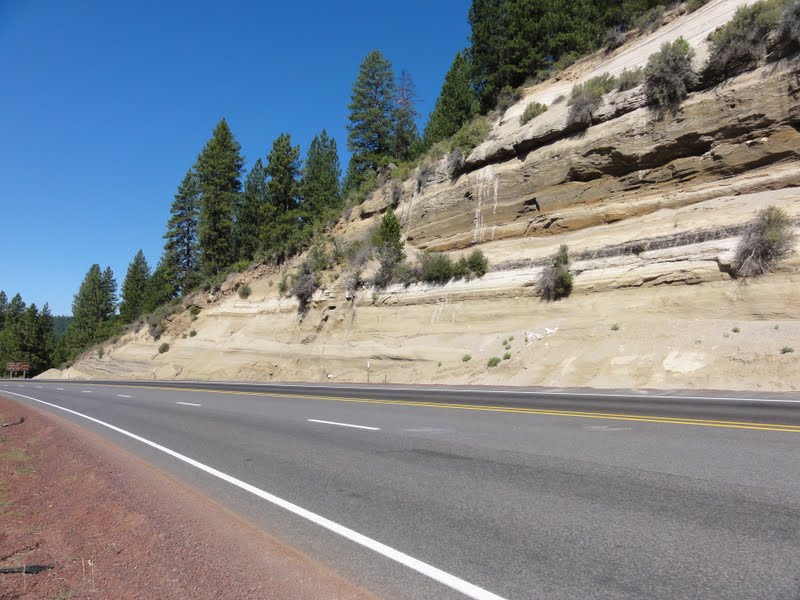
Road cut on Highway 97, Oregon
I've seen people take variously-colored sands and make art of them, but the earth does it effortlessly. Streams and lakes layer sediments in a cacophony of colors, then dry up and vanish, leaving puzzles behind. We stop the car. We walk alongside, we explore, we tease out those stories. These are the things that send my heart racing, leave my skin tingling, make me feel like I can fly. Beneath most surfaces, there's fascination. And the more I know this great and glorious Gaia, the more I love her.

For AW #37, with love.

18 July, 2011

Accretionary Wedge #36 Now Available!

Get your geology on!  This one's all about regrets, so you might want to practice your delivery of the word "D'oh!" before you head over.

23 June, 2011

The Seduction of Subduction

This:

Cascades from Skykomish River, near Gold Bar
This is why I love the word subduction.  Every time I'm reading about the geology of a region, when I come across that word, I get a tingle down ye olde spine.  Because I know we're in for it.  I know the landscape's going to be exciting.  I know we're in for volcanoes and earthquakes and some really wild metamorphism, accretionary wedges and the whole shebang.  It's all there.  Tell me we've got a subduction zone on our hands, and you'll see me bounce like a Jack Russell terrier who's just eaten its owner's entire stock of No Doz and chased it down with a case of Full Throttle.

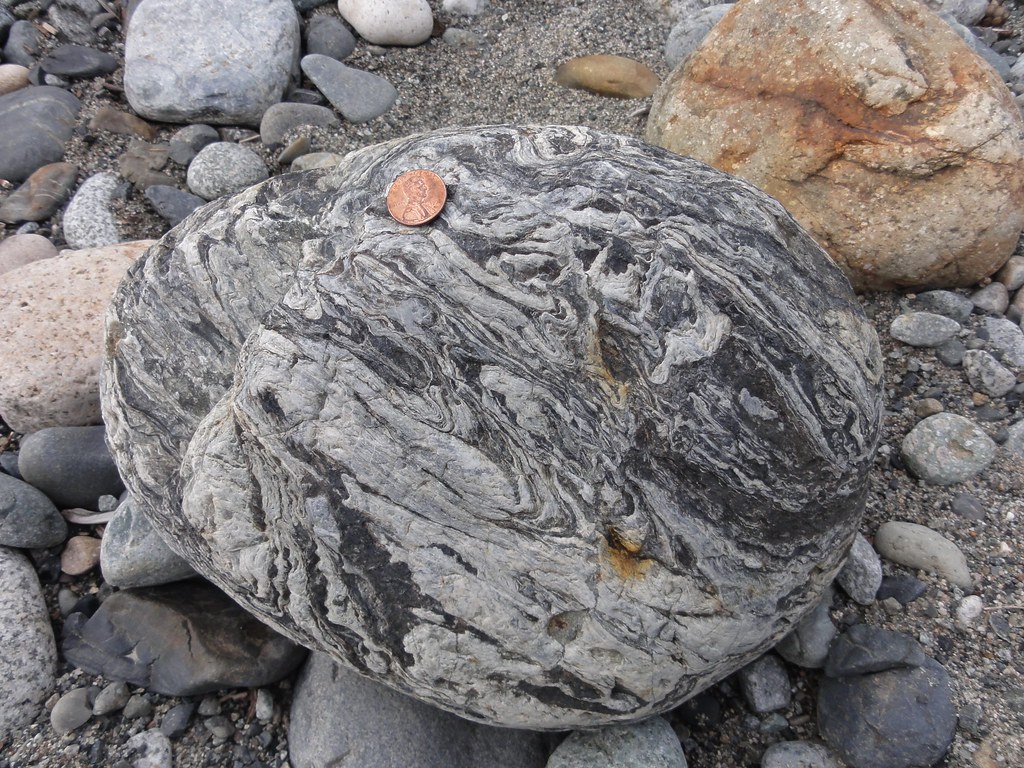
In a subduction zone, you get some really wild rocks, rocks that've been through it, rocks that have been chewed up and spit out, rocks that, were they a letter, would get the post office in deep trouble for the amount of folding, spindling and mutilating they've endured. 

Metamorphic Rock, Skykomish River
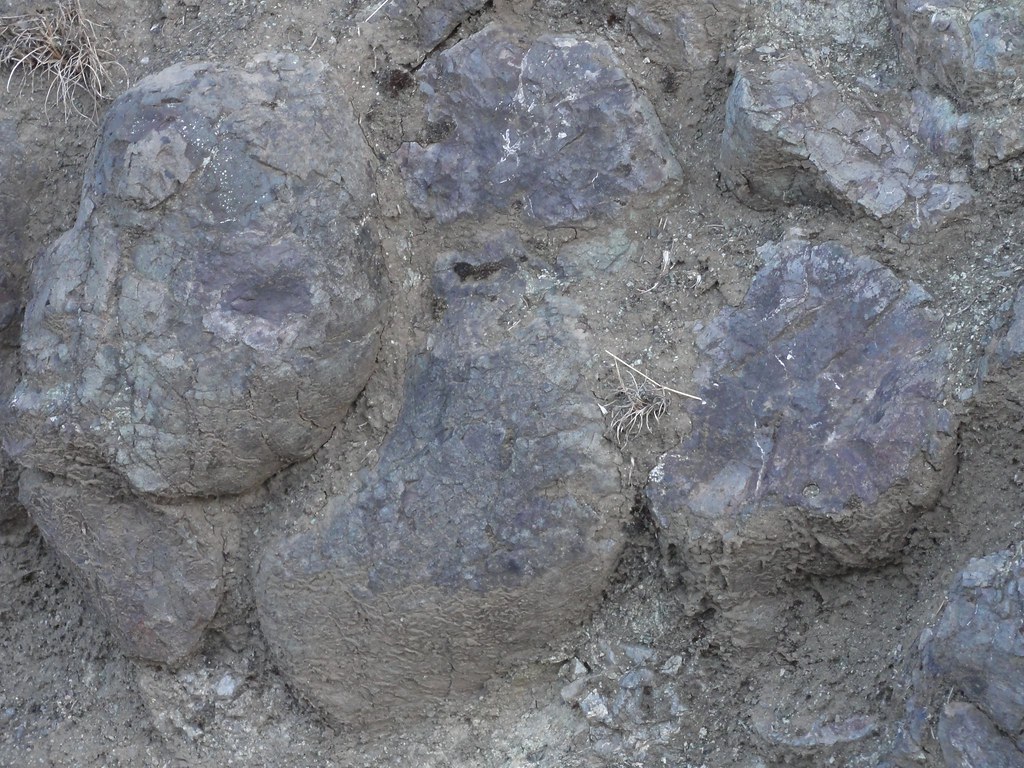
A subduction zone takes your basic rocks and makes them sublime.  It pushes them down and raises them up.  It takes bits of the seafloor and chucks them up on land.

Pillow Basalts, Olympic Mountains
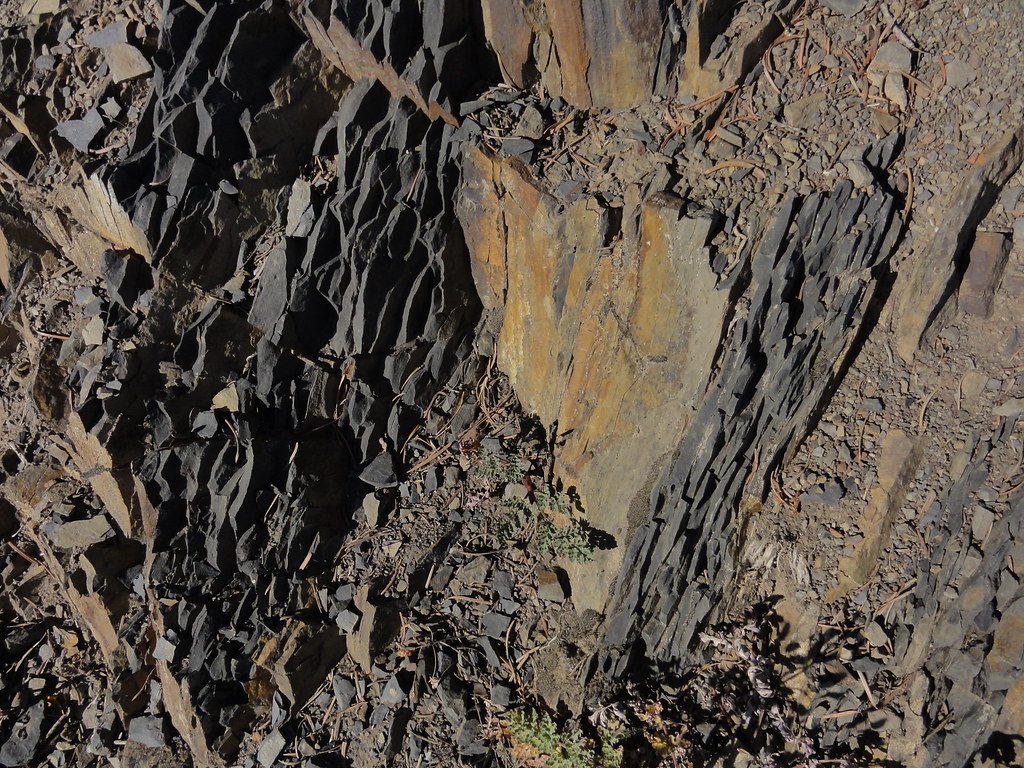
It takes your basic quiet marine shales, which had been resting peacefully in nice horizontal layers on the sea bed, and squeezes and cooks them into phyllite.  And then it hoists them high, standing them on end, and makes mountains of them.

Phyllite, Olympic Mountains
Right now, right beneath me, the Juan de Fuca plate is subducting beneath the North American continent.  That subduction is the reason I've got land to sit on: over millions of years, subduction zone after subduction zone has formed around here, as oceanic plates meet continental, and as the seafloor goes down, bits of island arcs and seafloor sediments and appreciable chunks of the seafloor itself have gotten plastered on, creating the majority of Washington state, and the mountains that lured me here.  It's a dangerous place to live.  This beauty does come with risk: chains of violent volcanoes, the certainty of an eventual megathrust earthquake.  But it's worth the risk. 

I've been seduced by subduction.  Looking at the result, who wouldn't be?

Olympic Mountains

06 June, 2011

Accretionary Wedge #34: Encore

So I post the Accretionary Wedge #34, pack up the tents and roll the carnival out of town, and what happens?  People who should've been part of the show turn up.  Seems we'll have to roll back in, then, because these acts shouldn't be missed!

Image Credit
Due to Twitter not notifying me of a critical message, Anne Jefferson's brilliant "Bacteria in the sky, making it rain, snow, and hail" got left at the side of the road. And that's bad, because it's headspinningly weird! Biology contributes to hydrology which is part of geology contributes to biology and around and around we go!  The remarkable interconnectedness of all these things - life, water and rocks - can make dizzy.  Kinda feeling like I've been standing in the center of a really fast merry-go-round now...

Speaking of standing in the center of things that make you feel funny, Helena's Weird AND Scenic scenery at Craters of the Moon will leave your head spinning happily.  What's weirder than a landscape that looks like "black vomit" and is so heavy that it's sunk a 100km region right down?  Rafting volcanoes, dragon skin, a maclargehuge rift - that's weird and no mistake!

While we're on the subject of craters....  My Intrepid Companion likes to pretend he's got nothing to say about geology, but he does.  And he seems to think a maclargehuge hole in the ground caused by a meteor isn't weird, but when you think about how rare it is to find one this perfectly preserved on Earth, what with all our various agents of erosion, it totally is.  So, go feast your eyes on what happens when outer space geology smacks in to Earth geology.

Garry Hayes at Geotripper rather made my jaw drop with this one: Weird Geology: Accretionary Wedge #34...Our Human Nightmares.  Because I hadn't put geology and pareidolia together before, but he did, and it's fascinating.  Beautiful.  And just a little deliciously scary.

So you see, my darlings, why this carnival had to roll back in to town.  The world is far more weird (and wonderful) than we'd revealed in our original installment.  And over this next year, keep your eyes open for odd, outrageous, and ooo-inducing geology, because we've not yet exhausted this topic, and you could run away and join the weird geology carnival next summer.

29 May, 2011

Accretionary Wedge #34: Weird Geology

It seems to me that there would be no such science as geology if dear old planet Earth wasn't really damned weird.

Image Credit: Chris Rowan
People had been running into seashells on mountaintops for years.  Seashells.  On mountaintops.  "That's weird," they said, and eventually, some clever types not content with "Funny old world, innit?" and "God must've done it" arguments said, "That's really weird.  How'd they get up there?  How, in fact, did mountains get there?"  And then you had Hutton sailing people around to Siccar Point and pointing out the rather dramatic angular unconformity there.  Now, that was weird.  So weird he took twenty-five years and a very verbose book to explain it.

Now, of course, we don't think it's all that weird.  But that's only because it's familiar.  It's like your Great Aunt Vanessa, whose personal quirks like dressing every square inch of exposed furniture surface in doilies and pontificating on the personalities of her plants strikes first-time visitors as mightily strange, but after you've got used to her and had the origins of those oddities explained away, just seems charmingly eccentric.

I mean, the very idea that these big ol' solid continents go rafting round the world was so laughably ridiculous on its face that nearly everybody laughed at poor old Alfie Wegener when he floated the idea.  Sure, everybody'd looked at a map of the world at some point and went, "Hmm, Africa and South America are a perfect fit.  Well, that's weird," but not as weird as Wegener's idea - until the evidence piled up, and everything fell into place, and the mountains made sense, and now everybody who knows anything about geology doesn't think plate tectonics is all that weird at all.  But it is.  Really, really weird.  Just because something makes perfect sense and can be proven scientifically doesn't mean it's not strange.

It's hard to remember how weird all this stuff really is.  Which is why I invited all you all to hop in the wayback machine or scurry out to the field in search of bizarre, befuddling, or simply baffling bits of geology.  What follows is a carnival sideshow of Weird Geology.  Step right this way, ladies and gentlemen, and feast your eyes on mind-boggling minerals, eccentric erratics, and a veritable smorgasbord of delightfully strange stones!

Image Credit: NIH

Roll up and see the famous Siamese Twins, Evelyn of Georneys and Michael of Through the Sandglass, conjoined at the posts Geology Word of the Week: Y is for Yardang and Yardangs: an Accretionary Wedge Weirdness Cross-post!  Feel the stare of the yardang!  Marvel at its perfect form and conformation!

Step right this way, ladies and gentlemen!  Hear Metageologist at Earth Science Erratics announce, "Chalk is weird."  Surely not chalk, you say!  But surely yes!  This dull, dry, bland-tasting (admit it, you had a nibble, perfectly normal for a geologist even though you weren't technically a geologist at that age) and indeed chalky rock is indubitably weird, and, dare we say, even strange.  See chalk as you've never seen it before!

And speaking of seeing, don't believe your eyes!  Geology is a master of illusion.  Venture into Magma Cum Laude's tempting tent, and Jessica shall show you illusions that will leave your brain befuddled and your senses insensible!  It's all here in Weird Geology: Accretionary Wedge #34, wherein it is proved that seeing should not always be believing.

Image Credit: kh1234567890
Weird Geology?  Holy Haleakala, what's weirder than molten rock? Let Matt at Research at a Snail's Pace show you there's nothing ordinary about rocks melting deep in the earth!

And then, ladies and gentlemen, come this way and walk on land - moving land, that is!  That's right, Rachael at 4.5 Billion Years of Wonder has a Slow Motion Landslide that must be trod upon to be believed!  It will give a whole new meaning to "the earth moved."  Guaranteed!

But that's not all!  No, simple moving earth is not all landslides have to offer!  Let David at History of Geology show you The landslide of Köfels: Geology between Pseudoscience and Pseudotachylite, where you will find pumice created by the friction of a landslide!  That's truly weird!  Weirder, even, than The toad in the hole...

Watch your step, folks, watch your step!  That may be Quicksand you're headed for!  At Ron Schott's Geology Home Companion Blog, it is proved "that not all terra is firma," a lesson you won't soon forget!

Image Credit: The Church of Man-Love

Hoodoo?  Voodoo?  Erosiondoo!  Phillip at Geology Blues knows that Goblin Valley is Weird!  Take an eerie journey through the hoodoos, at night, on Halloween - the only way to see your truly weird geology!

Oh, but ladies and gentlemen, Malcom at Pawn of the Pumice Castle has landforms that are not only weird, but unsolvedAccretionary Wedge #34: That is Weird will introduce you to the great and terrible mystery of Mima Mounds.  Prepare to be amazed!

And, speaking of mounds, go Geocaching and discover Quellschwemmkegel - mounds created by springs.  No mystery how these formed, but plenty weird, as Ole well knows!

Image Credit: Visboo
Ladies and gentlemen, you've seen breccia, but never like this!  You will marvel, you will ponder, Silver Fox of Looking for Detachment will prompt Some Thoughts on Weirdness, and A Picture (or Two) (or Three) - and what magnificent pictures they are!  How big can breccia be?  Come this way and find out!

Rocks can be magical, and what could be more magical than a crystal-filled rock appearing where no rock has ever been before?  Special to AW-34 Weird Geology, a blast from the past, Ann at Ann's Musing on Geology and Other Things has the story of a stone rafted on ice, buried, and brought to the surface by frost. Marvelous!

Continue your tour of  Accretionary Wedge 34: Weird geology at Hypo-theses, where Doctor Ian will show you rocks that will make you gasp, yes, gasp in shock and delight!

And you know that Accretionary Wedge #34 - Weird Geology would not be complete without a very weird wave-cut bench, which On-The-Rocks at Geosciblog provides for your entertainment and edification.

Now see, right here at ETEV, captured in stone, frozen forever, phenomena that will make you wonder about Permanent Impermanence: or, How the Fuck Did That Fossilize? 

And speaking of fossils, ladies and gentlemen, prepare to be amazed, astonished, and astounded at fossil rocks.  Step Outside the Interzone, where Lockwood hosts Weird Geology: Name That Rock Type!  What's in a name?  Much more than you realize!

Ladies and gentlemen, the carnival is over, but the Weird Geology is still out there, awaiting discovery.  Take up your rock hammers, your beer, and your hand lens, don your boots, and go, intrepid explorers, to reveal the weird and the wonderful, the bizarre and the beautiful, the anomalous and the alluring bones of this good planet Earth.


Image Credit: IGN

25 May, 2011

Permanent Impermanence: or, How the Fuck Did That Fossilize?

It's Weird Geology month here for the Accretionary Wedge.  Geology might not be quite as weird as quantum physics, but it's got its moments.

There's a great many weird things to choose from, but I'll tell you what warps my mind: seeing things we normally think of as temporary preserved forever in stone.

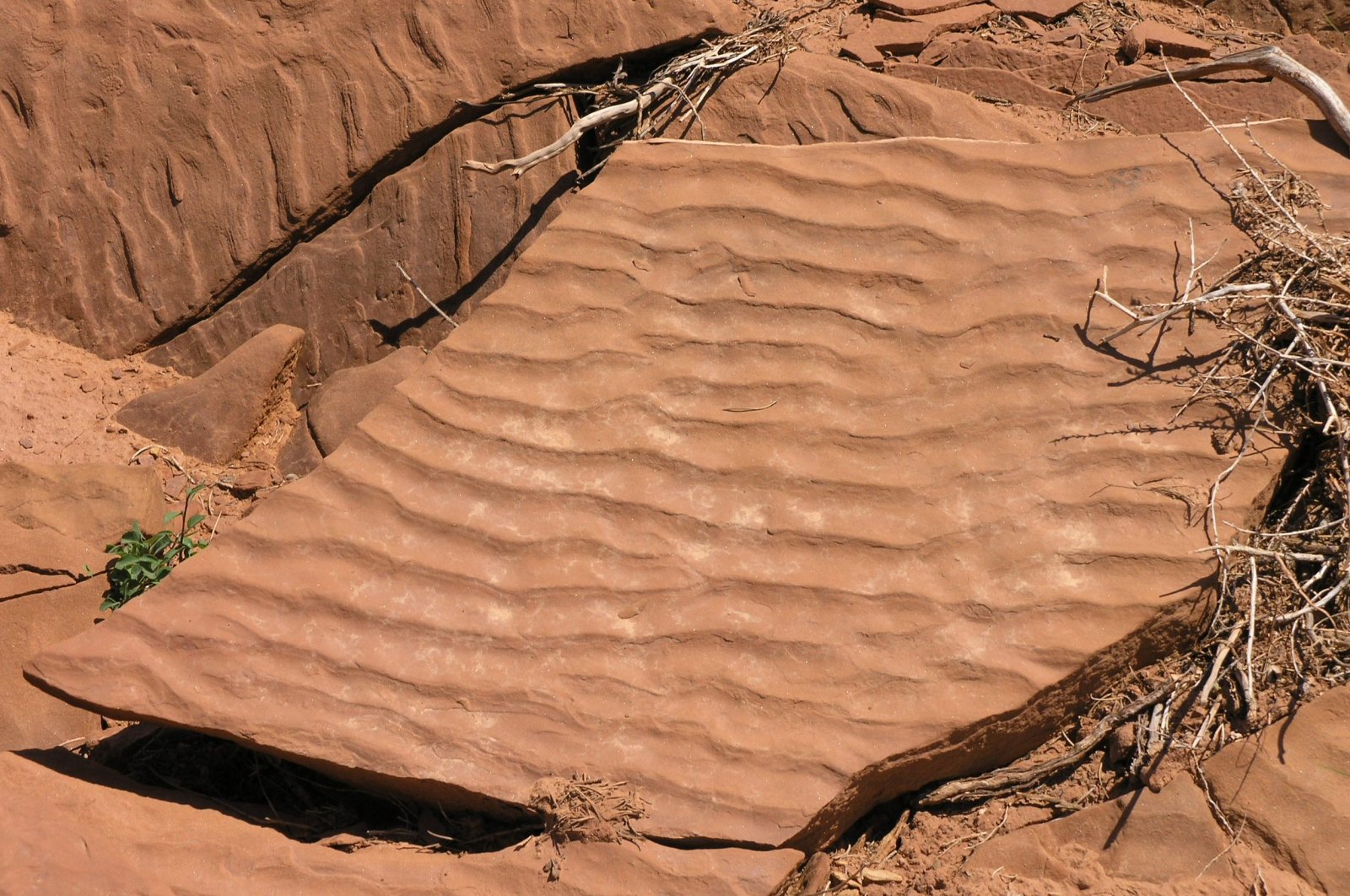
Ripples in the Moenkopi Formation
Two hundred and forty million years ago, waves left ripples in soft sands and silts.  Currents worked and reworked these sediments, and you'd think that something so ephemeral would be wiped away long before the ancient mud flats and river beds turned to stone.  But this time, other sediments swept in and buried the ripples whole.  They lay there under their blanket for hundreds of millions of years, as ages passed, an orogeny lifted the plateau, time turned ancient muds to rock, and erosion wore the blanket away.  Now here we are, in the middle of a desert, looking at the echo of wetter days.

I'm sorry, but that's just bloody weird.


25 April, 2011

Accretionary Wedge #33: Now Available!

Okay, well, it has been for days now, and I'm only just getting to announcing it.  But just in case you hadn't heard, Accretionary Wedge #33: Geology and the Built Environment: Past, Present, Future is up at Geological Musings in the Taconic Mountains.  Excellent stuff.  Get over there and get your geo build on!

13 April, 2011

Accretionary Wedge #33: Call for Posts!

You've got until the 17th, people.  Get your geologic feng shui on!  And if you haven't got any, host John van Hoesen has kindly agreed you can daydream away.  So build yourself that geologic dream house.

How much fun is that, am I right?

Living With Geology

John Van Hoesen of Geologic Musings in the Taconic Mountains asks a good question for this month's Accretionary Wedge: “How much or what kind of ‘geology, have you incorporated into you home / living space?”

If I had my druthers, this house o' mine would be slathered in stone.  Floors, counters, patio, all stone, of all sorts of varieties.  Sometimes, I stand in the aisles of Home Depot and just dream.  Travertine?  Slate?  Granite?  Gabbro?  Something more exotic?  I love it all.

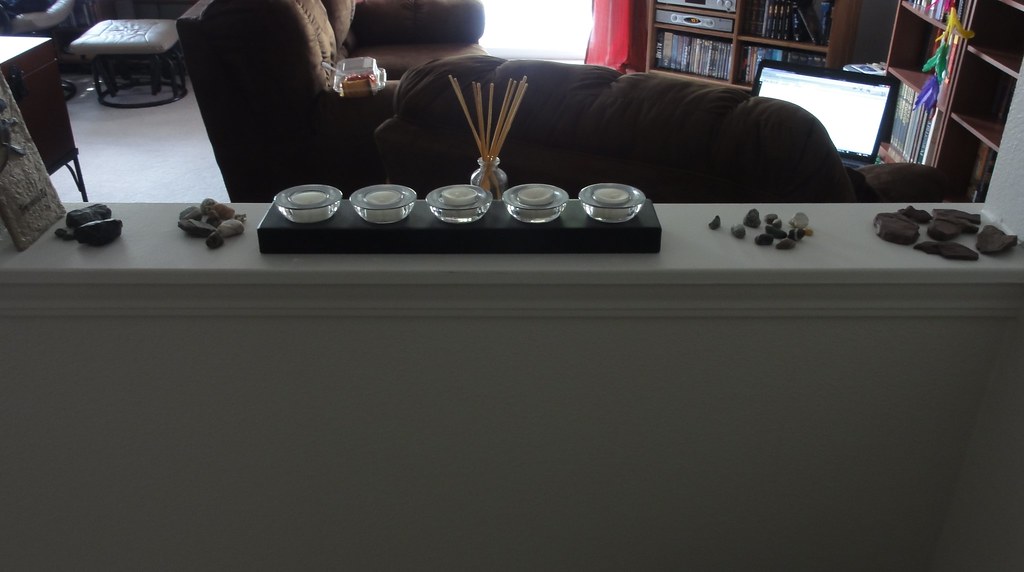
However.  This is an apartment, and the complex might not take too kindly to me ripping various and sundry bits up and replacing them with a riot of rock.  So I've had to make do with hand samples.  They're everywhere!

Mah not-so-grand entrance


If it's flat, it'll fit a rock.  That's my philosophy.


03 March, 2011

Desert Karst Oasis

"Throw me your favorite geologic picture," she says.  Like it's that easy!  I can't play favorites - every time I choose one, another one gets tears in its pixels and starts wailing, "Wait, what about me?"  And some of them chose to bow out of the Mardi Gras parade, claiming they weren't colorful enough for such an event.  Whatever.

So we'll do this.  We'll cut to the chase and play a favorite - a favorite place, one of my favorite places in the world.  We'll take a trek through the desert and come upon an oasis.

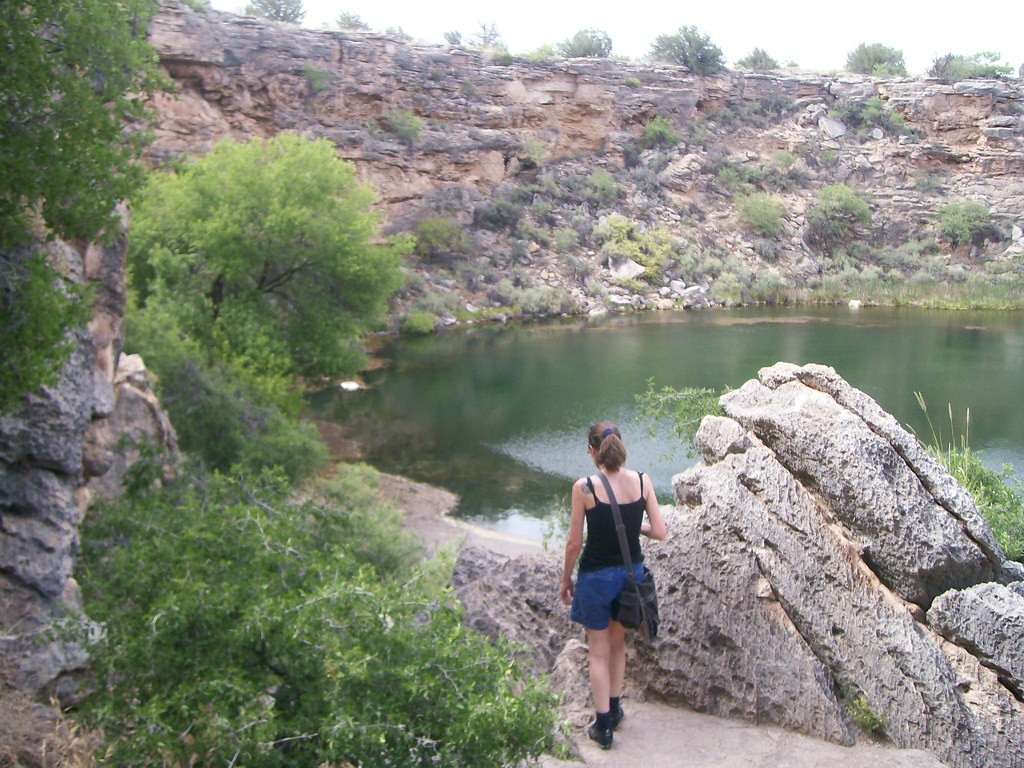
Montezuma Well, ambush shot by Cujo
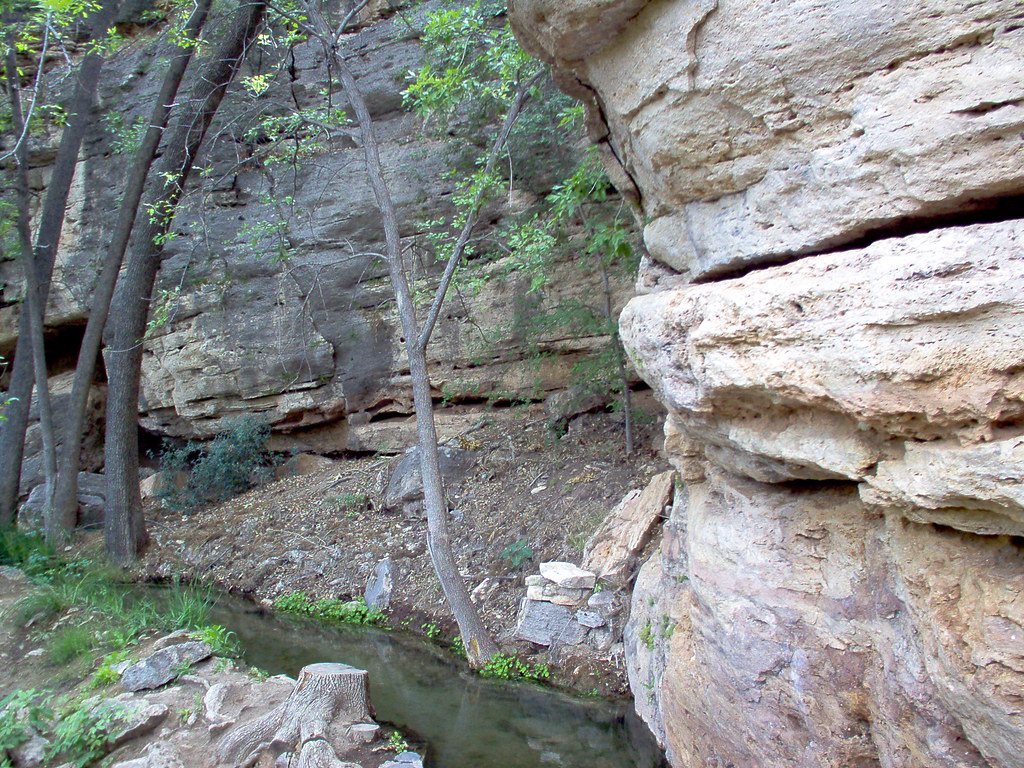
Down around Camp Verde in Arizona, you'll come across a picture-perfect karst terrain.  The old beds of lake-deposited limestone lay flat, dry and hot under the sun, carved into gullies and hills by wetter times.  In some places, sinkholes pit the scenery.  They're lovely examples of the power of water and gravity together to sculpt the scenery.

Camp Verde got its name because a river runs through it, causing a line of green to conga through the hot, scrubby hills.  It was enough of a shock that explorers named it the Verde River, because it was very nearly the only green thing they'd seen for absolute miles.

Water's rare and precious here.  You don't expect deep, placid pools of it just lying about.  But drive through the dirt and dust, past lizards and rattlesnakes and blocks of ancient lake floor, and eventually, you'll find yourself gazing down into a blue-green pond.  Long ago, water dissolved a large pocket in the limestone, and gravity collapsed the roof, leaving a hole deep enough to reach a perched groundwater table lying atop old mudstones.  Even in these drier times, springs still feed it to the tune of over a million gallons per day.

It's here that the Spanish name for the ancient Pueblo peoples who lived in this area, Sinagua, becomes something of a misnomer.  They most certainly weren't "without water" in this place. They had an abundance.  And they took full advantage, tucking houses and a granary into the cliffs along the sinkhole's rim, more houses down by the swallet where the waters flow out into Beaver Creek, and building a canal along the base of the cliffs outside the sinkhole.

The old Sinagua canal
Walk down the cliffside here, and you'll find yourself in an unexpected paradise.  Water cascades down a desert waterfall, flows along the old canal, and feeds tall sycamores and other trees and plants.  It's shady, cool, and possibly the most peaceful place in Arizona.  And just look at all of that gorgeously-exposed geology!

I'll have far more to say about it, plus a plethora of pictures, when we get to our Arizona geology series.  How's that for a teaser, eh?

Now that you've had a nice rest at the water's edge, on with the parade!

28 October, 2010

Oh, Schist! And Other Stories

Yes, it's taken me this long to settle on an appropriate deskcrop for this month's Accretionary Wedge.  In point of fact, I haven't got any deskcrops.  I haven't got a desk.  If I did have a desk, I wouldn't be able to use it, as it would be covered in rocks, books, and the occasional knickknack. 

I have, however, got bookshelves, the bits of which that aren't filled with books and knickknacks are covered in rocks.  I have also got tables, which are mostly covered in rocks.  Breakfast bar?  I hope you like stone-cold stones for meals, because that's what's on the bar.  Little half-wall in the entry way?  Home to more rocks.  And every single rock in this house has some sort of meaning.  Each and every one tells stories.  And they were all hollering "Me! ME! MEEE!" when I attempted to choose just one.  Worse than puppies, they are.

Ultimately, it came down to rocks from home.  And I couldn't choose only one. 

Some of you may not know this about me, but I have an abiding fondness for schist.  I'm not sure why.  There's just something about its foliation that I adore.  It may have a lot to do with the fact that it's a) not volcanic, b) is metamorphic, and c) something I can identify with greater than 89% confidence despite all that.

It wasn't always like that.  In fact, the first piece of schist I collected, I figured was just an unusual bit of volcanic rock.  It's the dark one here in this photo:


It's been with me since the early 2000s, when I grabbed it from the formerly-vacant lot behind my old apartment.  Needed nice, dark, interesting rocks for a mini-Zen garden I was building, didn't I?  And there it stayed for years, nestled in white sand, and after I moved to Washington it lived in a Ziplock bag, awaiting a day when I had more space for Zen rock gardens.  Then I visited Arizona, picked up that lovely golden piece of mica schist that's sitting beside it, removed it from its bag to add to the Arizona collection, and went, "Wait a damned minute... Oh, schist!" 

I believe it may even be a bit of Brahma schist.  Not sure.  I mean, it was sitting about 3,000 feet above where it should've been, so I know it's a souvenir rock someone picked up and later discarded.  An anthro-erratic, if you will.  Could've come from anywhere.  But I love it anyway.

The mica schist beside it comes from the Mingus Mountains (no, people from Arizona don't usually refer to them as the Black Hills, at least, not where I came from).  And that other bit there is a very nice little grossular garnet I picked up at the same rock shop.

But I promised you more than schist, and here's a nice little bit you may enjoy from the same display:


That, my darlings, is a fragment of the nickel-iron meteorite that slammed into Northern Arizona about 50,000 years ago and left us with the enormous hole in the ground known as Barringer Meteor Crater.  They sell bits of it in the gift shop.  I was rather skeptical, so I grabbed a magnet with a bottle opener and a resin-encased scorpion and did a little field test.  Tink!  Yep, it's magnetic, all right.  So I bought the bits, and a tube of rock flour.  That white powder is pulverized Kaibab limestone.  The meteor hit so hard that it turned major bits of strata right over and turned some into dust so fine that the frontier ladies used it as talcum powder.

So many rocks in that case.  So many stories.  But I shall conclude with this one:


That, my darlings, is a lovely bit of bornite, which I first knew as peacock rock.  Fascinated me as a kid.  I couldn't care less if it was a copper ore back then - all I knew was, it's pretty.  And I'd lost my piece.  So one of my major objectives when I went home for a visit was finding a nice specimen.  Where else to go but Gold King Mine, where I'd got my first?  If you ever get a chance, go to Jerome and visit Gold King Mine.  It's a hoot, and they have lovely rocks and fossils in their shop.

Aside from the fond childhood memories, aside from teaching me more about the copper industry to fueled so much northern Arizona commerce, and aside from the fact it's pretty, this deskcrop also broke the barriers between me and my newest brother.  You see, my parents had acquired a lavender-point Siamese, whom I hadn't seen since he was a tiny kitten.  He didn't remember me.  He wanted nothing to do with me.  I was a Very Scary Intrusion into his settled universe.  He ran from me whenever I came in - until the day I returned from Gold King Mine with a nice set of rocks and fossils.  I'd laid them out on the carpet while I sorted, labeled, and stowed for the journey home.

He inspected the fossils, creeping ever closer, and found the bornite as tasty as I do:


We have been friends ever since.  So, my darlings, remember this: geology not only provides us with knowledge, awe, wonder, and amusement, it can also facilitate better relationships with the important felids in your life.  Trust me, bonding happens.  Especially when you're doing something fascinating, like trying to build a home for all those lovely samples:


Cats love deskcrops.  Spread the word!

01 October, 2010

AW #27 Now Available!

For the three or four of you who haven't yet discovered this, the latest Accretionary Wedge is up at Lockwood's, and it is brilliant.

This ends weeks of torture, as I'd see tweets of various geology posts with some note like, "This is my AW submission!" and, sweating and nearly sobbing, I would therefore refrain from reading since I wanted to enjoy them as officially part of the Wedge.  Argh.  Well, I read each and every one tonight, and they were all wonderful, my darlings, simply wonderful.

Thank you, dearest Lockwood, for putting this together, and thank you, dear AW contributors, for your incredible submissions!  I fell in love with geology all over again almost two dozen times.

You rock.

19 September, 2010

Accretionary Wedges

The geologically inclined among ye have got a couple of very important deadlines coming up!  First is September's Accretionary Wedge, to be hosted at Outside the Interzone:
...the topic I settled on is "What is the most important geological experience you've had?" The key word there is "important," and the real task is going to be figuring out what that means for you. It may (or may not) be something that led you to the discipline (Note that August 2009's AW was "Inspiration," what inspired us to get into geology, and this isn't really intended to be a repeat of that, though for some, it might be.), or a class, or a work experience, or a field experience. It might have been a puzzle or problem solved, or job landed, a degree completed. Perhaps it was something else entirely. It could have been an awful, disastrous experience from which you learned an important lesson. Maybe it's still in your future- something you're looking forward to. Additionally, explain why it was important. Was it something you'd recommend to others?
Lockwood reports there's still room for more, so getcher entries in by September 27th.

Already done?  Great!  Get a jump on October's AW:
October's theme is going to be "Desk-crops." This can be any rock or other geological* specimen that you have lying around your office/desk/lab that has a story to tell. The spookier the better. Photos and/or illustrations are very important (although not absolutely required). This is taken directly from Ron Schott's "deskrcop series" of his rocks and such - great examples of what I had in mind with the theme (but not the only way to skin this horse).
If your submission's submitted past the October 29th deadline, one of two things might happen to it: Trick or Treat.  Take a wild guess as to which.

30 January, 2010

Time to Be Fillin' the Hold

(Postdated for those who've only just got out of the taverns. New content be below.)


Captain Cujo be worried, me hearties: the hold be nearly empty, and the crew be nowhere in sight.  We have an unhappy captain:
At the risk of being a martinet, I'm not satisfied. We sail this weekend regardless, because I doubt I'll be able to do much next weekend, and if we keep pushing cruises back we'll eventually be so far back in time that we meet ourselves, or something like that.
We can't be havin' wi' this.  So allow myself to repeat myself:

Captain Cujo be lookin' for ye!

Once again, I'll be donning the funny hat and and as many pistols as I can carry as I host a cruise of the carnival. I'd love to see submissions from folks who haven't participated before, particularly if they're regular readers. If you submit your entry before January 29, that would be even better. I'll have more time to work on that narrative thing I heard about in composition class. January 29 is the deadline, however.

If you're still not sure what sort of article works as a COTEB article, click on the COTEB keyword and check out some past carnivals.

So, as Admiral Hunter says, send us your treasures, and we'll see you in a few days.

BTW, if you don't have a website, but you have an article that you've written, send it to me and I'll put it up here as a guest post.
We be expectin' a big crew this time, especially in light o' the fact so many o' us missed the boat after the holidays.  So get yer submissions in by January 29th.

Or suffer the shame o' missin' the boat.

25 January, 2010

It Be That Time Again

(Postdated - new content be below)


Ahoy, ye Elitist Bastards!  Captain Cujo be lookin' for ye!

Once again, I'll be donning the funny hat and and as many pistols as I can carry as I host a cruise of the carnival. I'd love to see submissions from folks who haven't participated before, particularly if they're regular readers. If you submit your entry before January 29, that would be even better. I'll have more time to work on that narrative thing I heard about in composition class. January 29 is the deadline, however.

If you're still not sure what sort of article works as a COTEB article, click on the COTEB keyword and check out some past carnivals.

So, as Admiral Hunter says, send us your treasures, and we'll see you in a few days.

BTW, if you don't have a website, but you have an article that you've written, send it to me and I'll put it up here as a guest post.
We be expectin' a big crew this time, especially in light o' the fact so many o' us missed the boat after the holidays.  So get yer submissions in by January 29th.

25 December, 2009

To Yer Posts, Sailors!

(Postdated so ye olde crew makes it aboard. New content be below.)


It be that time again!  Time for ye to pick yer best elitist bastardry and get aboard!  We be sailin' Christmas weekend, if time an' tides be on our sides.  Get yer links in to me no later than end o' day December 26th.  We be sailin' out from Last Hussar's Barracks, and ye don't want to be late when ye're dealin' wi' a captain named Last Hussar, now, do ye?

If ye've never sailed before, here's how it be done:

1. Pick a blog post o' yours that hits the stupid where it hurts.

2. Send us the link at elitistbastardscarnival@gmail.com.

That be it.  Simple enough, innit?

And if ye see a bit o' elitist bastardry while ye be out and about on the intertoobz, be sure to send us the link.  A crew's just not complete without a few press-ganged folk.

See ye aboard!

05 December, 2009

Captain on Deck - Muster Up, Me Hearties!

(Postdated, etc. New content be below.)


Aye, our communication failures be fixed, and Captain Stephanie be ready to take the helm.  But she be in need o' a crew.  So rouse yerselves from yer turkey comas, muster yer best elitist bastardry, and get on deck by end o' day Friday.

If ye've never sailed before, here's how ye join the crew:

1. Pick a blog post o' yours that hits the stupid where it hurts.

2. Send us the link at elitistbastardscarnival@gmail.com.

That be it.  What could be more easy?  Ye can write about anything ye like - we take all manner o' intelligent and interesting discourse.

See ye aboard!