Showing posts with label sunday science. Show all posts

29 November, 2009

Sunday Sensational Science

Getting Acquainted with Agassiz
Parte the Second: The Ice Man Cometh


In Parte the First, I introduced you to Louis Agassiz, who dominated my hometown by way of the peak named after him.  We explored the odd fascinating fact, and I promised you much, much more.

In this edition, we shall discuss his illustrious career, and some of the details that made me fall in love with the man.  Grab your ice axe and follow me after the jump, where we'll go cover the earth in ice with Agassiz.


22 November, 2009

Sunday Sensational Science

Getting Acquainted with Agassiz
Parte the First: Introductions


Jean Louis Rodolphe Agassiz, Swiss geologist, paleontologist, and dear friend of famous American poets, has been a part of my life since childhood.  I'll tell you why in just a moment.  First, a few facts about the man, and then a guessing game.

Agassiz is world-famous for his work on glaciers.  He strode the ice of the Swiss Alps, the snowy Jura Mountains.  He visited mountains in the American West.  His world was white.

Now for the guess, and no clicking on the photo to cheat: which snowy mountain ridge is this?


Think you've got it?  Given up?  Follow me after the jump for the answer, and then we'll get to know Louis.


08 November, 2009

Sunday Sensational Science

Shocking Truth About Aftershocks


We've discussed earthquakes before, and everybody's probably pretty aware of the fact that when you have an earthquake, you're probably going to have an aftershock.  Or two.  Or two dozen.  Most of us think those aftershocks will last, at most, a few days. 


New studies suggest that some aftershocks will go on - are you ready for this? - for a few centuries:
Many researchers assume that small-scale seismic activity reveals where stress is building up in the Earth’s crust — stress that can cause larger quakes in the future, says Mian Liu, a geophysicist at the University of Missouri in Columbia. However, Liu and Seth Stein of Northwestern University in Evanston, Ill., report in the Nov. 5 Nature, many moderate-sized temblors that occur far from the edges of tectonic plates could be merely the aftershocks of larger quakes that occurred along the same faults decades or even centuries ago.

[snip]

Stein and Liu analyzed earthquake data gathered worldwide. For major quakes that occurred where the sides of a fault moved past each other at average rates of more than 10 millimeters per year — as the two sides of many tectonic boundaries do — aftershocks died off after a decade or so. But for faults where the sides scraped past each other at just a few millimeters per year, aftershocks lasted about 100 years, the researchers reported. The longest series of aftershocks, some which have lasted several centuries, were triggered by quakes that occurred in continental interiors along slow-moving faults.
Bet you folks in the Midwest didn't think New Madrid was sending you old news, did you?  But it certainly seems so.


Let's step back a moment and take a look at the mechanics here:
Large earthquakes are often followed by aftershocks, the result of changes in the surrounding crust brought about by the initial shock. Aftershocks are most common immediately after the main quake. As time passes and the fault recovers, they become increasingly rare. This pattern of decay in seismic activity is described by Omori's Law but Stein and Liu found that the pace of the decay is a matter of location.

At the boundaries between tectonic plates, any changes wreaked by a big quake are completely overwhelmed by the movements of the plates themselves. At around a centimetre per year, they are regular geological Ferraris. They  soon "reload" the fault, dampen the aftershocks, and return the status quo within 10 years. In the middle of continents, faults move at less than a millimetre every year. In this slow lane, things can take a century or more to return to normal after a big quake, and aftershocks stick around for that duration.

It's a tale of two faults!  Let's have a look at New Madrid, shall we?  Go ahead.  Search for photos of "New Madrid Fault."  I'll wait.

Lots of maps, not many photos, right?  That's because not a lot's going on there.  Here's the best I could do:


Ed Yong says,
Again, New Madrid proves the principle - a cluster of large earthquakes hit the area in the past thousand years, but the crust shows no sign of recent deformation according to two decades of GPS measurements. It seems that recent activity really is the legacy of centuries-old quakes, a threat that has since shut down.
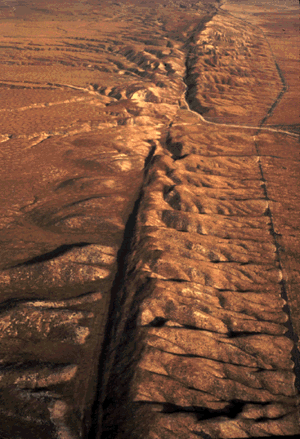
In other words, not a lot going on that would show at the surface.  It's a slow, sleepy fault, despite the excitement it caused over the winter of 1811-1812.  Compare that to the San Andreas, which is bleeding obvious:


Compared to New Madrid, the San Andreas fault is a speed demon, and it shows.  There are other differences, of course - one's a transform fault where two plates are scooting past each other, the other's more of a rift type thing where North America started developing a split personality and then changed its mind(s?) - but the main thing is speed.  Cecil Turtle compared to Speedy Gonzales, shall we say.  According to the study, San Andreas locks and loads within a decade or so, leaving the aftershocks in the dust and nervous Californians waiting for the Big One.  New Madrid's still squirming around trying to get comfortable after a fairly dramatic disruption.  And every time it twitches noticeably, folks in the Midwest experience a nervous attack of their own.

The river did, after all, run backwards the last time this thing went crack.  Bound to worry folks a bit.  But according to Stein and Liu, there's nothing much to worry about - at least, not where New Madrid's concerned.  You're just in for hundreds of years of aftershocks, since the fault moves more than 100 times slower than the San Andreas.  This is good news.

And the data are beautiful:


"A number of us had suspected this," Liu said, "because many of the earthquakes we see today in the Midwest have patterns that look like aftershocks. They happen on the faults we think caused the big earthquakes in 1811 and 1812, and they've been getting smaller with time."

To test this idea, Stein and Liu used results from lab experiments on how faults in rocks work to predict that aftershocks would extend much longer on slower moving faults. They then looked at data from faults around the world and found the expected pattern. For example, aftershocks continue today from the magnitude 7.2 Hebgen Lake earthquake that shook Montana, Idaho and Wyoming 50 years ago.

"This makes sense because the Hebgen Lake fault moves faster than the New Madrid faults but slower than the San Andreas," Stein noted. "The observations and theory came together the way we like but don't always get."


This might be of some comfort to residents near the epicenter of the Hebgen Lake Quake.  Then again, it might not.  It's rather hard to feel comforted by the fact that the fault moves slower than the San Andreas, and therefore shall have aftershocks longer, when the last big quake took down a mountainside, ripped open roads, created a new lake, and left fault scarps all over the damned place, right?

And this study points to the fact that the small isn't always a foreshadow of the big:

The new results will help investigators in both understanding earthquakes in continents and trying to assess earthquake hazards there. "Until now," Liu observed, "we've mostly tried to tell where large earthquakes will happen by looking at where small ones do." That's why many scientists were surprised by the disastrous May 2008 magnitude 7.9 earthquake in Sichuan, China -- a place where there hadn't been many earthquakes in the past few hundred years.

"Predicting big quakes based on small quakes is like the 'Whack-a-mole' game -- you wait for the mole to come up where it went down," Stein said. "But we now know the big earthquakes can pop up somewhere else. Instead of just focusing on where small earthquakes happen, we need to use methods like GPS satellites and computer modeling to look for places where the earth is storing up energy for a large future earthquake. We don't see that in the Midwest today, but we want to keep looking."

Sounds like a very good idea to me.  Anything we can do to increase the chances of successful earthquake prediction could help save a lot of lives.  And it allows us to rest easier when we find out that those little temblors are just past earthquakes saying "So long, and thanks for all the fish."


25 October, 2009

Sunday Sensational Science

Science at the Show


Alas, no deliciously-researched, fresh-out-o'-the-lab science today, my darlings.  I haven't had time to research a thing.  No more Ardis have been unleashed upon the world.  And I want to talk about Superman anyway.

As most of you know, I've spent the last summer reading every science book I could lay my hands upon.  And you've heard me bemoan my woeful ignorance.  I have a memory like a rusted-out sieve, I have the mathematical comprehension of a brain-damaged mouse, and when it comes to being able to visualize these very difficult concepts - well, show me a video, because I can't do it myself.  I often despair.  I'll never know enough or understand enough, and it sometimes seems I've retained nothing from all that reading.

Turns out, I've retained far more than I thought.  And so follows a tale of two viewings of Superman Returns.  The connection shall become clear in a moment.

I first saw Superman Returns when it was released in the theatre. Three years ago, I knew a bit about astronomy, geology, physics, and such, but not enough to really internalize anything.  When I scribbled about the movie in my journal, my focus was on the characters and story.  I hadn't paid a bit of attention to the science.  In fact, I don't believe there was a single instant during the movie where science really impinged upon my awareness.

Not so, now.  And that awareness began with the opening credits.  You see, now I know why planets are spherical.  So this half-a-planet with rings just didn't ring (ha) true.  Maybe a planet could've esploded, but leaving half all sharp and pointy whilst still having a beautiful ring system?  Really?  No.  It's visually pleasing, but as far as finding something like that out in the universe, I highly doubt it.  And here's the reason why:
One consequence of Newton's law of gravitation - which states that as the distance between two objects increases, the gravitational pull between them becomes weaker by the square of their separation - is that all planets are round.  A sphere has a volume that grows with the cube of the radius of the orb, while its surface area increases with the square of the radius.  This combination of the square of the radius for the surface area with the inverse square of the gravitational force leads to a sphere being the only stable form that a large gravitational mass can maintain.  In fact, to address the astrophysical question of what distinguishes a very large asteroid from a very small planet, one answer is its shape.  A small rock that you hold in your hand can have an irregular shape, as its self-gravitational pull is not large enough to deform it into a sphere.  However, if the rock were the size of Pluto, then gravity would indeed dominate, and it would be impossible to structure the planetoid so that it had anything other than a spherical profile.
That's from The Physics of Superheroes by James Kakalios.  Damned good book.  I highly recommend it.

So, half a planet with a ring system - not no, but hell no.

Moving on, then.  What about all that vaunted super-strength?  We Earth-bound misfits tend to think that it's a simple lack of strength that prevents us from doing things like, oh, say, catching jets and throwing unwanted continents off the planet.  At least, we think so if we don't know much about physics.  As I watched Superman grab the runaway jet at the beginning, I kept thinking of things like mass and inertia.  In order to stop the thing, Supes needs more than super-strength.  He'd need super-propulsion, and just where the hell is that coming from?

It's magic, obviously.  Has to be, because it just ain't happening in the real world.  I don't care how super he is, the propulsion has to come from somewhere, and it takes a hell of a lot of energy, and even if the biological being in question's from Krypton, not bleedin' likely, guv.

Not that I didn't enjoy watching said scene, especially when the filmmakers had the presence of mind to show the jet plane deforming under Superman's grip.  That was actually kind of neat.

Here's what I really want to talk about, though: lifting a continent on your shoulders.  And here's where I turn to James Kakalios once again, because he's already done the heavy lifting for me:
It is worth pointing out here that mass is not the same as weight.  "Weight" is another term for "force on an object due to gravity."  Mass, on the other hand, is a measure of how much stuff ("atoms" for you specialists) an object contains.  The mass of the atoms in an object is what gives it its "inertia," a fancy term to describe its resistance to change when a force is applied.  Even in outer space, an object's mass is the same as on the Earth's surface, because the number and type of atoms it contains does not change.  An object in outer space may be "weightless," in that it is subject to a negligible attractive force from nearby planets, but it still resists change in motion, due to its mass.  A space-walking astronaut in deep space cannot just pick up and toss a space station around (assuming she had a platform on which to stand), even though the station and everyone on it is "weightless."  The mass of the space station is so large that the force the astronaut's muscles can apply produces only a negligible acceleration.

[snip]

When the astronaut mentioned above pushes on the space station, the force her muscles exert provides a very small acceleration to the station, but the station pushes back on her, and her acceleration is much larger (since her mass is much smaller).
So.  Even setting aside the difficulty of getting a small continent (okay, largish island) out of Earth's gravity, ignoring the small detail of how much energy it would take to accelerate such a thing to escape velocity (11.2 km/s, remember!), and other such quibbles, it's still a little hard to swallow Supes tossing a continent off into outer space.

I'm sure some genius can come up with something, but since I'm not seeing flames shooting out of his arse and people behind him aren't getting blasted to bits by some propulsive force, I'm a little not inclined to swallow easy explanations.

We won't discuss Supes' super breath, because I think we all know that no matter how hard he can blow, his lungs have finite capacity.  It would take a lot more than a lungful of air, even fast air, to blow out a gas explosion.

But we will ask a question related to the earthquake that started the gas explosion in the first place: where the fuck is the tsunami?

Seriously.  You drop a crystal in the ocean.  A continent suddenly springs up.  Helllooo, displacement!  Eureka?  Does no one remember Archimedes?
The most widely known anecdote about Archimedes tells of how he invented a method for determining the volume of an object with an irregular shape. According to Vitruvius, a new crown in the shape of a laurel wreath had been made for King Hiero II, and Archimedes was asked to determine whether it was of solid gold, or whether silver had been added by a dishonest goldsmith.[13] Archimedes had to solve the problem without damaging the crown, so he could not melt it down into a regularly shaped body in order to calculate its density. While taking a bath, he noticed that the level of the water in the tub rose as he got in, and realized that this effect could be used to determine the volume of the crown. For practical purposes water is incompressible,[14] so the submerged crown would displace an amount of water equal to its own volume. By dividing the weight of the crown by the volume of water displaced, the density of the crown could be obtained. This density would be lower than that of gold if cheaper and less dense metals had been added. Archimedes then took to the streets naked, so excited by his discovery that he had forgotten to dress, crying "Eureka!" (Greek: "εὕρηκα!," meaning "I have found it!")[15]


Even if it weren't for the fact that a huge freaking landmass just displaced a fuck of a lot of water, we had an earthquake to contend with.  We should all know about the relationship between earthquakes and tsunamis by now.  Here it is in a one easy picture:


Water go sploosh.  Metropolis go under.  It looks like it's right at sea level, after all.

But one thing was nice: the kryptonite continent looks a bit like schorl, so that was a little bit of all right.  At least they made a continent grown of crystal, from crystal, look somewhat plausible.  Enough to delight this geology buff, anyway.

Yes, it doesn't take much to please me, as long as the story's decent enough.  And that's really the point, isn't it?  Superman doesn't have to be super science. 

But it's a damned lot of fun to pick on the lack of science, innit?  And at least all of my science quibbles assured me of one thing: I've learned a hell of a lot more than I'd thought.

18 October, 2009

Sunday Sensational Science

The Greatest Show on Earth, Mark II: Q & A with Richard Dawkins

Ten days ago, Richard Dawkins spoke to 4,500 Seattle residents about the evidence for evolution.  In Parte the First of my report on the great day, we read the bits of Dawkins's wonderful book The Greatest Show on Earth that he shared during his lecture.  I promised you then we'd have the Q & A next time, and the Q & A we shall now have.  Few verbatim quotes, alas - my shorthand skillz are not mad, they're sad.  But we shall do our best.


Verbatim stuff's in quotations, fairly-accurate paraphrasing is indented, and my outtakes are not.  I hope I haven't sowed a bunch of confusion by trying to avoid it, but we shall see.

All questions came from the audience, either written on index cards or texted in, relayed by President Michael Amini of UW's Secular Student Union, and heartily enjoyed by us all.  Except, perhaps, poor Richard, who's had to answer some of these ad nauseum.  People don't know what a famous man suffers on the lecture circuit.  Dawkins is thrilled to discuss evolution and the evidence for it, but as you shall see, not so thrilled with some of the trifles thrown at him.  Refer back to the above photo when we hit that question, because his expression is priceless.

Right, then.  Onward, ho.
Q.  Amini apologized for the Discovery Institute, which got a hearty laugh from everybody and, as I recall, a rather appreciative twinkle from Dawkins.  Then he asked whether Dawkins believed any amount of evidence would convince people like the DIsco Tooters.

A.  Dawkins said "the most spectacular example" is Kurt Wise.  "In some sense, he must know the Earth is old, yet he is a Young Earth Creationist."  Dawkins noted Wise [sic] is honest enough to state that if all evidence pointed unavoidably to evolution [ed.: which it does, but apparently mountains o' evidence aren't enough for him], he'd be the first to admit it, but Scripture would trump that evidence.  That observation led Dawkins to say that Wise [sic] seems to him to be a "disgrace to human intellect."

Couldn't agree more, meself.
Dawkins then said that there's no hope of converting such people.  We "must bother with the enormous numbers who don't realize what the alternative" is.
 And that's why he's written this book, to present the evidence for evolution to those who are reachable.  Let us hope they are reached.

Q. What are important unanswered questions?
A. "What sex is all about is still a bit of a riddle... Seems a rather odd thing" to mix 50% of our genome up every time we reproduce.

The origin of life is still a "complete mystery."

"Where does subjective consciousness come from?"  To him, this is the most important question.
I'm sure some creationists scream with joy over those gaps in our knowledge, but they should keep in mind just how quickly science tends to shrink such gaps.  I myself believe that the above questions will be answered in my lifetime, as long as I don't get run over by a bus next week.  And I'm excited about it.  So does Dawkins seem - he loves asking those questions.
Q.  Where do you get your moral code?

A.  Dawkins discussed the "subtle and shifting zeitgeist."  Basically, he says that morality is something we get from each other, and it "applies to all of us whether or not we're religious."
 I believe he pointed out that morals change over time - even religious morals have changed.  I seem to remember a lot more from this than I wrote down, but it's nothing he's not said before, in The God Delusion and elsewhere.

The claim that morals come from the Ten Commandments is "absolute piffle."

Dawkins then discussed the evolutionary basis for morality.  Extensive morality - the kind that extends to strangers half a world away - may be a misfire of morality developed in small groups.  The rule of thumb then was "be nice to everybody you meet," and that still works.

Dawkins said we may have a lust to do good the same way we have lust for sex.
Provocative thought, no?
Q. Someone asked the difference between "theory" and "law."

A.  Dawkins, as I recall, talked a bit about how a "law" can be seen as "fact."  He said, "I don't look forward to a time when we talk about a 'law' of evolution," because "we can already say it's a fact."
Indeed, 'tis.

Q.  Where did you get your Crocoduck tie?

A.  It was made for him by Josh Timonen*, who runs RichardDawkins.net.  He had plenty of flattering stuff to say about Josh's creativity.

The "reason for crocoducks, of course," is because they're a "more than usually stupid plea for intermediates between any animal."  Dawkins said you might as well ask where the kangaroaches or hippopotamanzees are.
It's a concept he expands on in his book, and it's hilarious.  One of the things Dawkins is best at is ridiculing stupidity with elegant British relentlessness.
Q. What is the current status of human evolution.

A.  Dawkins said we now have a lot of fossils Darwin didn't have, and we now know the order in which we developed our distinctive bidedality and large brains.  We can trace that through the fossils.

For big brains to continue getting bigger, the brainiest individuals must have the most children.
Here, he paused with a sardonic twinkle, and the entire audience busted up laughing.  All of us are all too aware it seem to be the stupidest people breeding the most these days.
Dawkins continued, "It's sometimes said [human] evolution's come to an end," and "there's something to be said for that."  There's "not much in the way of selective death," differential survival.  Other selective pressure could still be ongoing.  He talked a bit about selection in favor of those incompetent at using contraceptives.
That's a damned good point, actually.
Q.  What would your theme song be?

A.  "I don't do that kind of question, sorry."

Refer to the above photo.  There's nothing quite like Richard Dawkins trying to find a polite way to say, I can't believe you thought that, out of the over 500 questions submitted, was one worth asking.
Q.  Hypothetical: you have to give a three-minute pitch for evolution while in an elevator with someone skeptical of evolution.

A.  Dawkins would choose to emphasize either the geographical* distribution of species or comparative molecular similarities between species.  He continued along the molecular lines, pointing out that we can now count the differences between genomes and construct a perfect family tree.

That's powerful stuff, that is.  And if you read The Greatest Show on Earth, you can make that elevator pitch using either example.
Q.  What is the difference between micro- and macro- evolution?

A.  Microevolution is the day-to-day, month-to-month, year-to-year fluctuation in gene sequences.  Dawkins used the example of the changing length of mouse whiskers in a population.  Macroevolution is what you get when you simply "leave microevolution to go on for a very long time."

Yes, indeed, it's really that simple.  Which leads me to suspect most creationists are being deliberately dense about it.
Q.  Do you celebrate Christmas?

A.  "I am a cultural Christian.  I live in a country which I would prefer stay Christian" rather "than the alternative" [ed.  I do believe he's talking about the fact that fundamentalist Islam and sharia law's becoming rather prevalent in Britian, and yeah, I see his point].  "I do celebrate" Christmas, but "can't say as I enjoy it much... I don't regard it as a very big deal."

And can you believe we ended a lecture on evolution with that inane question?  I have a feeling a few non-skeptics slipped in through the door, because that's just a silly thing to ask.

Alas, between my poor memory and horrid note-taking, that's all I can report.  I do remember thinking several times, though, that the morons who think Dawkins is somehow wobbling on the whole accomodationist question are just fucking idiots.  There was nothing, not when he was discussing the science or morality or even Christmas, that even hinted at an accomodationist stance.  Here's the sense I got: he'll tolerate religious scientists and religion in the culture at large because it's simply unavoidable.  But his stance hasn't softened at all: science and religion, religion and reason, aren't compatible, even though they can exist somewhat simultaneously in the same mind.  Anyone with any lingering doubts on this score should visit the above link.  And then visit here for the coup de grace.

I didn't get a chance to speak with Dawkins afterward (or get the book signed, damn it), but I did manage to snap a picture on the way out.  I hope the light from my flash reflecting above his head shall prove a useful metaphor for those who should really have some lightbulbs going off.


Since seeing him in person, and now reading The Greatest Show on Earth, I've gained a far deeper appreciation of Richard Dawkins.  He's a brilliant man, a very British man, a delightful and charming and unrelenting man, and we're lucky to have him as one of evolution's champions, Darwin's rottweiler, as it were.  Thomas Huxley would be proud.

Muchos gracias, Richard.


Photos of Richard Dawkins taken by my dear friend and official Thinking Brain Dog, Cujo359.  All except that absolutely awful one of the poor man signing books against a wretched backdrop, which you can blame on me.

*Fixed

11 October, 2009

Sunday Sensational Science

The Greatest Show On Earth


Come one, come all!  Roll right up to see the great Richard Dawkins!  He'll awe you with his intellect!  He'll astound you with his humor!  He'll make a case for evolution only the DIscoers can deny!  He'll call Kirk Cameron the other half of a Monty Python sketch!

Indeed, he did.  It's always nice to start a book reading with a gentle yet devastating British dig at former child actor and current nitwit creationist Kirk Cameron for being a no-show to the great Dawkins-Cameron debate on the O'Reilly Factor.  And that's just how Dawkins started his talk at the HEC Pavillion in Seattle.  Glorious.  The huge audience of skeptics, science buffs, atheists, humanists, and assorted critics of DIsco laughed mightily.  We were off to a good start.

Americans love a British accent.  We secular folk love a good science conversation.  Having Richard Dawkins read to us from his book, The Greatest Show on Earth, qualified as something of a paradise-on-Earth, despite the hard plastic stadium benches.

I can't re-create that experience in its entirety for you, but I can at least share enough of the essence so you can follow along at home.  Put in your favorite Dawkins podcast, imagine that deceptively-mellow British accent rolling over you, and dive into the bits of the book Dawkins read from.

You do own a copy of The Greatest Show on Earth, don't you?  If not, go out and purchase one forthwith, because you'll need it to get the full passages, which I shall not copy here.

Got the book?  Right, then.  Crack it open.  Turn to page 6 of Chapter One, Only a Theory?

The Archbishop of Canterbury has no problem with evolution, nor does the Pope (give or take the odd wobble over the precise palaeontological juncture when the human soul was injected), nor do educated priests and professors of theology.  This is a book about the positive evidence that evolution is a fact.  It is not intended as an anti-religious book.  I've done that, it's another T-shirt, this is not the place to wear it again....

Evolution is a fact.  Beyond reasonable doubt, beyond serious doubt, beyond sane, informed, intelligent doubt, beyond doubt evolution is a fact... No reputable scientist disputes it, and no unbiased reader will close the book doubting it.

Dawkins placed subtle but strong emphasis on "unbiased," there.  Perhaps the fact DIsco was whining that he wouldn't debate (i.e., be babbled incoherently at by) them had something to do with it.  There are people who would deny the fact of evolution if God hisownself showed up to stump for it, and Dawkins knows that.

This is a book for the fence-sitters, and for the champions of evolution, not the poor lost minds at DIsco.

So let's get to the evidence.  Turn to page 145, Chapter 6, Missing Link?  What Do You Mean, 'Missing'?

Creationists are deeply enamoured of the fossil record, because they have been taught (by each other) to repeat, over and over, the mantra that it is full of 'gaps': 'Show me your "intermediates"!'  They fondly (very fondly) imagine that these 'gaps' are an embarrassment to evolutionists.  Actually, we are lucky to have any fossils at all, let alone the massive numbers that we now do have to document evolutionary history - large numbers of which, by any standards, constitute beautiful 'intermediates'.... The fossil evidence for evolution in many major animal groups is wonderfully strong.  Nevertheless there are, of course, gaps, and creationists love them obsessively.

[I'm snipping out one of the funniest analogies in the book.  You will either have to buy it, or wonder why every time someone says "butler," those who have read the book or were present at the reading break into delighted laughter and scream, "There's a gap in the video record! - Now there's two gaps!"]
Evolution could so easily be disproved if just a single fossil turned up in the wrong date order.  Evolution has passed this test with flying colors.  Sceptics of evolution who wish to prove their case should be diligently scrabbling around in the rocks, desperately trying to find anachronistic fossils.  Maybe they'll find one.  Want a bet?

Dawkins has a wonderfully wicked sparkle in his eyes, an undeniably impish half-grin, when he says things like that.  Needless to say, no one present took that bet.

And, really, you haven't lived until you've heard Dawkins quote J.B.S. Haldane, lowering his voice to grump old curmudgeonly tones as he repeats the famous phrase, "Fossil rabbits in the Precambrian!"

We haven't found anything like fossil rabbits in the Precambrian.  What we have found is a rich abundance of fossils that show us the course of evolution from single-celled bacterium to the vast diversity of life today.  And we have Lucy and her kin, whose bones tell sometimes sad stories.  Turn now to page 188, Chapter 7, Missing Persons?  Missing No Longer.

The conclusion from studies of Lucy and her kind is that they had brains about the same size as chimpanzees' but, unlike chimpanzees, they walked upright on their hind legs, as we do....  Their bipedality is dramatically confirmed by the poignantly evocative set of footprints discovered by Mary Leakey in fossilized volcanic ash....

The first Australopithecine to be discovered, and the type specimen of the genus, was the so-called Tuang Child.  At the age of three and a half the Taung Child was eaten by an eagle.  The evidence is that damage marks to the eye sockets of the fossil are identical to marks made by modern eagles on modern monkeys as they rip out their eyes.  Poor little Taung Child, shrieking on the wind as you were borne aloft by the aquiline fury, you would have found no comfort in your destined fame, two and a half million years on, as the type specimen of Australopithecus africanus.  Poor Taung mother, weeping in the Pliocene.
Dry eyes in the house?  Not so much.  And this is one of those moments that I will wield against anyone who accuses science of lacking emotional power, drama, and meaning.

We need a bit of comic relief now.  Turn to page 211, Chapter 8, You Did It Yourself In Nine Months, and you shall have it.

That irascible genius J.B.S. Haldane, who did much else besides being one of the three leading architects of neo-Darwinism, was once challenged by a lady after a public lecture.  It's a word-of-mouth anecdote, and John Maynard Smith is sadly not available to confirm the exact words, but this is approximately how the exchange went:
Evolution sceptic: Professor Haldane, even given the billions of years that you say were available for evolution, I simply cannot believe it is possible to go from a single cell to a complicated human body, with its trillions of cells organized into bones and muscles and nerves, a heart that pumps without ceasing for decades, miles and miles of blood vessels and kidney tubules, and a brain capable of thinking and talking and feeling.

JBS: But madam, you did it yourself.  And it only took you nine months.
Dry eye in the house?  I shouldn't think so, although mirth was responsible for the tears this time.

Dawkins has a talent for juxtaposing the funny, outrageous and astonishing all in one brilliant package, and he does it again on page 268, Chapter 9, The Ark of the Continents.

It is almost too ridiculous to mention it, but I'm afraid I have to because of the more than 40 per cent of the American population who, as I lamented in Chapter 1, accept the Bible literally: think what the geographical distribution of animals should look like if they'd all dispersed from Noah's Ark.  Shouldn't there be some sort of law of decreasing species diversity as we move away from an epicentre - perhaps Mount Ararat?...

Why would all those marsupials - ranging from tiny pouched mice through koalas and bilbys to giant kangaroos and Diprotodonts - why would all those marsupials, but no placentals at all, have migrated en masse to Australia?  Which route did they take?....

Did all thirty-seven and more species of lemur troop in a body down Noah's gangplank and hightail it (literally in the case of the ringtail) for Madagascar, leaving not a single straggler by the wayside, anywhere throughout the length and breadth of Africa?

Once again, I am sorry to take a sledgehammer to so small and fragile a nut, but I have to do so because more than 40 per cent of the American people believe literally in the story of Noah's Ark.... And, as recent polls have shown, Britain is not far behind (or should that read 'ahead'?), along with parts of Europe and most of the Islamic world.
Sad, sad sad.  And he added an additional dig from a poll recently released that showed that 28% of people believe that humans actually walked with dinosaurs.  This number didn't surprise me.  Something on the order of 28% of Americans also frequently believe another falsehood, which is that Republicans are better at governing than Democrats, Independents, Greens, or the Association of Village Idiots.  Not surprising, then, that they believe the Flintstones is a documentary.

Dawkins went on to describe why so many people, both the 28-percenters and others more intelligent, have been deceived by the appearance of design in living things.  It's all down to the evolutionary arms race.  "In an arms race," he said, "the environment that counts may be the predators."  The evolutionary tango between predator and prey is the "reason why animals are infused so compellingly with the illusion of design."  But an illusion is all it is.

Turn to page 384, Chapter 12, Arms Races and 'Evolutionary Theodicy'.


One thing about arms races that might worry enthusiasts for intelligent design is the heavy dose of futility that loads them down.  If we are going to postulate a designer of the cheetah, he has evidently put every ounce of his designing expertise into the task of perfecting a superlative killer.... But the very same designer has equally evidently strained every nerve to design a gazelle that is superbly equipped to escape from those very same cheetahs.  For heaven's sake, whose side is the designer on?... Does the designer's left hand not know what his right hand is doing?  Is he a sadist, who enjoys the spectator sport and is forever upping the ante on both sides to increase the thrill of the chase?

....Needless to say, no such problems arise on the evolutionary interpretation of what is going on.  Each side is struggling to outwit the other because, on both sides, those individuals who succeed will automatically pass on the genes that contributed to their success.  Ideas of 'futility' and 'waste' spring to our minds because we are human, and capable of looking at the welfare of the whole ecosystem.  Natural selection cares only for the survival and reproduction of individual genes.
A fact IDiots often forget.  Or actively, willfully deny.

We come now to the end, page 425, Chapter 13, There is Grandeur in This View of Life.

The fact of our own existence is almost too surprising to bear.  So is the fact that we are surrounded by a rich ecosystem of animals that more or less closely resemble us, by plants that resemble us a little less and on which we ultimately depend for our nourishment, and by bacteria that resemble our remoter ancestors and to which we shall all return in decay when our time is past...

It is no accident that we see green almost wherever we look.  It is no accident that we find ourselves perched on one tiny twig in the midst of a blossoming and flourishing tree of life; no accident that we are surrounded by millions of other species, eating, growing, rotting, swimming, walking, flying, burrowing, stalking, chasing, fleeing, outpacing, outwitting.  Without green plants to outnumber us at least ten to one there would be no energy to power us.  Without the ever-escalating arms races between predators and prey, parasites and hosts, without Darwin's 'war of nature,' without his 'famine and death' there would be no nervous systems capable of seeing anything at all, let alone of appreciating and understanding it.  We are surrounded by endless forms, most beautiful and most wonderful, and it is no accident, but the direct consequence of evolution by non-random natural selection - the only game in town, the greatest show on Earth.
That it is.

Next week, thee shall have the Q&A section, which shall include actual photos of the great event, and insights from Richard Dawkins available nowhere else.  At least, you'll have as many insights as I can reconstruct from my wretched attempts at note-taking...


As always, click the pics for photo sources.

04 October, 2009

Sunday Sensational Science

Cousin Ardi


You didn't think we'd got without Sunday Sensational Science when there's news like Ardi out there, did you?  Of course not!  A new addition to the family doesn't happen every day, after all.  And make no mistake: while we don't know if Ardi's in a direct line of descent or not, we can be sure she's part of our family tree:
Ardi, of course, is short for Ardipithecus ramidus, one of the earliest hominins found to date. Her skeleton (see image below), as well as bits and pieces of other skeletons of the same species, were described this week in a special edition of the journal Science. While a close relative of Australopithecus afarensis (made famous by "Lucy"), Ardipithecus ramidus is about half a million years older than the earliest Australopithecus afarensis and is a bit closer to the last common ancestor between living chimpanzees and humans.* As such the remains of Ardi and her kind give us a closer look at how some of the earliest humans evolved.
That's exciting stuff, my darlings. Lucy changed our thinking about our origins to a remarkable degree - after all, she proved bipedalism came before brains, among other things.  Ardi will show us how we got from tree-dwelling primates to A. afarensis, who could've given you a run for your money in a foot race on flat ground.

We've actually known about her for almost two decades now:

This introduction has been a long time coming. Some 4.4 million years ago, a hominid now known as Ardipithecus ramidus lived in what were then forests in Ethiopia. Fifteen years ago, Tim White of Berkeley and a team of Ethiopian and American scientists published the first account of Ardipithecus, which they had just discovered. But it was just a preliminary report, and White promised more details later, once he and his colleagues had carefully prepared and analyzed all the fossils they had unearthed. “Later,” it turned out, meant 15 years.

That's how careful science is done, my darlings.  Tim White and his colleagues weren't about to run their yaps without knowing what they're talking about.  As Brian Switek pointed out, there wasn't any Ida-like hype for this important find.  Just good, careful science.

Of course, their caution didn't prevent news organizations from mucking up the story with all sorts of silly headlines and confused interpretations of the science.  No, Ardi's not a missing link - we really need to stop thinking there's this Great Chain of Being with all sorts of links missing.  And as for this nonsense about "oldest human," well, she's not even human, folks:
These fossils are not "human." We limit "human" to the members of our Genus Homo, collectively called Hominidae often shortened to hominins.  The great apes, including humans are collectively called Hominids. "Ardi" is not a member of our genus, and is not a human. The notion of a "missing link" is falsely claimed by creationists to mean that there was a direct intermediate between modern humans and modern apes. This was never suggested by any evolutionary scientist, all the way back to Darwin. The discoverers of the newly reported fossils do think that even some of the common shared features of Chimps and Humans evolved independently. This is called convergent evolution, and is perhaps what Shreeve was refering to as "missing link" being falsified.
One of the most exciting things about her is what she can tell us about that common ancestor, and what traits did and did not come from that ancestor:
Much like Australopithecus afarensis, Ardipithecus ramidus had upper-body traits that exhibit adaptation to life in the trees while it had relatively broad hips more consistent with bipedal locomotion. The arms of Ardipithecus ramidus were very long (it could put its hands on its knees standing up; take a moment and try to do the same) and it had hands tipped in curved fingers well-adapted to grasping branches (see image to the upper left). It does not appear to have moved through the canopy by swinging from limb to limb, like a gibbon, but instead moved through the trees on all fours, grasping the branches below it rather than hanging from those above.
ArdipithecusThe hips of Ardipithecus ramidus, however, suggest that it probably spent a good deal of time walking upright. (See image to the left. Grey reconstruction is Ardipithecus ramidus. Yellow is Australopithecus afarensis.) In knuckle-walking apes like chimpanzees the blades of the pelvis are flat and come up over the back. In Ardipithecus ramidus the blades of the pelvis form are somewhat more bowl-shaped, a shape that helps hold the viscera of the abdomen in place in hominins that were constantly walking upright. The arrangement in Ardipithecus ramidus did not provide as much support as in our own genus, Homo, or even later australopithecines, but it offered more support than the same bones in chimpanzees. (It should be noted, though, that this interpretation is already controversial.)

[snip]

The hypothesis that Ardipithecus ramidus was arboreally-adapted but did not knuckle-walk, however, is consistent with recent studies that suggest that knuckle-walking was not the ancestral mode of locomotion in the last common ancestor of humans and chimpanzees. In fact, slight differences in the way that gorillas and chimpanzees knuckle-walk may even mean that this "typical" ape mode of locomotion evolved more than once. And while most of the focus has been on Ardipithecus ramidus, the constellation of traits we see in its skeleton may suggest that living chimpanzees are more evolutionarily specialized than we previously thought. What we need to find are early fossil chimpanzees; their side of the family tree is practically blank. Being able to compare early humans with early chimpanzees would tell us much about the evolution of both groups.
Here's a nice comparison of everybody, starting with a chimpanzee on the left, Ardi in the middle (2 views shown), and Lucy at right:


So here we see the skeleton of a chimp, a front and side view of Ardi, and Lucy aka Astralopithecus afarensis, roughly to scale (Ardi is just over one-meter or a little over three feet in height). And low and behold, Ardi has the double curved spine of a hominid, long ape-like arms, while pelvis, legs, and feet are almost perfectly in between. Based on all that, Ardi could walk upright almost as well as Lucy, using her arms to carry back goodies from the grassland to her forest enclave. And with those long arms, fingers, and toes, including the partially opposing big toe, she could probably climb almost as well as an adult chimp or juvenile gorilla. That's about as good a transitional fossil between a more ape-like, knuckle-walking ancestor and a bipedal hominid like Lucy as you could ask for.
Now, as Brian mentioned above, whether knuckle-walking even existed in our last common ancestor is in doubt.  But it's striking to see just how easily Ardi slots in.

And since creationists are so easily confused, might we just repeat for the record: humans didn't evolve from chimpanzees.  Thank you.

Ardi's discovery is going to take us a long way toward understanding where we came from and how we got here, just as Lucy did.  It's so important, in fact, that Science was kind enough to make those papers free and easy to access.  I can't wait for the books, the lectures, and perhaps even the grand tour.  There's something special about looking on the bones of your relatively-close cousins.

Welcome to the family, Ardi!


(Tip o' the shot glass to Darksyde for several of the links contained in this post.  All images were filched from the various and sundry articles linked, should you want to track down their origins.  Science gets free drinks for the month for their great good sense in making so much science accessible to non-subscribers.  Raise a glass to our new family member, and to the scientists, bloggers and publishers who brought her by.)

20 September, 2009

Sunday Sensational Science

Arizona Rockhounding

One thing Arizona doesn't lack is rocks. We've got nearly every type of rock on earth, plus a big one from space. And they're not buried under a bunch of inconvenient vegetation. They're right out in plain sight. For the geologist, Arizona is utter paradise.

I did some rockhounding in my home state, and subjected you to the results in Arts & Cats I, II & III. You even got to see my horrible attempt at photographing the completed collection:

Now comes the science part, which is a hell of a lot more interesting than just looking at someone's random collection of rocks. We'll be discussing a select sampling, delving into deep time and discovering how little (well, mostly big) rocks are made.

And, yes, there will be a cat involved.

We'll leave the photography to others for the most part, though. Blurry snapshots will not do for these grand old rocks.

Let's begin in the deepest of deep time. Let's talk schist.

Alas, I could not find a decent photograph of a Brahma Schist specimen, so this shot of schist in-situ will have to do. I can't prove beyond reasonable doubt that the dark bit of schist I picked up by my house in Flagstaff is, indeed, Brahma Schist, but like any good suspect, it matches the general description. We'll run with it.

The Brahma Schist is found with the Vishnu and Rama Schists, gorgeously exposed in the Grand Canyon. When you hold a piece of this schist in your hand, you're holding nearly two billion years of history. Brahma Schist "[c]onsists of amphibolite, hornblende-biotite-plagioclase schist, biotite- plagioclase schist, orthoamphibole-bearing schist and gneiss, and metamorphosed sulfide deposits." It was created from a variety of volcanic rocks from mafic to intermediate composition. That's a fancy way of saying the Brahma Schist is made from volcanic islands that, due to the vagaries of plate tectonics, got squashed up against the North American continent a long time ago.

As the islands collided and ocean crust sank into the subduction zone, mountains formed and the lower part of the earth's crust got pushed down into the squishy, near-molten mantle. Schist formed in the middle bits of this mass.

Since it came from dark volcanic rocks, the Brahma Schist is fairly dark. But schist is a variable stone, and our next specimen looks like a flaky chunk of the sun when the light hits it right. My darlings, allow me to introduce you to mica schist.

Well, actually, Jim and Ellen of Jim & Ellen's Rock-N-Shop shall be doing the honors:
Mica schist represents the final stage of metamorphism. Just short of actual remelting, mica schist is the penultimate product of alteration, by heat, volatile gasses, and pressure, of the mixture of the hydrated and oxidized minerals in shale and muddy sandstones. The "normal" stages of the metamorphic process due to plate tectonic activities are as follows: Shale - slate - phyllite - Mica schist. Sandy shales, on complete recrystallization, will be compressed and recrystallize to a final rock that appears to be mostly mica. The mica crystals have arranged themselves so that the flat plates have grown at right angles to the crustal pressure affecting the rock. Other volatile compounds produced in this intense metamorphic environment are garnet, staurolite, andalusite and kyanite as well as bits of granite and feldspar which are not very obvious because the flat cleavage planes of mica dominate the outward appearance of the specimens.
My gorgeous hunk of mica schist comes from Mingus Mountain, which is part of Arizona's Black Range. Mingus "exposes Precambrian, Cambrian, Devonian, Mississippian, Pennsylvanian, and Tertiary rocks." A long history, to be sure! It's one of the few mountains near Northern Arizona that wasn't caused by a recent volcano going boom. Further discussions of its geology, alas, shall have to wait until I've finished reading up on Arizona's geology, as no one seems to have been considerate enough to a) put up a long description online b) where Google can easily find it.

Ignorance is not bliss.

Mingus overshadows Jerome, Arizona, where you can come across all sorts of interesting and often valuable rocks. Some of the rocks aren't even rocks as most folks understand them, but metal. Jerome owes its existence to copper, which deposits were "the result of two giant, mineral-rich hydrothermal vents that formed its ore deposits some 1.7 billion years ago." That's right - hydrothermal. As in, deep ocean vents. The ore bodies "occur at the top of a great pile of Precambrian submarine volcanic rocks, now so metamorphosed that they were at one time thought to be an intrusion. Some of the rocks in direct contact with the ore bodies have been dated as about 1,800 million years old." (source) Pretty amazing to think that my little nugget of native copper from Jerome might be about as ancient as my Brahma schist.

Copper usually doesn't appear in shiny little lumps, but in ores. One of those ores, and one of my favorite finds, is conichalcite, calcium copper arsenate hydroxide. What a mouthful, right? Here's what Amethyst Galleries has to say about it:
Conichalcite has a sparkling grass green color that once observed is hard to mistake for any other mineral. It is often encrusted onto limonitic rocks that have a red to yellow color and the two produce a very colorful specimen. Conichalcite forms in the oxidation zone of copper ore bodies. Oxygen rich ground water that might react with copper sulfide and/or copper oxide minerals produce a wonderful assortment of attractive and colorful minerals in a zone called the oxidation zone. Conichalcite is just one of these minerals. Other oxidation zone minerals include malachite, azurite, linnarite, etc.

Conichalcite forms a solid solution series with the mineral calciovolborthite. A solid solution series occurs when two or more structurally identical minerals can interchange elements within their chemistries without dramatically altering the crystal structure. In the case of conichalcite and calciovolborthite the two elements are arsenic and vanadium. Conichalcite is the arsenic rich end member of the series and calciovolborthite is the vanadium rich end member.

My bit comes from Sonora, Mexico, but it's also common enough around Arizona to count as an Arizona rock.

Another copper ore, bornite (copper iron sulfide), is one of the most flamboyant minerals ever. Its spectacular blues and purples are actually tarnish:
The colors are from an iridescent tarnish that forms on bornite upon exposure to air. The tarnish is made of assorted copper oxides or hydroxides that form a mere atoms thin layer over the bornite. The thickness of the layers is close to the wavelength of light. When light waves bounce between the bornite surface and the top of the tarnish layer they will leave with the wavelengths of various colors. This effect is the same as the rainbow effect that occurs with oil on water. In the case of bornite, the tarnish will have a purplish, violet or blue color. Because bornite is often intergrown with chalcopyrite which tarnishes to more greens and yellows, the peacock ore may have many colors ranging from purple to blue to green to yellow.
As you can see, it's also considered a rather tasty treat by my parents' cat Spook. I'm not sure it's part of the recommended daily allowance of minerals, but I don't think he cares.

It's not just attractive to humans and cats, but valuable:
Bornite is an important copper ore mineral and occurs widely in porphyry copper deposits along with the more common chalcopyrite. Chalcopyrite and bornite are both typically replaced by chalcocite and covellite in the supergene enrichment zone of copper deposits. Bornite is also found as disseminations in mafic igneous rocks, in contact metamorphic skarn deposits, in pegmatites and in sedimentary cupriferous shales. It is important for its copper content of about 63 percent by mass and is found in Arizona, Butte, Montana, and Mexico.
I have no idea where my specimen came from, because the gift shop at Gold King Mine didn't say. We'll pretend it's a native, then.

My next copper ore is most definitely an Arizona native, although I had to go all the way home to Washington to get it. Pima County's not one of my usual stomping grounds in Arizona, though I've been down Highway 83 and passed right by the Santa Rita Mountains, where my lovely specimen of azurite hails from. It came from Gunsight Pass, close to the old ghost town of Helvetia.

First, some geology to set the scene:
Here as in many southern Arizona mountains the geologic pattern includes enigmatic thrust faults with slices of Paleozoic sedimentary rocks sitting astride or leaning up against a Precambrian core. The overthrust school subscribes to broad movement of a thin sheet of rocks from as much as 100 miles to the southwest. Thrust faulting in the Santa Ritas occurred 75 to 80 million years ago. Because their sedimentary sequence is relatively complete and only slightly deformed, these mountains contain more clues than most to the geologic history of the region. Both Paleozoic sedimentary strata and Precambrian core are intruded by Tertiary porphyry associated with scattered copper deposits. (source)
And those scattered copper deposits are sometimes given away by the presence of azurite (copper carbonate hydroxide), a gorgeous mineral formed from the weathering of copper ore:
Azurite is a very popular mineral because of its unparalleled color, a deep blue called "azure", hence its name. Azure is derived from the arabic word for blue. The color is due to the presence of copper (a strong coloring agent), and the way the copper chemically combines with the carbonate groups (CO3) and hydroxyls (OH). Azurite has been used as a dye for paints and fabrics for eons. Unfortunately, at times its color is too deep and larger crystals can appear black. Small crystals and crusts show the lighter azure color well. Azurite is often associated with its colorful close cousin, malachite.
In fact, malachite often sneaks in and replaces azurite.

If the emphasis seems a little heavy on copper and its mineral ores, well, that's because copper and Arizona are virtually synonymous. You can't really throw a stone in most of the state without hitting a copper mine, or so it often seems. In fact, here's one now:


Open pit mines became the done thing in Jerome after a little incident with chemistry and the United Verde mine back in 1894. Which, oddly enough, created yet more minerals I plan to someday get my hands on.

But let us move on from copper and all its varieties, and spend some time in Arizona's coastal dunes. In order to do so, we'll have to travel back in time about 262 million years, to the time when the Toroweap Formation was being deposited. The Toroweap's a riot of rocks - sandstones, limestones and mudstones, in places even containing gypsum. Allow Ron Blakey and Wayne Ranney to set the scene (source):
Toward the end of the Early Permian, two marine transgressions finally completed the [Colorado] plateau's Paleozoic section of rocks. Both seas entered the region, this time from the west. The first of these transgressions deposited marine, sabkha, and shoreline sediments known as the Toroweap Formation.... [In the Sedona area,] eolian shoreline environments deposited resistant, cross-bedded sandstone that laterally replaces the softer sabkha deposits. These eolian deposits form an "upper Coconino Sandstone" (or "sandy Toroweap Formation," take your pick) in Northern Arizona (Oak Creek Canyon...)."
Below it, sometimes mingling with it, the Coconino Sandstone is a huge erg (dune field) deposit that indicates Arizona was once a sea of sand. It's 500 to 1000 feet thick, cream or pale golden-colored sandstone formed after the ancient Pedregosa Sea retreated 265 million years ago. In places in Oak Creek Canyon, you can see its exquisite cross-bedding, showing that it's basically petrified dunes. It forms a nice white counterpoint to the tans and pale reds of the Toroweap Formation, and yes, thank you, all of them look wonderful in my collection.

Since the fragments I picked up were rather too wee to photograph well, and online sources are more excited about cliffs than specimens, you'll just have to content yourselves with a photo of me collecting bits of the two formations:

Exciting, right? Just imagine walking alongside a road with no shoulder and hairpin turns just because you're determined to get yourself a piece of Oak Creek Canyon, and you might find it a bit more entertaining. Yes, I'm obsessive.

The final piece in the collection I shall subject you to today, so unique that I must force my foul photography upon you, is a bit of a mystery, because I picked it up from the Dry Beaver Creek stream bed along Highway 179 back in the 90s. Being that it's obviously been swimming, it could be a piece of anything. It could be a hunk of the Hermit Formation, which includes red and white cross-bedded calcareous sandstone and siltstone. The Hermit was formed from fluvial redbeds, a fancy way of saying that large river systems spread a bunch of sediment around an arid landscape. It could be a chunk of the Schnebly Hill formation along with a bit of Coconino Sandstone. Or it might be a bit of the Supai Group, with the white bits bleached by submersion in a less fickle water source than Dry Beaver Creek. You can read up on Sedona-area geology and take your pick. No matter what it is, holding it in hand reminds you that Arizona's gone through a lot of interesting changes in its (in places) 2-billion year history.

And you can read all about it in the rocks.

(As always, click the pics for sources. If all you get is a ginormous version, that means I'm the one responsible. My apologies.)