Let's have a road trip, shall we? Yes, I do know we were in the middle of Oregon, getting ready to shove our noses against some particularly delicious road cuts, but this is a virtual car - we can skip states in the blink of an eye.
So hop in. We're on our way to Mount St. Helens today. The skies are very nearly clear - by Washington state standards, anyway. Warm sun mingles with a cool breeze that snickers about autumn's imminent arrival. You've got your nose plastered to the car window as we drive up Spirit Lake Memorial Highway from Castle Rock. All you're seeing at this point are low hills and a flat bit of valley, plastered with green stuff. Biology is a perennial problem for geologists round here. You can barely see the hills for the trees. And you can't even tell we're driving along the shore of a lake. But here it is: visible in satellite views, anyway.
View Larger Map
We turn off at the Mount St. Helens Visitor's Center. Lovely building, quite a lot of nice displays, and a nice nature trail along Silver Lake.
And you're just burning for your first glimpse of Mount St. Helens her own self, but the clouds aren't cooperating. That's quite all right, because I want you to focus on the lake for a bit. Maybe it'll help if I tell you Mount St. Helens created it.
Showing posts with label science. Show all posts
Showing posts with label science. Show all posts
29 September, 2011


28 September, 2011
Epic Excitement: Reading Quad Map Documentation
I'm not being facetious. I spent a good portion of Sunday reading the pamphlet for the Geologic Map of the Silver Lake Quadrangle, Cowlitz County, Washington (pdf). And I was enthralled.
There's high excitement in that data. There's a whole history contained in it, over forty million years of oceans, deltas, volcanic eruptions, flood basalts, floods, lahars - enough stuff to keep a disaster buff busy for days. Yes, at a glance, it's couched in dry scientific language. There are words in there I had to look up: I had no idea what they meant, my Greek and Latin are still too poor to puzzle out meanings from roots, and even several years of intensive reading in geology hasn't exposed me to all of the terms. I discovered paludal. I love paludal. Now I know it comes from the Latin word palus, which means "marsh," and so means "sediments that accumulated in a marsh environment." I still think lacustrine and fluvial are prettier words, just as lakes and streams are often prettier than marshes, but who cares if it isn't the kind of word that sparkles as it rolls off the tongue? Think of the Scrabble games you could win!
And I came across an old friend: hyaloclastite. Check this out:

Those white bits are zeolites. The whole mass is probably quite similar to what you'd find in the Silver Lake quadrangle. Hyaloclastites form when lava hits water. Yes, I know, you normally think pillows, and those are what happen when the lava doesn't esplode. But let me refer you to another mouthful of a word: phreatomagmatic. In this case, instead of forming nice pillows, the lava hit the water and basically shattered due to sudden cooling. They're talking about tuffs, as well. Tuff is a rock formed from volcanic ash. So, if I've understood me geology correctly, I don't even have to read on to the next paragraph to understand what happened: lava encountered a shallow-water environment, either due to an underwater eruption or a lava flow into the water source, and that sudden quenching caused it to shatter rather spectacularly.
And now we consult the experts:
The whole pamphlet is filled with such things (sans recipes). We learn about ancient shorelines, meet up with our old friends the Columbia River Basalts, witness the birth of Mount St. Helens, and discover that this is a horrible quadrangle to site your house in if you don't want it bulldozed by a lahar. Reading this pamphlet was like parking the TARDIS and watching 40 million years of subduction zone antics unfold: when you began, you had a nice oceanfront view. Then came the eruptions, and the marshes, and continents colliding, and flood basalts, and the incredible violence of the Cascades' birth. I got so wrapped up in it that when it came time to stop and call my best friend, I became upset.
Who would have known reading the documentation for a geologic map could be so damned fun?
But that's geology. It's a very accessible science. Learn a little of the lingo, get a general understanding of how things work by reading excellent pop sci books and palling around with geologists, combine that with Google searches for unfamiliar terms, and you can enjoy the source material. You don't need years of college education. You don't need calculus. You'll run the risk of coming away with a burning desire to go traipse around the countryside and take a petrology class, yes, but you can understand this stuff. You're not reading a science paper so much as a story, one that begins in the middle of things and is still going on right at this moment. And did I mention, explosions!
If you can't get excited by all that, I have very little hope for you.
 That's our Lockwood, that is! I'm not sure when Google started doing this, or how it works, but that's actually pretty awesome.
There's high excitement in that data. There's a whole history contained in it, over forty million years of oceans, deltas, volcanic eruptions, flood basalts, floods, lahars - enough stuff to keep a disaster buff busy for days. Yes, at a glance, it's couched in dry scientific language. There are words in there I had to look up: I had no idea what they meant, my Greek and Latin are still too poor to puzzle out meanings from roots, and even several years of intensive reading in geology hasn't exposed me to all of the terms. I discovered paludal. I love paludal. Now I know it comes from the Latin word palus, which means "marsh," and so means "sediments that accumulated in a marsh environment." I still think lacustrine and fluvial are prettier words, just as lakes and streams are often prettier than marshes, but who cares if it isn't the kind of word that sparkles as it rolls off the tongue? Think of the Scrabble games you could win!
And I came across an old friend: hyaloclastite. Check this out:
The massive to well-bedded, poorly sorted, mafic tuffs typically consist of angular, commonly scoriaceous basalt clasts cemented by abundant zeolites and yellowish clays. Most of the tuffs are thought to be hyaloclastites generated by phreatomagmatic eruptions.And I squeed, because I remembered: I've even seen a hyaloclastite. Saw it with Lockwood on Mary's Peak, didn't I? Even got the picture, complete with zeolite, to show ye:

Those white bits are zeolites. The whole mass is probably quite similar to what you'd find in the Silver Lake quadrangle. Hyaloclastites form when lava hits water. Yes, I know, you normally think pillows, and those are what happen when the lava doesn't esplode. But let me refer you to another mouthful of a word: phreatomagmatic. In this case, instead of forming nice pillows, the lava hit the water and basically shattered due to sudden cooling. They're talking about tuffs, as well. Tuff is a rock formed from volcanic ash. So, if I've understood me geology correctly, I don't even have to read on to the next paragraph to understand what happened: lava encountered a shallow-water environment, either due to an underwater eruption or a lava flow into the water source, and that sudden quenching caused it to shatter rather spectacularly.
And now we consult the experts:
Now we're cooking with geology! (Incidentally, you can cook with geology: you will need a chicken, banana leaves, a shovel and gloves, some seasonings, and 2000° F fresh Lava.)In some localities the clastic beds appear to grade upward into massive basaltic andesite flows, suggesting that the phreatomagmatic eruptions were triggered when subaerially erupted lavas flowed over water-saturated sands, probably near or at the late Eocene shoreline.
The whole pamphlet is filled with such things (sans recipes). We learn about ancient shorelines, meet up with our old friends the Columbia River Basalts, witness the birth of Mount St. Helens, and discover that this is a horrible quadrangle to site your house in if you don't want it bulldozed by a lahar. Reading this pamphlet was like parking the TARDIS and watching 40 million years of subduction zone antics unfold: when you began, you had a nice oceanfront view. Then came the eruptions, and the marshes, and continents colliding, and flood basalts, and the incredible violence of the Cascades' birth. I got so wrapped up in it that when it came time to stop and call my best friend, I became upset.
Who would have known reading the documentation for a geologic map could be so damned fun?
But that's geology. It's a very accessible science. Learn a little of the lingo, get a general understanding of how things work by reading excellent pop sci books and palling around with geologists, combine that with Google searches for unfamiliar terms, and you can enjoy the source material. You don't need years of college education. You don't need calculus. You'll run the risk of coming away with a burning desire to go traipse around the countryside and take a petrology class, yes, but you can understand this stuff. You're not reading a science paper so much as a story, one that begins in the middle of things and is still going on right at this moment. And did I mention, explosions!
If you can't get excited by all that, I have very little hope for you.
Bonus delight, here's what I saw when I Googled "hyaloclastite":

21 September, 2011
My Volcano Phobia is Officially Pining for the Fjords
We would have ended the summer adventuring season with a bang if Mount St. Helens had been so kind as to erupt.
I used to have a bit of a volcano phobia. I'd have nightmares of majestic mountains suddenly exploding, threatening me with pyroclastic flows and hot red lava. I remember those dreams: tense, terrified sequences that sometimes began with the first jets of steam and ash from an unexpected eruption, sometimes picking up in mid-drama as I tried to gather cat and loved ones and flee. There was a dream where I lived in my childhood home again: the Peaks were putting on a spectacular show outside the sliding glass doors, lava bombs and ash falling all round, hot bits of volcanic ejecta setting off massive forest fires. Lava flows once chased me all the way from Flagstaff to Phoenix, melting the car's tires and cutting off escape routes. I'd wake up exhausted, heart pounding, eyeballing the nearest mountain for the slightest sign of unrest. I'd run through evacuation plans in my mind and check the news (at the time, rumor had it the ground around Flagstaff was rising by an inch a year, and I believed there was a magma chamber filling up below the mountains). I'd watch teevee shows about eruptions and consider that the oldest volcanics nearby were less than 1,000 years old. The volcanoes were sleeping, not dead, and I was ready: if they so much as twitched, I'd be outta there like a shot.
I never ever in my entire life wanted to see a volcano erupt live. Not even the tame little Hawaiian ones. Nossir. I'd take my eruptions on teevee from a safe distance of several hundred miles, thanks ever so much.
So what did I do? Moved to a subduction zone, where things regularly go boom. My stepmother laughed at me. But as I told her, they monitor these things intensively, and the moment one of them woke, I'd be on her doorstep with cat and suitcase in hand.
I never would have gone to Mount Saint Helens the first time if I'd known she was, actually, erupting. And I would have fled if I'd realized the pretty wisps of steam emerging from the dome weren't merely residual heat, but active dome-building. The parking lot was filled with scorch marks from hot rocks falling from the sky. And I was damned glad we'd brought the fast car - if it looked to be an eruption, we'd be so outta there.
And we got home after a hell of an experience, and I looked some things up, and realized I'd stared into the heart of an erupting volcano, one that had violent tendencies, and nothing bad had happened.
Still, I'd run, wouldn't I? If I saw her start to blow, I'd surely scream and run away.
Then I started studying geology.
And then I went back.
And found myself disappointed St. Helens is sleeping.
The scorch marks in the parking lot are faded now. The dome isn't steaming. The seismometers on her slopes are quiet. And I wished she'd wake up. I wished she was busy dome-building again. I wished I could stand on the viewing platform at Johnston Ridge and watch her put on a show. Not a big one, mind, but just a little something for the kids. Cujo and Steamforged had never seen her in person before. I had the new camera. C'mon, girl, just a little plume for your old buddy Dana. I wrote you a get-well card when you blew apart in '80, remember?
No such luck. But it doesn't matter if she's erupting or not - she's still spectacular. The blast zone is still a virtual moonscape, despite all the wildflowers and alders. You just don't get to see bald slopes and deep, wild erosion in western Washington. There's nothing like a VEI-5 eruption to clear away all that pesky biology.
We took the long climb from the parking lot to Johnston Ridge Observatory. At first, the ridge hides the mountain. She peeks at you, gradually comes into view, and you almost don't notice because you're goggling at the downed trees and nearly-naked slopes of the blast zone.

Note the biology starting to get all uppity. I think we need another VEI-5 to teach it a lesson. Yes, it's pretty; yes, that's how western Washington's supposed to be, but damn it, it's beginning to block the geology views.
And yes, that's a bit of the crater rim rising above the bushes. Stick with me. A few more feet of climbing, and you'll see views.
I used to have a bit of a volcano phobia. I'd have nightmares of majestic mountains suddenly exploding, threatening me with pyroclastic flows and hot red lava. I remember those dreams: tense, terrified sequences that sometimes began with the first jets of steam and ash from an unexpected eruption, sometimes picking up in mid-drama as I tried to gather cat and loved ones and flee. There was a dream where I lived in my childhood home again: the Peaks were putting on a spectacular show outside the sliding glass doors, lava bombs and ash falling all round, hot bits of volcanic ejecta setting off massive forest fires. Lava flows once chased me all the way from Flagstaff to Phoenix, melting the car's tires and cutting off escape routes. I'd wake up exhausted, heart pounding, eyeballing the nearest mountain for the slightest sign of unrest. I'd run through evacuation plans in my mind and check the news (at the time, rumor had it the ground around Flagstaff was rising by an inch a year, and I believed there was a magma chamber filling up below the mountains). I'd watch teevee shows about eruptions and consider that the oldest volcanics nearby were less than 1,000 years old. The volcanoes were sleeping, not dead, and I was ready: if they so much as twitched, I'd be outta there like a shot.
I never ever in my entire life wanted to see a volcano erupt live. Not even the tame little Hawaiian ones. Nossir. I'd take my eruptions on teevee from a safe distance of several hundred miles, thanks ever so much.
So what did I do? Moved to a subduction zone, where things regularly go boom. My stepmother laughed at me. But as I told her, they monitor these things intensively, and the moment one of them woke, I'd be on her doorstep with cat and suitcase in hand.
I never would have gone to Mount Saint Helens the first time if I'd known she was, actually, erupting. And I would have fled if I'd realized the pretty wisps of steam emerging from the dome weren't merely residual heat, but active dome-building. The parking lot was filled with scorch marks from hot rocks falling from the sky. And I was damned glad we'd brought the fast car - if it looked to be an eruption, we'd be so outta there.
And we got home after a hell of an experience, and I looked some things up, and realized I'd stared into the heart of an erupting volcano, one that had violent tendencies, and nothing bad had happened.
Still, I'd run, wouldn't I? If I saw her start to blow, I'd surely scream and run away.
Then I started studying geology.
And then I went back.
And found myself disappointed St. Helens is sleeping.
The scorch marks in the parking lot are faded now. The dome isn't steaming. The seismometers on her slopes are quiet. And I wished she'd wake up. I wished she was busy dome-building again. I wished I could stand on the viewing platform at Johnston Ridge and watch her put on a show. Not a big one, mind, but just a little something for the kids. Cujo and Steamforged had never seen her in person before. I had the new camera. C'mon, girl, just a little plume for your old buddy Dana. I wrote you a get-well card when you blew apart in '80, remember?
No such luck. But it doesn't matter if she's erupting or not - she's still spectacular. The blast zone is still a virtual moonscape, despite all the wildflowers and alders. You just don't get to see bald slopes and deep, wild erosion in western Washington. There's nothing like a VEI-5 eruption to clear away all that pesky biology.
We took the long climb from the parking lot to Johnston Ridge Observatory. At first, the ridge hides the mountain. She peeks at you, gradually comes into view, and you almost don't notice because you're goggling at the downed trees and nearly-naked slopes of the blast zone.

Note the biology starting to get all uppity. I think we need another VEI-5 to teach it a lesson. Yes, it's pretty; yes, that's how western Washington's supposed to be, but damn it, it's beginning to block the geology views.
And yes, that's a bit of the crater rim rising above the bushes. Stick with me. A few more feet of climbing, and you'll see views.
16 September, 2011
Sapere Aude!
This post first sailed on the HMS Elitist Bastard, three long years ago, when PZ Myers hosted Carnival of the Elitist Bastards III. I've been meaning to repost it eventually, as many of you weren't with me back in those halcyon days of joyous elitist bastardry, and I like this piece. I love the Latin phrase I found for its title: sapere aude, dare to know. So many incredible people dared to know, and gave us the modern world.
What will we dare to know? What world will we hand to those who come after us?
The Enlightenment. Those two words send a cascade of awe and delight down my spine. They set synapses to firing like chains of fireworks. Names and ideas erupt from the sparks: Newton, Spinoza and Leibniz released science and mathematics from their classical and medieval cages and advanced them by light years in a virtual instant. Voltaire, Diderot and Rousseau struck through chains and risked their lives to set human minds free. Locke, Smith and Montesquieu set forth major components of political and economic philosophy that led to democracy and capitalism. Franklin, Jefferson, and Hamilton created a whole new kind of nation from scratch. Beethoven, Mozart, and Goethe elevated music and literature to heights they had never known before.
Men, and not a few women, dared to know, and changed the world.
There had been hints of an awakening for centuries. A few flames burned dimly in the Middle Ages. A few flames flared up brilliantly during the Renaissance. But the Enlightenment was a conflagration, a wildfire beside a candelabra. In less than two centuries, the scientific method arose and began advancing knowledge at an incredible pace; the foundations of democracy and liberalism were laid and thriving nations built on them; education was no longer a prerogative of the fortunate few, but a practical gift offered to a broad swath of the population. The entire Western way of thinking changed virtually beyond recognition. All of those ideas we take for granted - freedom of religion, equality, political and civil rights, and countless more - emerged because of men and women who refused to remain ignorant.
Look at the lives and work of any group of Enlightenment thinkers, and you'll see similarities. They were desperate to know and understand. They were determined to use rational thought to overcome superstition. They believed in man's ability to understand the world. They didn't believe religion had all the answers, or even most. They weren't afraid to challenge established authority; indeed, they often risked their lives to do so. They found ways to make end-runs around the censors, evaded every attempt to silence them, and believed beyond doubt that what they were doing was right, necessary, and valuable.
They argued with absolutely everyone, each other included. They accepted no limits to their curiosity. There was nowhere to them that Man was forbidden to go.
In the salons of Paris, the coffee houses and Gresham College in London, in the dining rooms and halls of power all throughout Europe, intellect raged. Pamphlets, books, magazines, scientific papers all poured into the streets and captured the imaginations of men and women who then used those ideas to create new governments, societies, and values. Knowledge was passed into the hands of ordinary people, and those ordinary people did extraordinary things with it.
The two revolutions of the 18th century, the American and the French, get all of the attention, but neither would have been possible without the revolution in ideas that preceded them. Never before in the history of Western civilization had common people been entrusted to govern. Even Greece, that thriving original democracy, was more of an aristocracy than anything else. But the Enlightenment thinkers believed that all regular people lacked was education and the freedom to use their native intelligence. Given those things, a peasant could rise to rule. Peasants eventually did.
It wasn't just the aristocracy and absolute monarchy that the Enlightenment thinkers overthrew. They broke the stranglehold religion had over the populace. Religion didn't escape their scrutiny. The sacred got subjected to the same empirical analysis as the natural world, and where it was found wanting, it suffered the same scathing criticism unleashed on politics, pseudoscience, and ignorance. Some of them treated Christianity with respect and reverence, but they were in a minority. Most Enlightenment thinkers had no use for a Church that sought to keep people in ignorance and servitude, a faith that led to intolerance and claimed miracles it couldn't prove, and religions rotten with hypocrisy.
"Let's eat some Jesuit," Voltaire wrote in Candide. Baron d'Holbach proselytized for atheism, churning out a flood of books and pamphlets proclaiming that there is no God, only nature, and that only a society of atheists has any hope of being truly moral. He often had to publish his books under innocuous titles to evade the censors. But other philosophes left nothing to doubt with theirs: among the books on offer was Toland's Christianity Not Mysterious. Pretty revolutionary for a world in which religion still ruled.
Other books might have seemed innocent enough until they were opened. Woolston's Six Discourses on the Miracles of Our Savior proclaimed the Resurrection of Christ "the most notorious and monstrous Imposture, that was ever put upon mankind." Voltaire, when completing the Philosophical Dictionary, wrote, "Theology amuses me. There we find man's insanity in all its plenitude." Jefferson removed all of the miracles from the Bible, a decision which Hume would have applauded.
The only sacred thing was the pursuit of knowledge. Rational thinking, empiricism, science, and intellect reigned supreme. The next world meant very little to them, if anything at all. People had to make a difference in this one. And that was exactly what they set out to do, and succeeded. They brought us the modern age.
The Enlightenment never truly ended: its results permeate every aspect of our lives. But there hasn't been another time quite like it since. The passion for knowledge has been eclipsed. We've entered an age in which ignorance rather than intelligence is celebrated. As Kant said, it's easier to be immature, to let others do the thinking. We become habituated to the yoke: we become afraid of freedom. "The guardians who have so benevolently taken over the supervision of men have carefully seen to it that the far greatest part of them (including the entire fair sex) regard taking the step to maturity as very dangerous, not to mention difficult," Kant wrote. "Having first made their domestic livestock dumb, and having carefully made sure that these docile creatures will not take a single step without the go-cart to which they are harnessed, these guardians then show them the danger that threatens them, should they attempt to walk alone."
He could have been describing our age.
Fundamentalist religion is attempting to rein us in. Governments want to control, not serve, the governed. This has always been the case. The powerful never relinquish power easily, and they always desire more power. It's easier for them to take it from people made willfully powerless.
War, poverty, ignorance and despair are rising all around us.
We should be thrilled.
After all, the Enlightenment grew out of a desperate age. Europe was torn by war, crushed by despotic governments, ripped apart by religious strife, and it was from this harrowing that the philosophes grew. When I look at the conditions surrounding the Enlightenment, I see clear parallels. Strife can destroy people: it can also galvanize them.
I think we're standing on the cusp of a new Age of Enlightenment.
Bloggers are the new pamphleteers. What bloggers are saying today about politics and religion, life and learning, show the same spirit as those tracts poured from the pens of subversive thinkers who went on to redefine the foundations of the world.
Comments threads and message boards have become the new salons, where ideas are exchanged and intelligence elevated. Those discussions wouldn't have been out of place in the most illustrious gatherings of learned people.
All we need is the passion, the commitment, and the courage those revolutionaries displayed. Nothing is beyond us. But we have to step outside of the little boxes we've put ourselves in. Scientists need to brush shoulders with artists. Writers need to converse with mathematicians. Political philosophers and musicians should mingle. That cross-fertilization of knowledge is what leads to world-shaking ideas, quantum leaps in human understanding.
Politeness and deference are sweet social ideas, but we can't defer to those who would impose ignorance and superstition. Contention was the order of the day during the Enlightenment. We should never shy away from it. Conventional thinking will get us nowhere. The world is on the cusp of a crisis: we're never going to get anything solved if we don't break away from tradition and habit. We won't solve a damned thing if we don't risk capsizing the boat.
The philosophes changed the world not by force of arms, but force of mind. Their ideas, their writings, their experiments, are what changed the world irrevocably.
It can happen again. Ignorance has no power to stand against those who dare to know. And those who dare have the power to change everything.
What will we dare to know? What world will we hand to those who come after us?
Enlightenment is man's emergence from his self-imposed immaturity. Immaturity is the inability to use one's understanding without guidance from another. This immaturity is self-imposed when its cause lies not in lack of understanding, but in lack of resolve and courage to use it without guidance from another. Sapere Aude! [dare to know] "Have courage to use your own understanding!"--that is the motto of enlightenment.
- Immanuel Kant, "An Answer to the Question: What is Enlightenment?"
The Enlightenment. Those two words send a cascade of awe and delight down my spine. They set synapses to firing like chains of fireworks. Names and ideas erupt from the sparks: Newton, Spinoza and Leibniz released science and mathematics from their classical and medieval cages and advanced them by light years in a virtual instant. Voltaire, Diderot and Rousseau struck through chains and risked their lives to set human minds free. Locke, Smith and Montesquieu set forth major components of political and economic philosophy that led to democracy and capitalism. Franklin, Jefferson, and Hamilton created a whole new kind of nation from scratch. Beethoven, Mozart, and Goethe elevated music and literature to heights they had never known before.
Men, and not a few women, dared to know, and changed the world.
There had been hints of an awakening for centuries. A few flames burned dimly in the Middle Ages. A few flames flared up brilliantly during the Renaissance. But the Enlightenment was a conflagration, a wildfire beside a candelabra. In less than two centuries, the scientific method arose and began advancing knowledge at an incredible pace; the foundations of democracy and liberalism were laid and thriving nations built on them; education was no longer a prerogative of the fortunate few, but a practical gift offered to a broad swath of the population. The entire Western way of thinking changed virtually beyond recognition. All of those ideas we take for granted - freedom of religion, equality, political and civil rights, and countless more - emerged because of men and women who refused to remain ignorant.
Look at the lives and work of any group of Enlightenment thinkers, and you'll see similarities. They were desperate to know and understand. They were determined to use rational thought to overcome superstition. They believed in man's ability to understand the world. They didn't believe religion had all the answers, or even most. They weren't afraid to challenge established authority; indeed, they often risked their lives to do so. They found ways to make end-runs around the censors, evaded every attempt to silence them, and believed beyond doubt that what they were doing was right, necessary, and valuable.
They argued with absolutely everyone, each other included. They accepted no limits to their curiosity. There was nowhere to them that Man was forbidden to go.
All is not lost when one puts the people in a condition to see it has intelligence. On the contrary, all is lost when you treat it like a herd of cattle, for sooner or later it will gore you with its horns.-Voltaire
In the salons of Paris, the coffee houses and Gresham College in London, in the dining rooms and halls of power all throughout Europe, intellect raged. Pamphlets, books, magazines, scientific papers all poured into the streets and captured the imaginations of men and women who then used those ideas to create new governments, societies, and values. Knowledge was passed into the hands of ordinary people, and those ordinary people did extraordinary things with it.
The two revolutions of the 18th century, the American and the French, get all of the attention, but neither would have been possible without the revolution in ideas that preceded them. Never before in the history of Western civilization had common people been entrusted to govern. Even Greece, that thriving original democracy, was more of an aristocracy than anything else. But the Enlightenment thinkers believed that all regular people lacked was education and the freedom to use their native intelligence. Given those things, a peasant could rise to rule. Peasants eventually did.
It wasn't just the aristocracy and absolute monarchy that the Enlightenment thinkers overthrew. They broke the stranglehold religion had over the populace. Religion didn't escape their scrutiny. The sacred got subjected to the same empirical analysis as the natural world, and where it was found wanting, it suffered the same scathing criticism unleashed on politics, pseudoscience, and ignorance. Some of them treated Christianity with respect and reverence, but they were in a minority. Most Enlightenment thinkers had no use for a Church that sought to keep people in ignorance and servitude, a faith that led to intolerance and claimed miracles it couldn't prove, and religions rotten with hypocrisy.
"Let's eat some Jesuit," Voltaire wrote in Candide. Baron d'Holbach proselytized for atheism, churning out a flood of books and pamphlets proclaiming that there is no God, only nature, and that only a society of atheists has any hope of being truly moral. He often had to publish his books under innocuous titles to evade the censors. But other philosophes left nothing to doubt with theirs: among the books on offer was Toland's Christianity Not Mysterious. Pretty revolutionary for a world in which religion still ruled.
Other books might have seemed innocent enough until they were opened. Woolston's Six Discourses on the Miracles of Our Savior proclaimed the Resurrection of Christ "the most notorious and monstrous Imposture, that was ever put upon mankind." Voltaire, when completing the Philosophical Dictionary, wrote, "Theology amuses me. There we find man's insanity in all its plenitude." Jefferson removed all of the miracles from the Bible, a decision which Hume would have applauded.
The only sacred thing was the pursuit of knowledge. Rational thinking, empiricism, science, and intellect reigned supreme. The next world meant very little to them, if anything at all. People had to make a difference in this one. And that was exactly what they set out to do, and succeeded. They brought us the modern age.
A popular government without popular information or the means of acquiring it, is but a Prologue to Farce, or a Tragedy, or perhaps both. Knowledge will forever govern ignorance. and a people who mean to be their own Governors, must arm themselves with the power which knowledge gives.-James Madison
The Enlightenment never truly ended: its results permeate every aspect of our lives. But there hasn't been another time quite like it since. The passion for knowledge has been eclipsed. We've entered an age in which ignorance rather than intelligence is celebrated. As Kant said, it's easier to be immature, to let others do the thinking. We become habituated to the yoke: we become afraid of freedom. "The guardians who have so benevolently taken over the supervision of men have carefully seen to it that the far greatest part of them (including the entire fair sex) regard taking the step to maturity as very dangerous, not to mention difficult," Kant wrote. "Having first made their domestic livestock dumb, and having carefully made sure that these docile creatures will not take a single step without the go-cart to which they are harnessed, these guardians then show them the danger that threatens them, should they attempt to walk alone."
He could have been describing our age.
Fundamentalist religion is attempting to rein us in. Governments want to control, not serve, the governed. This has always been the case. The powerful never relinquish power easily, and they always desire more power. It's easier for them to take it from people made willfully powerless.
War, poverty, ignorance and despair are rising all around us.
We should be thrilled.
After all, the Enlightenment grew out of a desperate age. Europe was torn by war, crushed by despotic governments, ripped apart by religious strife, and it was from this harrowing that the philosophes grew. When I look at the conditions surrounding the Enlightenment, I see clear parallels. Strife can destroy people: it can also galvanize them.
I think we're standing on the cusp of a new Age of Enlightenment.
Bloggers are the new pamphleteers. What bloggers are saying today about politics and religion, life and learning, show the same spirit as those tracts poured from the pens of subversive thinkers who went on to redefine the foundations of the world.
Comments threads and message boards have become the new salons, where ideas are exchanged and intelligence elevated. Those discussions wouldn't have been out of place in the most illustrious gatherings of learned people.
All we need is the passion, the commitment, and the courage those revolutionaries displayed. Nothing is beyond us. But we have to step outside of the little boxes we've put ourselves in. Scientists need to brush shoulders with artists. Writers need to converse with mathematicians. Political philosophers and musicians should mingle. That cross-fertilization of knowledge is what leads to world-shaking ideas, quantum leaps in human understanding.
Politeness and deference are sweet social ideas, but we can't defer to those who would impose ignorance and superstition. Contention was the order of the day during the Enlightenment. We should never shy away from it. Conventional thinking will get us nowhere. The world is on the cusp of a crisis: we're never going to get anything solved if we don't break away from tradition and habit. We won't solve a damned thing if we don't risk capsizing the boat.
The philosophes changed the world not by force of arms, but force of mind. Their ideas, their writings, their experiments, are what changed the world irrevocably.
It can happen again. Ignorance has no power to stand against those who dare to know. And those who dare have the power to change everything.
Here and today begins a new age in the history of the world. Some day you will be able to say - I was present at its birth."-Johann Wolfgang von Goethe
15 September, 2011
A River Runs Through It - Sometimes At Flood Stage
Before Anne Jefferson, floods bored me.
I didn't used to put a lot of thought into how rivers overran. I knew the basics: too much water = overflowing banks. Simple equation, one even an Arizonan can solve. We watched it happen. Rain had a difficult time soaking into hard desert earth. So, every rainstorm, there would be flash floods, and every monsoon season, at least a few people who didn't quite grasp the fact that those floods were, in fact, flash, and furious: they'd get caught by surprise, and stranded, or drown. On one memorable occasion, some New River folk decided it would be a great idea to drive a backhoe into a flooding desert river that was usually a wash so they could see how deep the water was.
It's not a great idea to do that. It's too bad so many of them didn't survive to learn the lesson.
I learned my lessons from other people, and stayed away from flooded things. If the road had water over it (and believe me, Phoenix has lots of roads that seem built specifically so they can flood reliably every summer storm), I'd go another way. I never lived in a place too close to water. I knew vaguely what a floodplain was - it was the place non-natives built houses, and then wondered why they got washed out every few years when the rivers rose. I didn't directly experience a life-impacting flood until I moved to El Norte. Back in November of '07, right after I'd begun working for my present company, North Creek flooded so bad we got evacuated. I had to drive through water that reached the bottom of my car doors - something I'd been told never to do, but the police were there directing traffic, and it was the only way out. I thought I'd come home to find I could float up to my third-floor windows, but Forbes Creek had behaved itself beautifully, and we were as dry as one can get in a Seattle-area winter.
That still didn't make me think much of floods. In some vague way, the waterways in my story worlds would usually behave themselves. I thought of flooding on small scales, sometimes, but never really considered how rivers misbehave and what people who must live beside them do in order to tame them. Floods? Pfft. Boring. We had bigger matters to attend.
Then came Anne.
She's in to something I'd never thought had anything much to do with geology: hydrology. When she wrote a blog post, chances were you'd be getting damp. This is a big world, and more than just strictly local bits of it flood. Some of those floods can impact a region, some an entire country. And, as she said in the title of one memorable blog post, "A flood is a disaster when people are in the way."
Right. So, rivers don't behave themselves all the time. But we like to live by them. So what does a civilization do to deal with it? How do you tame the savage beast?
In order to understand how a river or stream might be at least semi-controlled, you've got to understand how it behaves. What causes it to flood? And what sort of flood does it flood - because I've discovered through her posts that rivers aren't just large generic entities. They have behaviors. A lot of factors influence how they'll flood and what those floods will be like. You get in to geology and geomorphology, even biology. What happens after you've asserted your authority? Because if you change the character of a waterway, you change habitats, and even small changes can lead to drastic impacts. You and I might think nothing of removing a log from a stream so it doesn't get all stagnant and backed up, but the critters who like that large woody debris might have something to say about it. If removing wood from a stream can have such dramatic impact, how much more can a dam, or dredging, or levees cause?
These are things I've never thought about before, not in any but the most fuzzy detail, but my characters have to know it. My civilizations have to deal with it. They have to deal with matters of sediment, how water undercuts banks and digs holes and behaves in different environments. If I want to have a realistic world built, I have to remember that rivers will be rivers, and have a science all their own. And sometimes, quite often in fact, they don't do what you wish them to do.
Because of Anne, I've added a whole new word to my lexicon: hydrogeology. I pay attention to what streams and rivers are up to. I look at watersheds in a completely different way. They fascinate me in ways they never could before. And when I finish this novel and you (hopefully) enjoy it, if there's an authentic ring to the rivers, remember: it began with Anne.
I didn't used to put a lot of thought into how rivers overran. I knew the basics: too much water = overflowing banks. Simple equation, one even an Arizonan can solve. We watched it happen. Rain had a difficult time soaking into hard desert earth. So, every rainstorm, there would be flash floods, and every monsoon season, at least a few people who didn't quite grasp the fact that those floods were, in fact, flash, and furious: they'd get caught by surprise, and stranded, or drown. On one memorable occasion, some New River folk decided it would be a great idea to drive a backhoe into a flooding desert river that was usually a wash so they could see how deep the water was.
It's not a great idea to do that. It's too bad so many of them didn't survive to learn the lesson.
I learned my lessons from other people, and stayed away from flooded things. If the road had water over it (and believe me, Phoenix has lots of roads that seem built specifically so they can flood reliably every summer storm), I'd go another way. I never lived in a place too close to water. I knew vaguely what a floodplain was - it was the place non-natives built houses, and then wondered why they got washed out every few years when the rivers rose. I didn't directly experience a life-impacting flood until I moved to El Norte. Back in November of '07, right after I'd begun working for my present company, North Creek flooded so bad we got evacuated. I had to drive through water that reached the bottom of my car doors - something I'd been told never to do, but the police were there directing traffic, and it was the only way out. I thought I'd come home to find I could float up to my third-floor windows, but Forbes Creek had behaved itself beautifully, and we were as dry as one can get in a Seattle-area winter.
That still didn't make me think much of floods. In some vague way, the waterways in my story worlds would usually behave themselves. I thought of flooding on small scales, sometimes, but never really considered how rivers misbehave and what people who must live beside them do in order to tame them. Floods? Pfft. Boring. We had bigger matters to attend.
Then came Anne.
She's in to something I'd never thought had anything much to do with geology: hydrology. When she wrote a blog post, chances were you'd be getting damp. This is a big world, and more than just strictly local bits of it flood. Some of those floods can impact a region, some an entire country. And, as she said in the title of one memorable blog post, "A flood is a disaster when people are in the way."
Right. So, rivers don't behave themselves all the time. But we like to live by them. So what does a civilization do to deal with it? How do you tame the savage beast?
In order to understand how a river or stream might be at least semi-controlled, you've got to understand how it behaves. What causes it to flood? And what sort of flood does it flood - because I've discovered through her posts that rivers aren't just large generic entities. They have behaviors. A lot of factors influence how they'll flood and what those floods will be like. You get in to geology and geomorphology, even biology. What happens after you've asserted your authority? Because if you change the character of a waterway, you change habitats, and even small changes can lead to drastic impacts. You and I might think nothing of removing a log from a stream so it doesn't get all stagnant and backed up, but the critters who like that large woody debris might have something to say about it. If removing wood from a stream can have such dramatic impact, how much more can a dam, or dredging, or levees cause?
These are things I've never thought about before, not in any but the most fuzzy detail, but my characters have to know it. My civilizations have to deal with it. They have to deal with matters of sediment, how water undercuts banks and digs holes and behaves in different environments. If I want to have a realistic world built, I have to remember that rivers will be rivers, and have a science all their own. And sometimes, quite often in fact, they don't do what you wish them to do.
Because of Anne, I've added a whole new word to my lexicon: hydrogeology. I pay attention to what streams and rivers are up to. I look at watersheds in a completely different way. They fascinate me in ways they never could before. And when I finish this novel and you (hopefully) enjoy it, if there's an authentic ring to the rivers, remember: it began with Anne.
14 September, 2011
"Adorers of the Good Science of Rock-breaking"
"Make them like me adorers of the good science of rock-breaking," Charles Darwin told Charles Lyell once, long ago. This, from a man who also once said of Robert Jameson's lectures on geology and zoology, "The sole effect they produced on me was the determination never as long as I lived to read a book on Geology." That, of course, was before Adam Sedgwick lectured him in geology and took him out for field work, which seems to have done the trick. He did read another book on geology, Lyell's Principles of Geology, which became his constant companion on his voyage with the Beagle. The concepts of geology prepared him to think in deep time. Without his passion for geology, without deep time sinking deep in his mind, the theory of evolution that changed the world might not be Darwin's.
I have become, like Darwin, an adorer of the good science of rock-breaking.
It's a love that bloomed late. It's always been there, since I was little and wondered at the mountains rising in my back window; at the vast chasm in the ground that revealed billions of years; at the sea that had become fields of stone. But just a bud, tucked away, unopened. I thought I knew what I wanted and needed from life: a degree in some sort of writerly discipline, like English or maybe History, until I decided the additional debt I'd have to take on wouldn't teach me any more than I could teach myself, and I left academia for the world of daytime wage-slavery and nighttime scribbling. I set geology aside, because what a fantasy writer needed couldn't be found in earth and stone. So I thought. I searched the stars, delved into physics, waved fondly to geology on my way to geography. I knew the basics: plates moved, mountains rose where they crashed. Enough to determine the shape of an imaginary world, wasn't that?
No.
And there was the small matter of a subduction zone, now: I'd moved away from the fossil seas. I didn't understand this terrible and beautiful new place. It wasn't a landscape I'd grown up with. So I explored it a bit, and the more I explored, the more I needed to understand, the more I realized a story world should be so much more than an ocean with a few haphazard continents sketched in. I wanted to understand this world so that I could understand that. So I delved, deep, into deep time, into continental crust and ocean floor. I turned to books on geology. They weren't enough. I found a few geobloggers. They were more, still not enough. I began writing geology in order to understand it, because there's no better way to learn than by teaching someone else. And it still wasn't enough.
The more I learned, the more I realized I didn't know.
And that isn't precisely the problem. If it was, I could decide that knowing a little more than most is quite enough to be going on with, and settle down, content with my little gems of knowledge. If I'd just stayed a bit more ignorant, it would have been okay.
There's a metaphor that explains why those few shining gems, no matter how many more I acquire, will never be enough. It's in the story I'm writing right now, in which Nahash, the Serpent of the Elder Tree, is tasked with giving knowledge and wisdom to a young girl. And this is what he does, the first time they meet:
Should I ever become a famous speculative fiction author, people will accuse me of being autobiographical. And, aside from the fact that I was an adult when I ate that fruit and drank that spring water, and didn't actually munch unidentified fruit and drink from the spring of an actual World Tree Serpent, they'll be quite correct. This is completely autobiographical. Since taking a bigger bite and a deeper drink from the fruit and springs of science, especially geology, I've been starving and parched. I'm desperate enough for more that I've considered going deep into debt for a degree I may never earn a living from. I'd beggar myself to get a full meal, and I know I'd walk away with a $30,000+ tab, and I'd still be starving. Add several fistfuls of dollars for grad school, and I'd still feel I hadn't had more than a bite to eat and a drop to drink.
There's no going back, now I'm an adorer of the good science of rock-breaking. There's no end to it, you see. It's a vast old Earth, and there's no way for any of us to know everything about it. And even if we could, have a look out in space - lots more planets out there, all unknown, all fascinating, all with incredible rocks to break.
Anne Jefferson asked, "If you are a geology enthusiast but not professional… what do you wish you could get in additional formal and informal education? What would you like from geosciences students, faculty, and professionals that would make your enthusiasm more informed and more fun?"
And these are the things I'll say to you professionals and pending professionals, you professors and students, you who have careers at surveys and for companies:
Do not withhold your passion.
If there's a book within you, write it. Let your love pour onto the page. Put as much of your knowledge and wisdom into words as you are able, and get it into my hands. You don't even need a publisher in this digital age: you can upload it as an ebook. I'll take whatever you've got. And if you need a wordsmith's help, well, you know where to find me.
If something fascinates you, blog it. Even if it's complicated and you think it's of doubtful interest to anyone outside of the geotribe, post it up there where I can see it. If you love it enough to spend time explaining it, chances are I'll love it enough to spend time doing my best to comprehend it.
If you've written a paper, share it. Blog about it, maybe even offer to send me a .pdf if you can. There's a huge, expensive double-barrier between laypeople and papers: the language is technical and hard, and the journals charge so much that even if we're willing to put in the work, we may not have the funds. We've already spent our ready cash on books and rock hammers and various, y'see. But if you're allowed to send out a copy, and you can give me an iota of understanding, I'll read it, struggle with it, combine it with those other precious bits of knowledge until I've made some sense of it.
Show me what you see. Post those pictures of outcrops. If we're in the same neighborhood with some time to spare, put those rocks in my hands. I know you've got a career and a family, and can't lead many field trips, but if you can take even a few of us out, do it. We'll happily keep you in meals, beer and gas money just for the chance to see the world through your eyes, in real time and real life.
Answer questions as time allows.
Point us at resources.
Let us eavesdrop on your conversations with other geologists and geology students.
And hell, if you want to make some spare cash, and you're not in a position where there might be a conflict of interest, consider teaching some online classes for a fee. There's plenty of us who can't quite afford college, but could scrape together some bucks for the opportunity to learn something directly from the experts.We'd practically kill for that opportunity, but the days when you were allowed to break rocks in prison are pretty much over, so there's not quite as much incentive to break the law.
In other words, mostly do what you're doing now, with maybe a few added extras.
That's what those of us without the cash for a college degree and not even a single community college class on offer need. We just need you to share as much as you can, challenge us as much as you can.
And you there, with the students: make them, like me, adorers of the good science of rock-breaking. Send them out into the world with passion, a hammer, and a desire to babble to the poor starving, parched enthusiasts hoping for just one more bite to eat and drop to drink.
This post is dedicated to the geobloggers who adopted me, answer questions and write remarkable posts and answer my plaintive "I can haz pdf?!" cries with a grin and a quick email. Dedicated most of all to Lockwood, who taught me how to properly break a rock, and gave me such rocks to break! Thanks will never be enough, so when you're next in the Pacific Northwest, my darlings, I shall give you a fine road cut (or several), a substantial meal, and more than one beer. And I meant what I said about being your wordsmith, should you ever need help writing a book.
 |
| Outcrop on Doherty Ridge. Photo by Cujo. |
It's a love that bloomed late. It's always been there, since I was little and wondered at the mountains rising in my back window; at the vast chasm in the ground that revealed billions of years; at the sea that had become fields of stone. But just a bud, tucked away, unopened. I thought I knew what I wanted and needed from life: a degree in some sort of writerly discipline, like English or maybe History, until I decided the additional debt I'd have to take on wouldn't teach me any more than I could teach myself, and I left academia for the world of daytime wage-slavery and nighttime scribbling. I set geology aside, because what a fantasy writer needed couldn't be found in earth and stone. So I thought. I searched the stars, delved into physics, waved fondly to geology on my way to geography. I knew the basics: plates moved, mountains rose where they crashed. Enough to determine the shape of an imaginary world, wasn't that?
No.
And there was the small matter of a subduction zone, now: I'd moved away from the fossil seas. I didn't understand this terrible and beautiful new place. It wasn't a landscape I'd grown up with. So I explored it a bit, and the more I explored, the more I needed to understand, the more I realized a story world should be so much more than an ocean with a few haphazard continents sketched in. I wanted to understand this world so that I could understand that. So I delved, deep, into deep time, into continental crust and ocean floor. I turned to books on geology. They weren't enough. I found a few geobloggers. They were more, still not enough. I began writing geology in order to understand it, because there's no better way to learn than by teaching someone else. And it still wasn't enough.
The more I learned, the more I realized I didn't know.
And that isn't precisely the problem. If it was, I could decide that knowing a little more than most is quite enough to be going on with, and settle down, content with my little gems of knowledge. If I'd just stayed a bit more ignorant, it would have been okay.
There's a metaphor that explains why those few shining gems, no matter how many more I acquire, will never be enough. It's in the story I'm writing right now, in which Nahash, the Serpent of the Elder Tree, is tasked with giving knowledge and wisdom to a young girl. And this is what he does, the first time they meet:
He led her round the tree, to the spring that bubbled out from between the roots, clear and deep. Another branch hung low there, and there was fruit on it, so heavy and ripe it was ready to fall. He plucked one of the fruits and turned back to her. "This fruit is knowledge. Do you see? It's probably sweet. Could be sour. You won't know until you've tasted it." He held it out. She reached for it, but he pulled it back. "There's something else. Once you've tasted it, no matter whether it's sour or sweet, you'll always be hungry. You'll starve. And that water, there-" He waved at the spring. "Sweetest water in the world, maybe the whole universe, but once you've had a drink from it you'll always be thirsty. Starving and parched. Is that how you want to spend your life? There are other ways of living, you know, and some of them are no less worthy. Some of them are even fun. Or so I've heard."
She held out her hand, but didn't speak.
"Are you quite sure? Because there's no going back, you know. Not ever."
Should I ever become a famous speculative fiction author, people will accuse me of being autobiographical. And, aside from the fact that I was an adult when I ate that fruit and drank that spring water, and didn't actually munch unidentified fruit and drink from the spring of an actual World Tree Serpent, they'll be quite correct. This is completely autobiographical. Since taking a bigger bite and a deeper drink from the fruit and springs of science, especially geology, I've been starving and parched. I'm desperate enough for more that I've considered going deep into debt for a degree I may never earn a living from. I'd beggar myself to get a full meal, and I know I'd walk away with a $30,000+ tab, and I'd still be starving. Add several fistfuls of dollars for grad school, and I'd still feel I hadn't had more than a bite to eat and a drop to drink.
There's no going back, now I'm an adorer of the good science of rock-breaking. There's no end to it, you see. It's a vast old Earth, and there's no way for any of us to know everything about it. And even if we could, have a look out in space - lots more planets out there, all unknown, all fascinating, all with incredible rocks to break.
 |
| On Doherty Ridge, with George's rock hammer. Photo by Cujo. |
Anne Jefferson asked, "If you are a geology enthusiast but not professional… what do you wish you could get in additional formal and informal education? What would you like from geosciences students, faculty, and professionals that would make your enthusiasm more informed and more fun?"
And these are the things I'll say to you professionals and pending professionals, you professors and students, you who have careers at surveys and for companies:
Do not withhold your passion.
If there's a book within you, write it. Let your love pour onto the page. Put as much of your knowledge and wisdom into words as you are able, and get it into my hands. You don't even need a publisher in this digital age: you can upload it as an ebook. I'll take whatever you've got. And if you need a wordsmith's help, well, you know where to find me.
If something fascinates you, blog it. Even if it's complicated and you think it's of doubtful interest to anyone outside of the geotribe, post it up there where I can see it. If you love it enough to spend time explaining it, chances are I'll love it enough to spend time doing my best to comprehend it.
If you've written a paper, share it. Blog about it, maybe even offer to send me a .pdf if you can. There's a huge, expensive double-barrier between laypeople and papers: the language is technical and hard, and the journals charge so much that even if we're willing to put in the work, we may not have the funds. We've already spent our ready cash on books and rock hammers and various, y'see. But if you're allowed to send out a copy, and you can give me an iota of understanding, I'll read it, struggle with it, combine it with those other precious bits of knowledge until I've made some sense of it.
Show me what you see. Post those pictures of outcrops. If we're in the same neighborhood with some time to spare, put those rocks in my hands. I know you've got a career and a family, and can't lead many field trips, but if you can take even a few of us out, do it. We'll happily keep you in meals, beer and gas money just for the chance to see the world through your eyes, in real time and real life.
Answer questions as time allows.
Point us at resources.
Let us eavesdrop on your conversations with other geologists and geology students.
And hell, if you want to make some spare cash, and you're not in a position where there might be a conflict of interest, consider teaching some online classes for a fee. There's plenty of us who can't quite afford college, but could scrape together some bucks for the opportunity to learn something directly from the experts.We'd practically kill for that opportunity, but the days when you were allowed to break rocks in prison are pretty much over, so there's not quite as much incentive to break the law.
In other words, mostly do what you're doing now, with maybe a few added extras.
That's what those of us without the cash for a college degree and not even a single community college class on offer need. We just need you to share as much as you can, challenge us as much as you can.
And you there, with the students: make them, like me, adorers of the good science of rock-breaking. Send them out into the world with passion, a hammer, and a desire to babble to the poor starving, parched enthusiasts hoping for just one more bite to eat and drop to drink.
 |
| Lockwood, Dana, rocks and rock hammer on Doherty Ridge. Photo by Cujo. |
This post is dedicated to the geobloggers who adopted me, answer questions and write remarkable posts and answer my plaintive "I can haz pdf?!" cries with a grin and a quick email. Dedicated most of all to Lockwood, who taught me how to properly break a rock, and gave me such rocks to break! Thanks will never be enough, so when you're next in the Pacific Northwest, my darlings, I shall give you a fine road cut (or several), a substantial meal, and more than one beer. And I meant what I said about being your wordsmith, should you ever need help writing a book.
08 September, 2011
Is There Anything More Pathetic Than Flood Geologists at GSA Meetings?
Yup. Actually, there is. And this is why the announcement that Flood geologists, those poor dumb souls who are so besotted with a Bronze Age work of fiction, are once again coming to the GSA's annual meeting should have you rubbing your hands with glee. Because, you see, the only thing more pathetic than Flood geologists is the fact that their own research has disproved their inane flood hypothesis.
Oh, yes, my darlings. That's delicious, isn't it? Tuck your napkin under your chin and go sink your teeth in to this bit of yum: "The defeat of Flood geology by Flood geology." It's eleven meaty pages of pure, savory, gourmet geo-goodness.
Really, all you need to do is grab Figure 1 and print it. Carry it with you. It's got everything neatly laid out, with little icons showing what bit of evidence says that the whole entire earth couldn't have been underwater at that time. And remember, this is evidence creationist geologists have found through their own research.
Here's my own quick-and-dirty summary:
And some of them know it:
Yup. Pretty much. And these poor inane souls are going to be at GSA, shouting "Gorilla! It's a gorilla!" every time you show them a duck.
Show them Figure 1, and they might just cry.
Oh, yes, my darlings. That's delicious, isn't it? Tuck your napkin under your chin and go sink your teeth in to this bit of yum: "The defeat of Flood geology by Flood geology." It's eleven meaty pages of pure, savory, gourmet geo-goodness.
Really, all you need to do is grab Figure 1 and print it. Carry it with you. It's got everything neatly laid out, with little icons showing what bit of evidence says that the whole entire earth couldn't have been underwater at that time. And remember, this is evidence creationist geologists have found through their own research.
Here's my own quick-and-dirty summary:
Subaerial deposits - raindrop impressions, dessication cracks, continental basalts, in-situ root beds, dinosaur eggs, glaciation, fossil charcoal, eolian dunes, paleosol, trackways.When you plot where examples of all of the above are found on a handy geologic timescale, you end up eliminating every bit of it, except for the Hadean Eon. It just doesn't work. It can't work.
Low- energy deposits and long pass ages of time: Cretaceous chalk, algal growths, various sea critter beds, reefs, lacrustine (lake) deposits, fluvial (stream or river) deposits.
Diversification of terrestrial animals: "Because such speciation cannot occur during a single year when the entire planet is underwater and during most of which the relevant animals are dead, [flood geologist S.J. Robinson] argued that the entire post-Carboniferous portion of the geologic column must be post-Flood."
The Mountains of Ararat: can't have Noah landing there if they don't exist, and any flood deposits would have to be on top of them, so, uh, y'know, it was some other mountains of Ararat!
And some of them know it:
So what's a Flood geologist to do?In the words of Flood geologist Max Hunter (2009:88), “It is somewhat ironic…that, almost a half century after publication of The Genesis Flood by Whitcomb and Morris in 1961, the geologic record attributed to the Genesis Flood is currently being assailed on all sides by diluvialists…[and] there remains not one square kilometer of rock at the earth’s surface that is indisputably Flood deposited.”
The continued denial of the implications of their own findings is an example of what I call the gorilla mindset: the attitude that if something looks like a duck, walks like a duck, and quacks like a duck, but religious dogma says it is a gorilla, then it is a gorilla.
 |
| According to Flood geologists, this is a gorilla. |
Yup. Pretty much. And these poor inane souls are going to be at GSA, shouting "Gorilla! It's a gorilla!" every time you show them a duck.
Show them Figure 1, and they might just cry.
07 September, 2011
The Long Reach of Mount Mazama
A caldera eruption is a massively violent thing. We're not talking the quiet calderas in shield volcanoes like Mauna Loa and Kilauea, which love erupting and frequently pour burning hot stuff all over the landscape, but generally stick to easygoing lava flows that allow people to get out of the way. We're not even talking about Fernandina Island, which had a caldera collapse in 1968 and is too dangerous for Galapagos-goers to visit. No, we're talking about the kinds of eruptions that happen fast, big and explosively.
We're talking about the kinds of eruptions that hurl ash and pumice so high and so far that the landscape for hundreds or thousands of miles around is blanketed in thick, choking ash. We're talking about eruptions that bury landscapes for hundreds of square miles in pumice fields tens of feet thick.
We're talking about the kind of eruption whose traces are still fresh and clear more than seven thousand years later.
It's hard to wrap your mind around this, but here we are: over thirty miles from Mount Mazama as the crow flies. Only now have we come near the northern boundary of the pumice fields, and they are still between six and eight feet thick.
Perspective time. I'm standing in a place where, if I'd been able to stand still during the fallout from the eruption, I'd have been over my head in pumice. Over thirty miles away, not in the path of any lahars or pyroclastic flows or any such excitements, and if I'd had a one-story house, it would have been buried to the eaves. And, people, these aren't itty-bitty bits of pumice. Stuff landing here reached up to nearly two inches long.
Now, pumice is light, I grant you that. But it's not exactly aerodynamic. Toss it up in the air, and it doesn't take very long to come back down. So just imagine the force needed to hurl one and two inch chunks of it over thirty miles to land in blankets that would have buried even basketball players standing on their tip-toes.
It's difficult to imagine. We just haven't had many events like that in our living memory. In fact, when my intrepid companion and I got to talking about caldera eruptions the other day, I had to ask Erik Klemetti when the last one was. Mount Pinatubo fits the bill: maclargehuge eruption with worldwide consequences that left a caldera nearly two miles across. Note that Erik called that a "small" caldera collapse! It's the closest to Mount Mazama we've come in the information age.
Then there was the Valley of 10,000 Smokes. Krakatau. Tambora. That last was the largest eruption in recorded history. I mention this because Pinatubo was a measly VEI 6. A piddly little colossal eruption. Mount Mazama, on the other hand, rated up there with Tambora: a VEI 7. Super-colossal.
And it has left its mark, so far away.
In the background, there are mountains, yes. In the foreground, flat or gently-rolling land. When Mount Mazama spewed its guts all over the landscape, it filled in valleys and leveled things out. The pumice-filled ash doesn't hold moisture well, so the scrappy Ponderosas, already in the rain shadow of the Cascades, are even more starved for water. This isn't a land that supports riots of vegetation. The only things that survive here are those used to doing without.
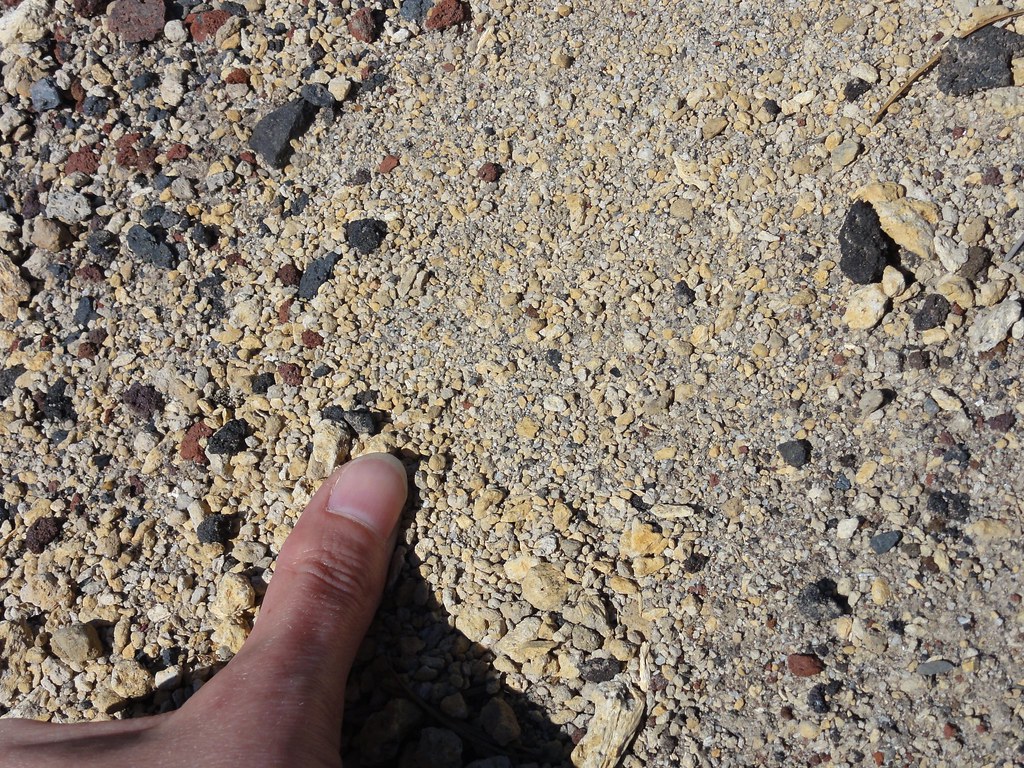
Close to the road, you'll notice all these lovely red and black bits mixed in with the yellow-white pumice. Those are cinders, trucked in and scattered on the road for traction on snowy winter days. I have to admit something to you: my heart did a little bound of joy, because that's what the roadsides in Flagstaff look like (usually minus the large pieces of pumice, but not always - we've got a stratovolcano that liked coating the area in pyroclastics, too). Things weren't so colorful before people came along and started spreading cinders on the roads. Just tough green plants, tan ash, and pale pumice as far as the eye could see.
I scrambled to the top of the cut to try to get away from contaminating cinders. No such luck. But I got to see scenes that could have come from my childhood: Ponderosa pines doing their best to make a living, scrubby little bushes with water-miser leaves, and plenty of dead wood, all fighting to hold on to loose, ashy, easily-drained ground. It's a small hill, not much taller than I am, but a hell of a climb in all that loose stuff. Little clouds of ash puffed up and coated my shoes. Moisture seemed sucked instantly from my skin. It smelled of volcanic earth and pine resin, and if you've never smelled that before, you're in for a treat. It's one of the most beautiful scents on earth.
And as you stand there, you ponder the force it takes to create a landscape like this, and your poor brain boggles. Thing is, this is only the beginning. By journey's end, you may just feel you've experienced a caldera eruption inside your own skull.
Lockwood DeWitt: Tour guide of Oregon geology extraordinaire, and without whom I wouldn't have known what the hell I was seeing.
We're talking about the kinds of eruptions that hurl ash and pumice so high and so far that the landscape for hundreds or thousands of miles around is blanketed in thick, choking ash. We're talking about eruptions that bury landscapes for hundreds of square miles in pumice fields tens of feet thick.
We're talking about the kind of eruption whose traces are still fresh and clear more than seven thousand years later.
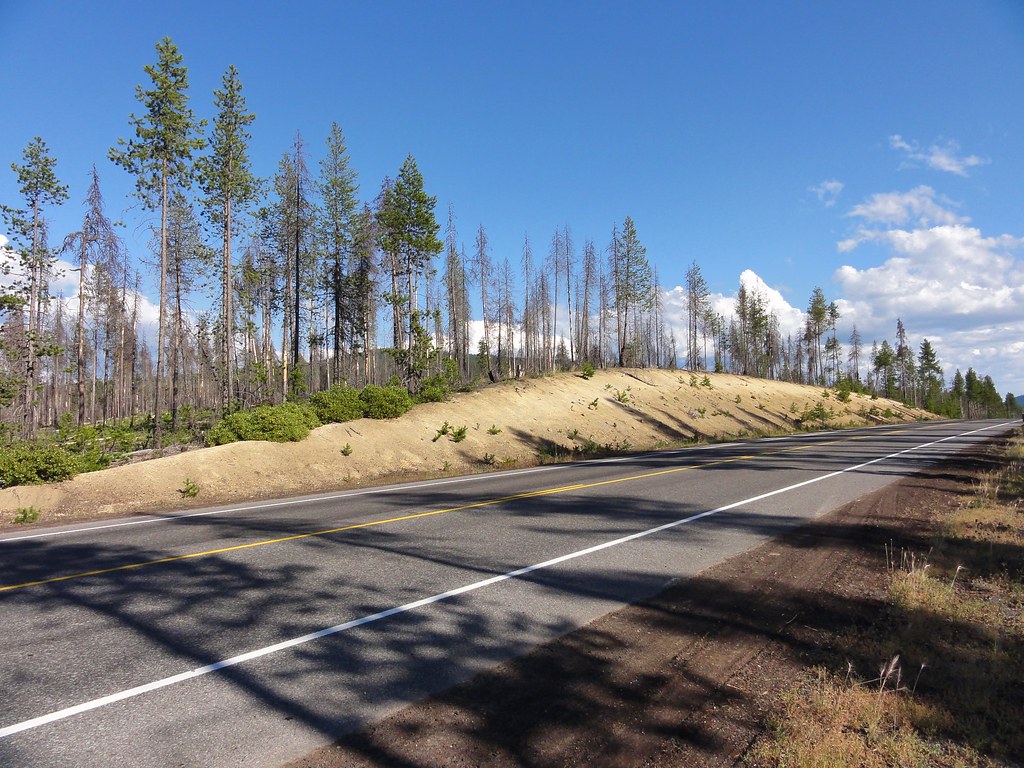 |
| Road cut through Mount Mazama pumice, Route 58 |
Perspective time. I'm standing in a place where, if I'd been able to stand still during the fallout from the eruption, I'd have been over my head in pumice. Over thirty miles away, not in the path of any lahars or pyroclastic flows or any such excitements, and if I'd had a one-story house, it would have been buried to the eaves. And, people, these aren't itty-bitty bits of pumice. Stuff landing here reached up to nearly two inches long.
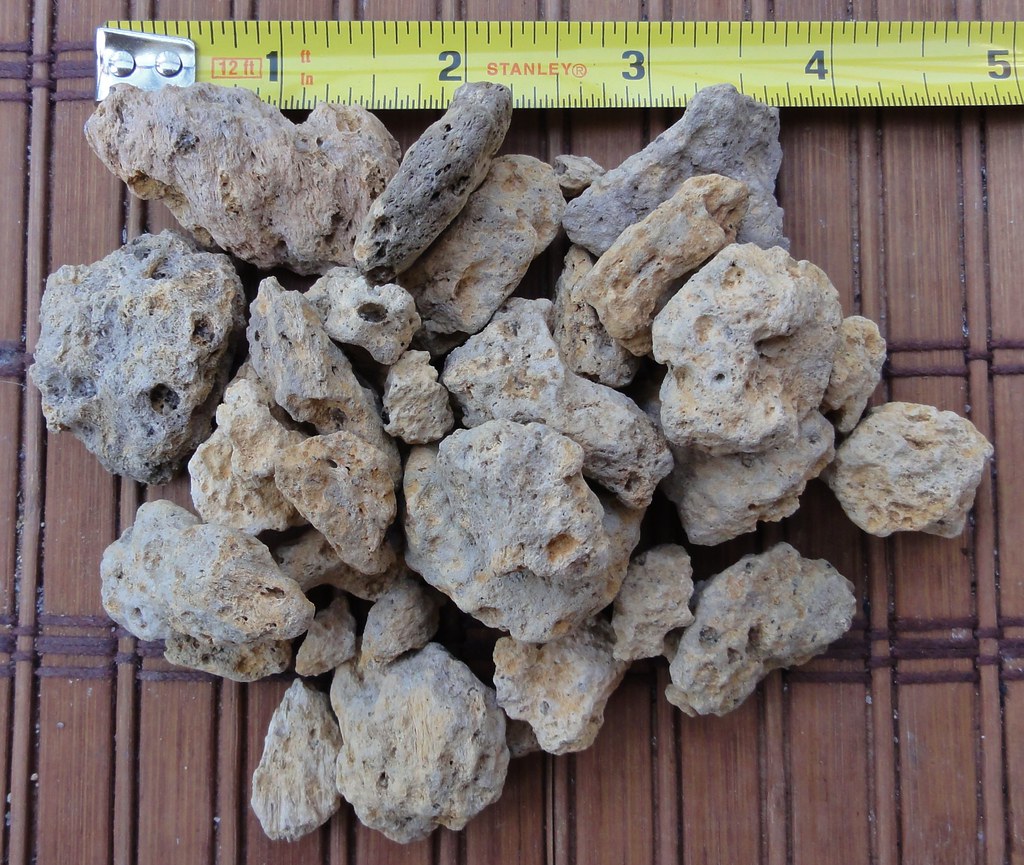 |
| Mount Mazama Pumice, collected at the road cut on 58 |
It's difficult to imagine. We just haven't had many events like that in our living memory. In fact, when my intrepid companion and I got to talking about caldera eruptions the other day, I had to ask Erik Klemetti when the last one was. Mount Pinatubo fits the bill: maclargehuge eruption with worldwide consequences that left a caldera nearly two miles across. Note that Erik called that a "small" caldera collapse! It's the closest to Mount Mazama we've come in the information age.
Then there was the Valley of 10,000 Smokes. Krakatau. Tambora. That last was the largest eruption in recorded history. I mention this because Pinatubo was a measly VEI 6. A piddly little colossal eruption. Mount Mazama, on the other hand, rated up there with Tambora: a VEI 7. Super-colossal.
And it has left its mark, so far away.
 |
| Pumice Flats |
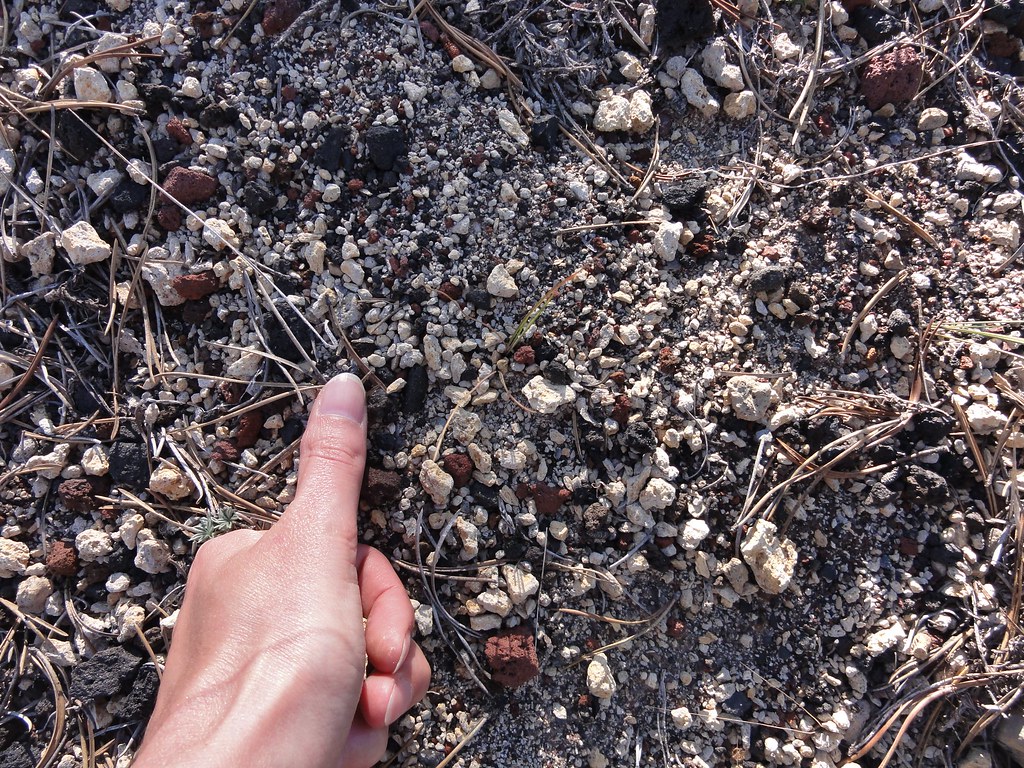 |
| Mount Mazama Pumice mixed with cinders. I should get a centimeter scale tattooed on my thumb, shouldn't I? |
 |
| Mount Mazama Pumice and cinders at top of cut |
And as you stand there, you ponder the force it takes to create a landscape like this, and your poor brain boggles. Thing is, this is only the beginning. By journey's end, you may just feel you've experienced a caldera eruption inside your own skull.
Ye olde indispensable references:
Roadside Geology of Oregon: Especially the marginalia, oddly enough.
Erik Klemetti: My go-to man for all things volcano, even on a Sunday, even on a holiday weekend.
Anne Jefferson: Who is not just a master of floods, it turns out, but knows some kick-ass volcanoes such as Fernandina.
03 September, 2011
Caturday Geocat: Hand Sample Analysis
My poor beautiful hand samples from our Oregon trip are just sitting forlorn on the porch, waiting for me to come up with a permanent home for them. I'm afraid I may never get to properly house them, however. My cat has taken a definite interest.

We have this little ritual when I come home for lunch. She usually spends the time outside on the porch, hanging out on her carpet square whilst I scarf some food and catch up on Twitter. Then she greets me at the door as I head outside for a smoke. She follows me over to the lounge chair, where I sit and enjoy the last moments of freedom before heading back for another four hours ofsoul-sucking drudgery agonizing boredom work. She consents to a scratch behind the ears, and then ambles over and starts inspecting the rocks.

Here she's analyzing one of the platy volcanic bits (which may or may not be basalt or basaltic andesite, but that's a story for another day). It's one of the ones with dendrites on it. Once she gets done with those, she'll establish ownership over the rhyolite by rubbing her cheeks all over every piece she can reach. I have to watch her on that - they've got some glassy textures and sharp edges.
She'll look up occasionally, stare off into the distance like she's considering what she's just learned from her latest inspection.
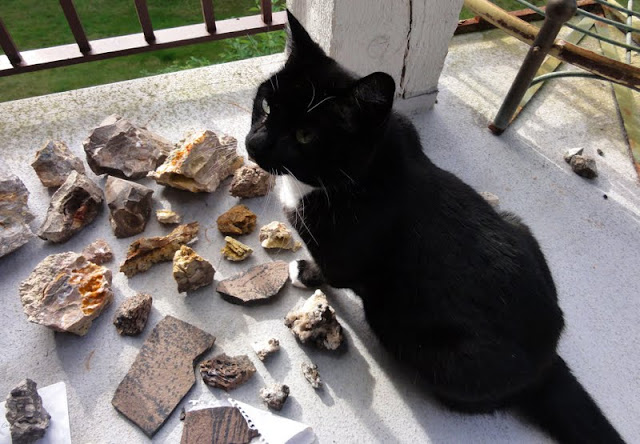
Then she'll go back to her favorite sample, a frothy bit of basalt or basaltic andesite with quartz in.

She loves that rock the best. She curls up with it every time we're out there together. I'm surprised it's not coated in cat hair, considering how much she snuggles with it.

It'll be winter soon, and both rocks and kitteh will have to come in from the cold and rain. But for now, I think I'll leave her hand samples just as they are. This time we have together, me and her and the rocks, is precious.
I'm lucky to live with a cat who shares my love of geology and Doctor Who. I can forgive the occasional homicidal rages. We all have our little quirks, after all.
You've had your Caturday dose of cute. Time for something of substance. Both Lockwood and Cujo have written up bits of our recent trip. Cujo explains why geology is important, and Lockwood's done a more in-depth look at his teaser tweeting, a sexy take on the Pinnacles, and a dedication to the teacher who introduced him to many of the wonders we saw. Enjoy!

We have this little ritual when I come home for lunch. She usually spends the time outside on the porch, hanging out on her carpet square whilst I scarf some food and catch up on Twitter. Then she greets me at the door as I head outside for a smoke. She follows me over to the lounge chair, where I sit and enjoy the last moments of freedom before heading back for another four hours of

Here she's analyzing one of the platy volcanic bits (which may or may not be basalt or basaltic andesite, but that's a story for another day). It's one of the ones with dendrites on it. Once she gets done with those, she'll establish ownership over the rhyolite by rubbing her cheeks all over every piece she can reach. I have to watch her on that - they've got some glassy textures and sharp edges.
She'll look up occasionally, stare off into the distance like she's considering what she's just learned from her latest inspection.

Then she'll go back to her favorite sample, a frothy bit of basalt or basaltic andesite with quartz in.

She loves that rock the best. She curls up with it every time we're out there together. I'm surprised it's not coated in cat hair, considering how much she snuggles with it.

It'll be winter soon, and both rocks and kitteh will have to come in from the cold and rain. But for now, I think I'll leave her hand samples just as they are. This time we have together, me and her and the rocks, is precious.
I'm lucky to live with a cat who shares my love of geology and Doctor Who. I can forgive the occasional homicidal rages. We all have our little quirks, after all.
You've had your Caturday dose of cute. Time for something of substance. Both Lockwood and Cujo have written up bits of our recent trip. Cujo explains why geology is important, and Lockwood's done a more in-depth look at his teaser tweeting, a sexy take on the Pinnacles, and a dedication to the teacher who introduced him to many of the wonders we saw. Enjoy!
02 September, 2011
Interlude With Dragonfly
I wish I could promise you drama. However, aside from some very nice scenery, Highway 58's about the least-dramatic road through the Cascades. When you reach Willamette Pass and stop by Odell Lake, you don't really feel as though you've just reached the mid-point through some of the most dramatic mountains in the United States. Sure, they explode occasionally, but they haven't exploded round here just lately. You haven't even climbed very much - you're at a mere 5,000 feet. There's some nice pointy peaks surrounding you, but it's not like you've been on a steep climb with hairpin turns through them. You don't feel like you've really worked for it.
Which is fine, because that's left you nice and relaxed and in a mood to amble round photographing pretty things. There's even a helpful sign that tells you what you're photographing:
Rather not what one expects in a shield volcano, is it? But that's what it is - a great big shield volcano composed of fifteen cubic kilometers worth of basaltic andesite. That's lots. And it's thought to be fairly young - around 100,000 years or so, which in geologic terms means it's barely out of diapers.
I know, I know. You're looking at its jaggedy profile and saying, "Dana, my dear, that looks more like a stratovolcano." Well, yes, of course it does. It stopped erupting before the last ice age ended, and the ice did a number on it. Ice is quite the artist (not Vanilla Ice, but actual ice, mind). It sculpted and carved and removed bits until this nice, sharp diamond shape was left.
And it left a rather nice lake, as well.
The glacier that covered this area carved out a nice basin, then closed it off with a terminal moraine, and left the lake behind. The Cascades are riddled with these high mountain lakes, and they're all quite lovely. Not warm. But pretty.
I'd have quite a few more pictures of mountains and so forth, only I came across this wonderful wee beastie as I was pottering about:
Well, you know I'm mad for these things. And this poor bloke was dying. When I saw him, he was a bit pathetically crumpled up, on his back, and just looking miserable lying there on the bare shoulder pavement. I didn't want him to finish the last moments of his life by being squished under a tire, so I scooped him up. He spent a comfortable few moments on my knee:
And he didn't seem much fussed by the whole thing. He just rested there calmly, and I thought, I'll never have a better opportunity to photograph a dragonfly's eyes. Only I'm a softhearted silly person who won't reposition a dying dragonfly for her own gain, so I bunged the camera in front of him and hoped for the best, although I couldn't see where we were aiming:
Looks a bit insouciant, doesn't he just? Rather like he's bellying up with an elbow on a bar, about to order a cold one. I liked him very much, and wished there was some reasonable way to prevent nature taking its course, but of course there's not. You can't rush an elderly dragonfly to the hospital and demand emergency resuscitation. So after a bit, I just eased him off into the weeds, where nature could finish taking its course without intervention from half a ton of passenger vehicle. I took one last photo, with my hand for scale, so you can have an idea of how very large he was:
My index finger is about 3 1/2 inches from knuckle to tip, for those who like precision. That translates into a seriously large dragonfly. I'm very nearly sure he's one of the darners, but they all look so similar I'm not sure exactly which he might be.
Strangely, these skinny creatures with their transparent wings don't feel delicate. Their little legs are sturdy, and their bodies hard and smooth. Even though this one had one pair of feet over the Styx, he seemed quite tough. They're even quite tough after hitting the hood of a Honda Civic at 60 miles per hour - we ended up with one plastered to the front during the trip, and while everything else had spattered, it was still a whole, recognizable dragonfly, although a bit crispy and very, very deceased. I have even more respect for these guys after seeing that. They're certainly not as dainty as they look.
After savoring my closest encounter with a dragonfly yet, we drove on. Hang on, my darlings, because it's about to get a wee bit explosive.
Which is fine, because that's left you nice and relaxed and in a mood to amble round photographing pretty things. There's even a helpful sign that tells you what you're photographing:
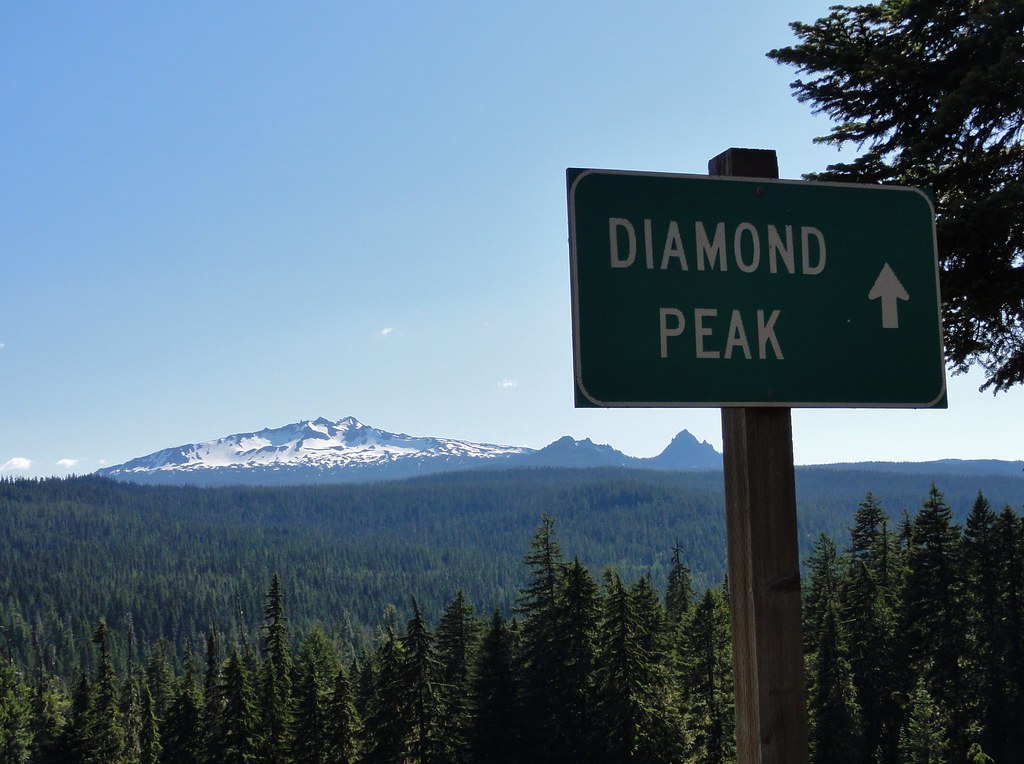 |
| Hard to be sure, but that could be Diamond Peak there in the distance |
I know, I know. You're looking at its jaggedy profile and saying, "Dana, my dear, that looks more like a stratovolcano." Well, yes, of course it does. It stopped erupting before the last ice age ended, and the ice did a number on it. Ice is quite the artist (not Vanilla Ice, but actual ice, mind). It sculpted and carved and removed bits until this nice, sharp diamond shape was left.
And it left a rather nice lake, as well.
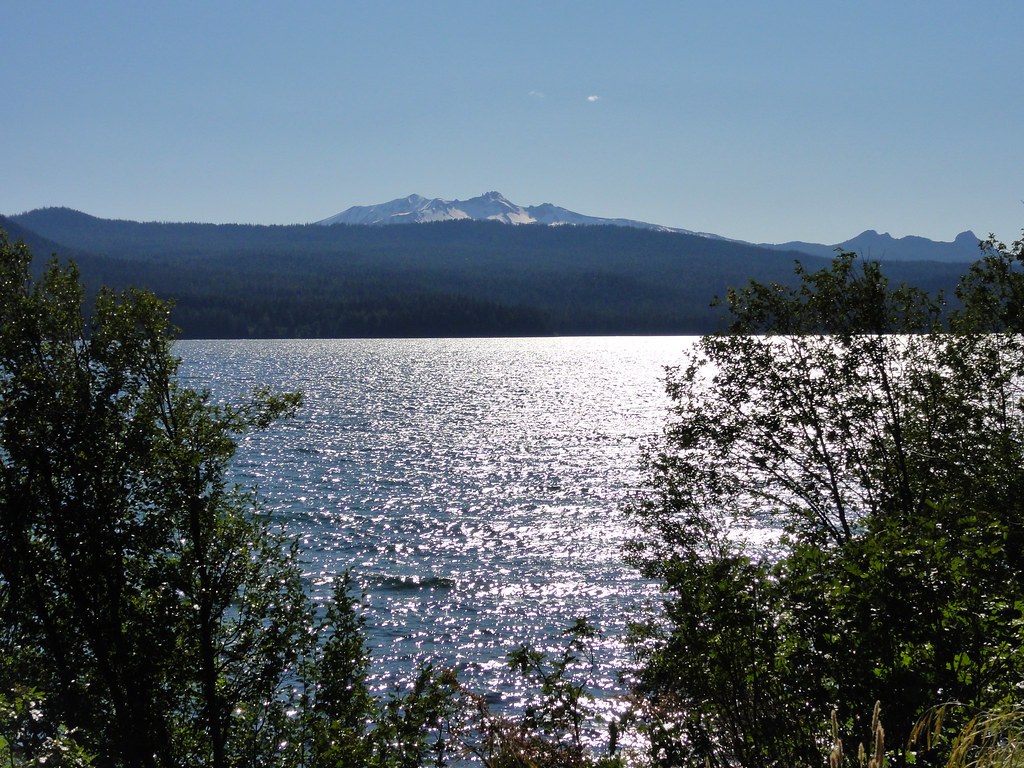 |
| A bit of Odell Lake |
I'd have quite a few more pictures of mountains and so forth, only I came across this wonderful wee beastie as I was pottering about:
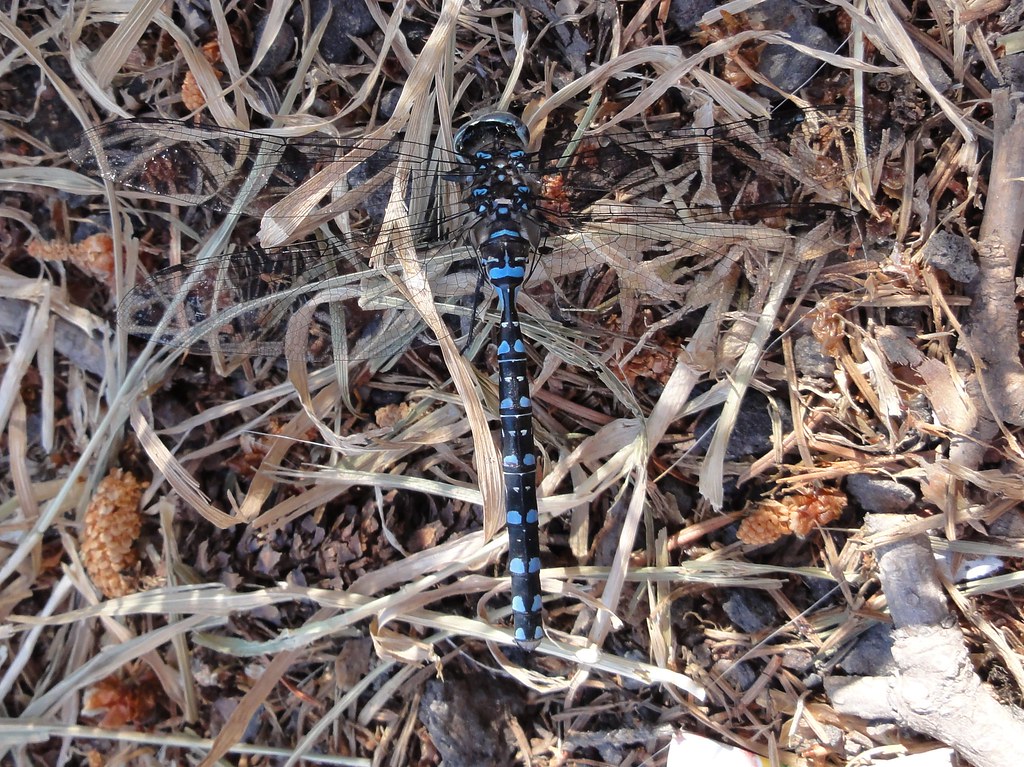 |
| An unexpected dragonfly |
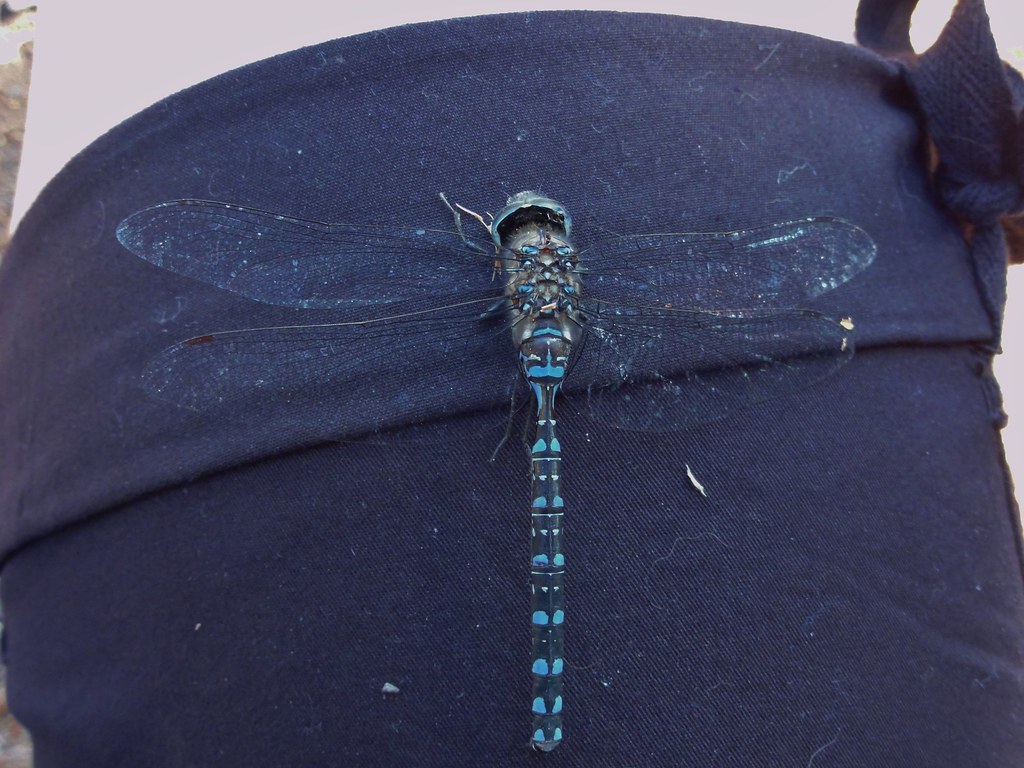 |
| A fine fellow |
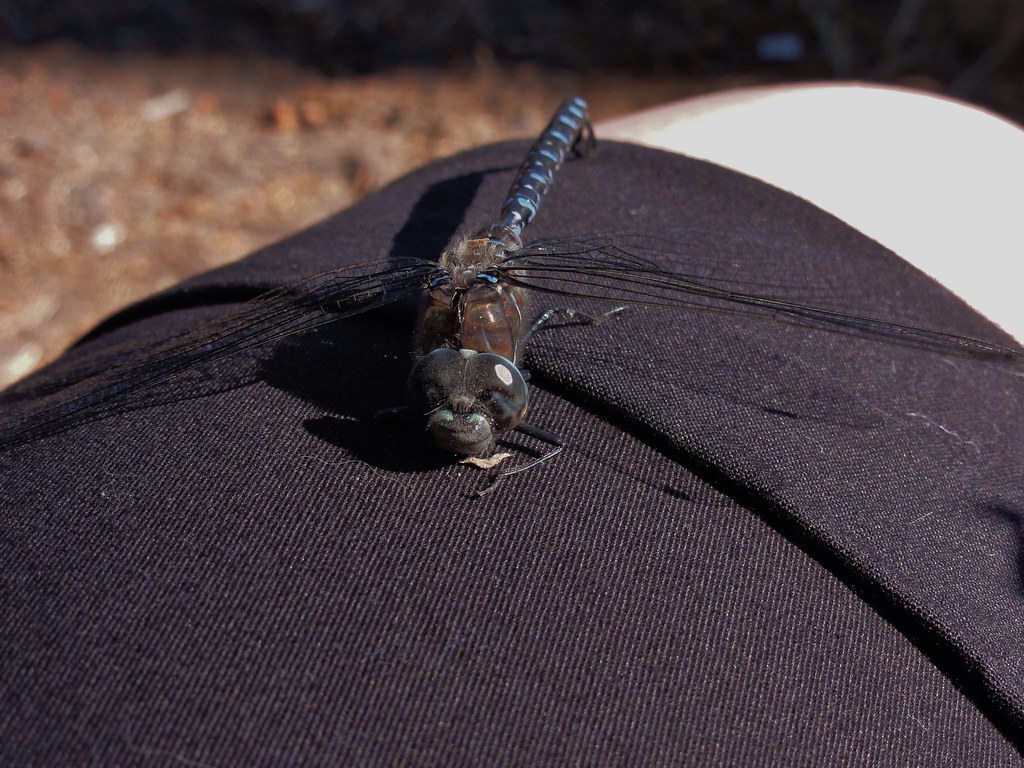 |
| Dragonfly eyes |
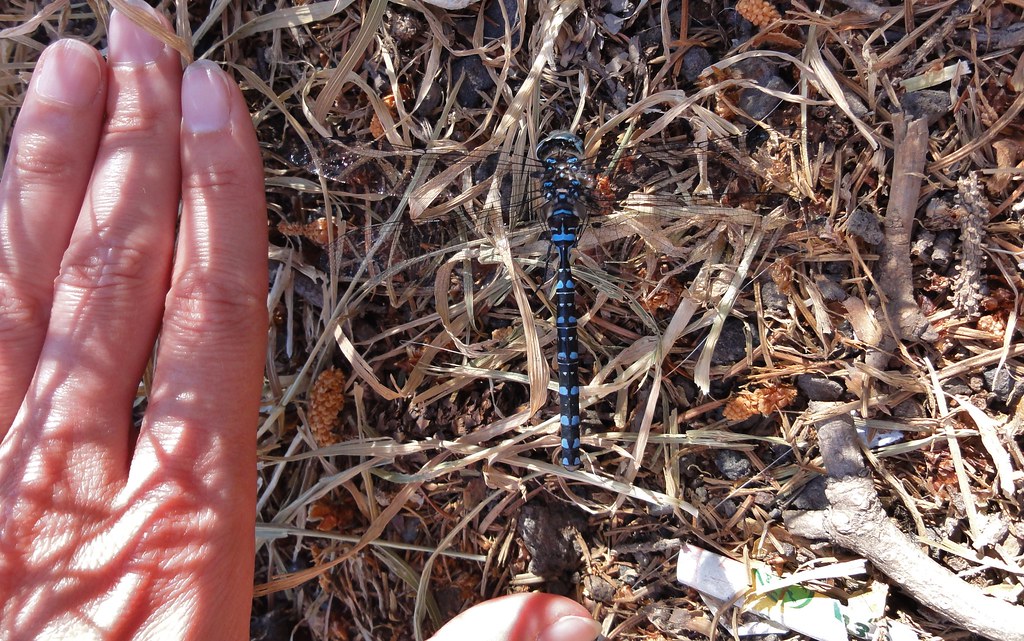 |
| Goodbye, dragonfly |
Strangely, these skinny creatures with their transparent wings don't feel delicate. Their little legs are sturdy, and their bodies hard and smooth. Even though this one had one pair of feet over the Styx, he seemed quite tough. They're even quite tough after hitting the hood of a Honda Civic at 60 miles per hour - we ended up with one plastered to the front during the trip, and while everything else had spattered, it was still a whole, recognizable dragonfly, although a bit crispy and very, very deceased. I have even more respect for these guys after seeing that. They're certainly not as dainty as they look.
After savoring my closest encounter with a dragonfly yet, we drove on. Hang on, my darlings, because it's about to get a wee bit explosive.
31 August, 2011
Crazy Columns and Ice-Polished Rocks: Salt Creek Falls
I'm not going to say a damned word about lineaments. Let's just say that traveling down Route 58 is something of an intrigue: you're crossing the Cascades, but it doesn't feel that way. You're on a long, nearly straight road that doesn't seem to go up much. Mountains rear all round you, and yet here you are, merrily zipping through them. There are some extraordinary things about the Pacific Northwest: these long, straight, bizarre structural features, some of which are barely accepted as real and others as yet only suspected, are among the most perplexing. But they're very nice to take a road trip on.
So there you are, zipping along, unfussed by steep grades or switchbacks, and then, just before you get to Willamette Pass, you've got this little attraction. Well, I say little. It's only the second-highest waterfall in all of Oregon.
Salt Creek Falls is a marvel of falling water, but it's not quite as interesting as the geology that surrounds it. I mean, yes, tall as Niagara, "most powerful waterfall in southern Oregon," yeah, fine. Whatevs. You know what I was looking at after having gawked at the pretty falling water for two minutes? That's right, the rocks.
There's a story here, and it begins on a tall, bald outcrop that'll draw a geologist's eye faster than any amount of falling water.
So there you are, zipping along, unfussed by steep grades or switchbacks, and then, just before you get to Willamette Pass, you've got this little attraction. Well, I say little. It's only the second-highest waterfall in all of Oregon.
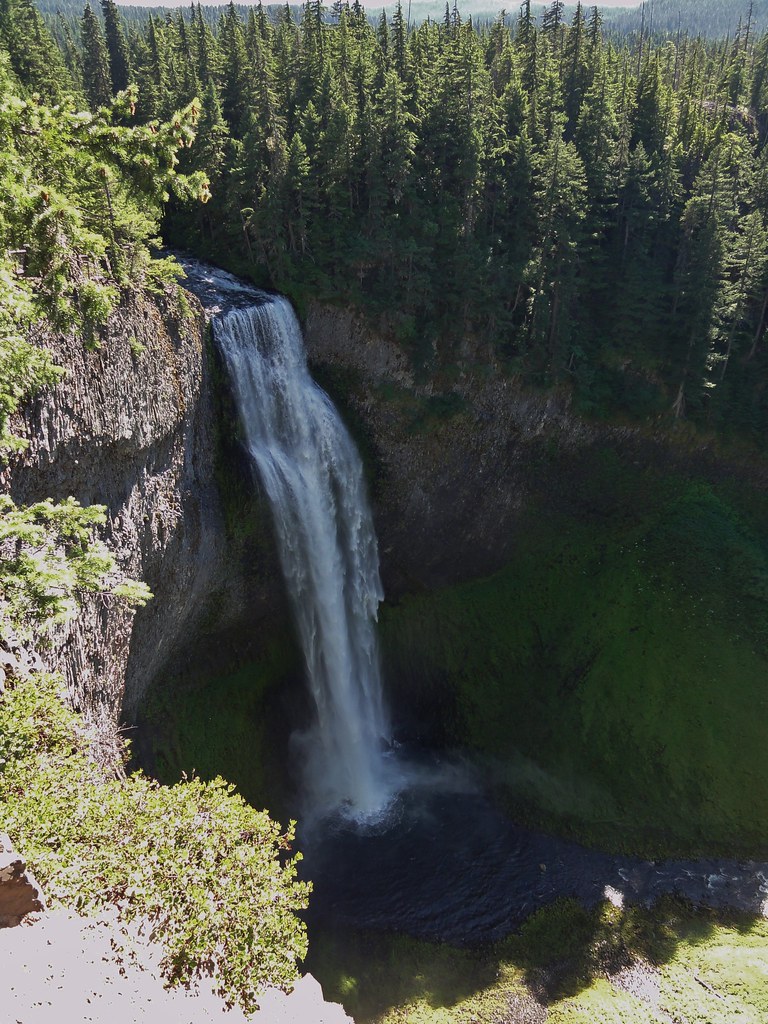 |
| Salt Creek Falls |
Salt Creek Falls is a marvel of falling water, but it's not quite as interesting as the geology that surrounds it. I mean, yes, tall as Niagara, "most powerful waterfall in southern Oregon," yeah, fine. Whatevs. You know what I was looking at after having gawked at the pretty falling water for two minutes? That's right, the rocks.
There's a story here, and it begins on a tall, bald outcrop that'll draw a geologist's eye faster than any amount of falling water.
30 August, 2011
Accretionary Wedge #37: Now Available! And Sexier than Ever!
There's some superfine geology in this month's Wedge. Go have a look!
28 August, 2011
Dear Famous Scientists: Please STFU About Areas Outside Your Expertise
Erik Klemetti, on Twitter, had steam coming from his ears on Wednesday:
And perhaps, just perhaps, if we smack them for stupidity often enough, they'll develop an ability to distinguish between different types of scientists, and figure out whom to call for a quote when various events occur.
But I have a beef with the big-name scientists *coughKakucough* who blabber about subjects they have little or no relevant expertise in rather than calmly saying, "Damn it, Jimmy, I'm a physicist, not a geologist. Go phone a geologist. Quote me as saying, 'I have no idea, as I did not study geology.'"
It's that simple. And someone who does science for a living should know enough to know when they don't know, and be intelligent enough and tough enough to be comfortable saying, "I don't know." Observe Professor Rowena Lohman, who teaches geophysics at Cornell. After delivering kick-ass accurate answers to a variety of questions within her area of expertise, is perfectly comfortable telling a CNN reporter that she is not omniscient:
That, ladies and gentlemen, is how it's done. Alas, that does not seem to be how Kaku does it.
I'd love to try an experiment. Next time there's big physics news, I'd love to interview a microbiologist, say, or a seismologist, and write up a big newspaper article using only them as experts, and then stuff it under the nose of Michio Kaku. "See what happens? See how infuriating it is when experts pop off on subjects they know nothing about?" Perhaps that would help him overcome the compulsion to spout on subjects far outside his realm. Perhaps that would convince him that he doesn't need to babble any old response to clueless journalists, but hand out the phone numbers of relevant scientists instead. And perhaps after several instances of that, the clueless journalists will become clued.
Alas, I don't work for a major paper. Anyone who does willing to try said experiment? It would be a kindness to several geologists whose heads are currently feeling a little prone to explosion.
(Shot glass raised to the poor nameless writer at CNN's opinion section who was smart enough to head for an expert in geophysics and tectonics rather than a string theorist when the earth went wobbly. Kudos to you, unknown wise journalist!)
That's probably because some journalists seem to find it impossible to distinguish between various types of scientist. They also want a big, recognizable name in their headline. So when an event happens and a scientist needs to be consulted, they call the first big name scientist who comes to mind, no matter their discipline. To quote Rocko's Modern Life: "Those guys are idiots."WHY, OH WHY did Bloomsberg talk to @michiokaku instead of a geologist about the VA earthquake? Come on, people! http://www.washingtonpost.com/business/kaku-says-virginia-earthquake-should-be-a-wake-up-call/2011/08/23/gIQAeeTXZJ_video.html
And perhaps, just perhaps, if we smack them for stupidity often enough, they'll develop an ability to distinguish between different types of scientists, and figure out whom to call for a quote when various events occur.
But I have a beef with the big-name scientists *coughKakucough* who blabber about subjects they have little or no relevant expertise in rather than calmly saying, "Damn it, Jimmy, I'm a physicist, not a geologist. Go phone a geologist. Quote me as saying, 'I have no idea, as I did not study geology.'"
It's that simple. And someone who does science for a living should know enough to know when they don't know, and be intelligent enough and tough enough to be comfortable saying, "I don't know." Observe Professor Rowena Lohman, who teaches geophysics at Cornell. After delivering kick-ass accurate answers to a variety of questions within her area of expertise, is perfectly comfortable telling a CNN reporter that she is not omniscient:
CNN: Is the East Coast ready for an earthquake?Lohman: That's a question for a different kind of scientist or engineer.
That, ladies and gentlemen, is how it's done. Alas, that does not seem to be how Kaku does it.
I'd love to try an experiment. Next time there's big physics news, I'd love to interview a microbiologist, say, or a seismologist, and write up a big newspaper article using only them as experts, and then stuff it under the nose of Michio Kaku. "See what happens? See how infuriating it is when experts pop off on subjects they know nothing about?" Perhaps that would help him overcome the compulsion to spout on subjects far outside his realm. Perhaps that would convince him that he doesn't need to babble any old response to clueless journalists, but hand out the phone numbers of relevant scientists instead. And perhaps after several instances of that, the clueless journalists will become clued.
Alas, I don't work for a major paper. Anyone who does willing to try said experiment? It would be a kindness to several geologists whose heads are currently feeling a little prone to explosion.
(Shot glass raised to the poor nameless writer at CNN's opinion section who was smart enough to head for an expert in geophysics and tectonics rather than a string theorist when the earth went wobbly. Kudos to you, unknown wise journalist!)
27 August, 2011
First Rule of Great GeoTrips: Start at OMSI and Build II - Fossil Madness!
One of the beautiful things about OMSI is the Paleontology Lab. This is a place where a mere rope stands between you and delights like this:
I believe they're freeing a triceratops from its matrix of rock. Again, the distractions of friends kept me from paying as much attention to the details as I might have done (no complaints about that!), but one can absorb quite a bit snapping a few photos and drooling over a few touchable displays.
Here's something I adored:
Okay, so it's not real. It's a resin cast. But it was taken from an actual stegosaurus, and stegosaurus is cool. The fact the tail spikes are called thagomizers because of a Far Side cartoon is fucking awesome. I got to touch a cast of a thagomizer, people. That tickles me right down to me toes.
I've always liked the Steg. Other kids in my grade-school class went in for T-Rex, but I figured a dinosaur with armor plates and freaking tail spikes that could potentially beat a T-Rex to death was way cooler. Besides, we have a special relationship, Steg and I. When I was out sick in kindergarten on the day when we were making clay dinos with cookie cutters, my teacher saved me a stegosaurus. I hung it on my wall and petted it and loved it, although I didn't name it George. You can keep your silly T-Rex, y'all. I have a bloody awesome stegosaurus. My Steg can kick your Rex's arse.
I'm more convinced of that than ever, because that tail spike was at least two feet long, and damned thick. You would not want to be walloped with one. Allosaurus certainly did not want, but got anyway. Yeow.
Here's another bit of yum:
Mesosaurus brasiliensis should gladden the hearts of all geologists. This is a Permian freshwater critter, a marine reptile that nommed on fish and swam around in lakes and rivers in what became South America and South Africa. It couldn't cross oceans, and there were no such things as bilges back in the Permian in which stowaways might travel. Turns out this aquatic reptile is excellent evidence that South America and South Africa were once joined - score one for plate tectonics!
There are leaves, too, though I didn't photograph the sign for them, so I haven't the foggiest what they are:
The preserved veins are incredible. The leaf margins don't seem to have been preserved well, which is unfortunate, because having preserved leaf margins would tell me whether these are from a temperate or tropical forest. Experts probably don't need no stinkin' leaf margins to figure it out.
Ooo. More triceratops!
Hard to believe something coherent will emerge from that mess, but the folks who take the tiny little tools and scrape the rocky matrix away a fragment at a time make it happen.
Sometimes, though, all you have to do is split open a slab, and a thing of beauty emerges:
How gorgeous is that? Archaeopteryx is a fascinating creature, which I should know much more about. Alas, all I know is that it's a creature with features of both bird and dinosaur, the first feathered dinosaur found, and there's been a recent dust-up over its place in the avian family tree, which Brian Switek dispatched nicely in an ode Archaeopteryx richly deserved. For myself, simply admiring.
You've gotta respect people who can wrap a huge, heavy rock full of delicate bones in plaster and haul the bastard back to the lab. After having hoofed a great many pounds of hand samples back to the car and then up the stairs, my hat, as it were, is off.
I believe, though I do not know, foolishly not having photographed the accompanying informative sign, that these are fossil brachiopods. They look quite a lot like clams and so forth, but there are differences between bivalves and brachiopods which explain why bivalves are now common as muck and living brachiopods are much rarer, although brachiopods were far more common in the past. Those wanting more information are encouraged to consult this handy .pdf.
I love this stuff. I love a rock that is, basically, all shells and can make cannonballs bounce. So when I had a chance to get my hands on some coquina for the first time ever, you can bet I fondled it. It's harder than you'd expect for something famously soft enough to absorb enormous balls of metal hurtling toward them at speeds meant to destroy. It feels quite solid. And very, very shelly.
Here we have vertebrae and ribs from a 20 million year old baleen whale, found in the Astoria Formation. Yes, some cool shit can be found in the Astoria Formation. Makes me want to go and play in it. I mean, bloody hell, this was found by a beach comber. Somebody bring me an extra-large comb, and let's go comb some beaches!
After all that fossil madness, it was time to rejoin the others down in the non-earth science area, and enjoy a photo op with Glacial Till, one of the best geotweeps I've ever had.

When we met up with Michael Klaas of Uncovered Earth later that evening, we got so busy chatting we forgot the photo op. We won't be so remiss again! Meeting the two of them was high on the list of highlights of this trip, and I can't wait to drag them out into the field.
Then it was off to Park Lane Suites, which has some very nice gneiss in its lobby, and together with the fact it's convenient and comfy, is among the reasons I recommend it for your Portland lodging needs.

 |
| Triceratops in jacket - snazzy! |
Here's something I adored:
 |
| Spike! |
I've always liked the Steg. Other kids in my grade-school class went in for T-Rex, but I figured a dinosaur with armor plates and freaking tail spikes that could potentially beat a T-Rex to death was way cooler. Besides, we have a special relationship, Steg and I. When I was out sick in kindergarten on the day when we were making clay dinos with cookie cutters, my teacher saved me a stegosaurus. I hung it on my wall and petted it and loved it, although I didn't name it George. You can keep your silly T-Rex, y'all. I have a bloody awesome stegosaurus. My Steg can kick your Rex's arse.
I'm more convinced of that than ever, because that tail spike was at least two feet long, and damned thick. You would not want to be walloped with one. Allosaurus certainly did not want, but got anyway. Yeow.
Here's another bit of yum:
 |
| Mesosaurus brasiliensis |
There are leaves, too, though I didn't photograph the sign for them, so I haven't the foggiest what they are:
 |
| Fossil leaves |
Ooo. More triceratops!
 |
| This is what fossil preparers deal with. Respect them. |
Sometimes, though, all you have to do is split open a slab, and a thing of beauty emerges:
 |
| Archaeopteryx replica |
 |
| Another Triceratops Interlude |
 |
| Brachiopods? |
 |
| Coquina! |
 |
| Baleen whale fossils |
After all that fossil madness, it was time to rejoin the others down in the non-earth science area, and enjoy a photo op with Glacial Till, one of the best geotweeps I've ever had.

When we met up with Michael Klaas of Uncovered Earth later that evening, we got so busy chatting we forgot the photo op. We won't be so remiss again! Meeting the two of them was high on the list of highlights of this trip, and I can't wait to drag them out into the field.
Then it was off to Park Lane Suites, which has some very nice gneiss in its lobby, and together with the fact it's convenient and comfy, is among the reasons I recommend it for your Portland lodging needs.

26 August, 2011
Earth Erotica
My non-geo friends don't get dry mouths and pounding hearts when passing road cuts. Sometimes, I think they're blind to beauty. Unclothed rocks are some of the most beautiful sights on earth.
Behold this road cut near Kingman, Arizona that had me screaming for the camera:
That's a beauty that loves even elderly digital cameras. She has faults - that makes her even more alluring. She makes me want to take risks, find a place to pull off the interstate, run my hands along her, explore every nuance of her appearance, know her every detail. Unfortunately, we had a schedule, and we only got that one tantalizing glance across the freeway, and then she was gone. The nice thing about the earth, though, is that she doesn't vanish into the night. She'll be there when I go back, lovely as ever.
There are surfaces, and we only sometimes get to see beneath them. The earth's beauty is far more than skin deep, but it's so often only the skin we see, and that cloaked with water, draped with plants, capped with buildings. But I grew up in canyon country, where the continent likes off-the-shoulder fashions and takes a minimalist approach to coverings. She's adventurous, daring, not afraid to show off. You don't even need a nice road cut to see her layers - go anywhere, find a place where running water's done some daring design, and you'll be struck speechless.
This gorgeous little canyon, cut into the Kaibab limestone, was so wonderful I had to steal my intrepid companion's camera for a decent shot - my old beast wouldn't do it justice. The near-sunset light, breaking through clouds, turned the stone creamy white and rich honey gold by turns as it shifted. This is old stone in an aging landscape, dusted with young volcanics, and the combination of youth and maturity brings out the best in both. You want to talk about a pounding heart: this sight had me literally off my feet, lying on a smooth expanse of bare stone in an attempt to catch her best angle.
In Arizona, there's not much hiding the earth from view. In the Pacific Northwest, she often goes bundled up, and so those places where you can get a look beneath all the biology becomes even more intriguing. Here, the Cowlitz River, just starting out, has cut a box canyon through Mt. Rainier's skin, polished it to a brilliant jet-black luster, and then set it against white water. There's now jewelry made by human hands that enhances natural beauty quite so well as that.
In the mountains, the roads wind along her and she dances, sometimes in brilliant colors, the sea floor raised up on land and cut away, showing off what deep water usually hides. Basalt is beautiful where it wraps round the Olympics, a crescent cloak that in these places looks like a veil whipped around a spinning belly dancer. This road is one of those that will reduce anyone with the slightest sensitivity to geology to incoherent outbursts of appreciative sounds.
Sometimes, to get somewhere and make something we consider useful, we cut down through massive mountain shoulders, and find that the rock we thought rather featureless and dull is endlessly intriguing. Orthogneiss glimmers and sparkles up close, threaded with white veins, riddled with faults that, like a dinner companion with a fascinating life story and a flair for the dramatic, keeps us entranced for hours. Other people might spend their time with the lovely blue lake and the snow-capped peaks - we're likely to have our noses up against bare stone, listening, admiring, and always wanting more.
I've seen people take variously-colored sands and make art of them, but the earth does it effortlessly. Streams and lakes layer sediments in a cacophony of colors, then dry up and vanish, leaving puzzles behind. We stop the car. We walk alongside, we explore, we tease out those stories. These are the things that send my heart racing, leave my skin tingling, make me feel like I can fly. Beneath most surfaces, there's fascination. And the more I know this great and glorious Gaia, the more I love her.
For AW #37, with love.
Behold this road cut near Kingman, Arizona that had me screaming for the camera:
 |
| Road cut on I40, Kingman, AZ |
That's a beauty that loves even elderly digital cameras. She has faults - that makes her even more alluring. She makes me want to take risks, find a place to pull off the interstate, run my hands along her, explore every nuance of her appearance, know her every detail. Unfortunately, we had a schedule, and we only got that one tantalizing glance across the freeway, and then she was gone. The nice thing about the earth, though, is that she doesn't vanish into the night. She'll be there when I go back, lovely as ever.
There are surfaces, and we only sometimes get to see beneath them. The earth's beauty is far more than skin deep, but it's so often only the skin we see, and that cloaked with water, draped with plants, capped with buildings. But I grew up in canyon country, where the continent likes off-the-shoulder fashions and takes a minimalist approach to coverings. She's adventurous, daring, not afraid to show off. You don't even need a nice road cut to see her layers - go anywhere, find a place where running water's done some daring design, and you'll be struck speechless.
 |
| Box Canyon, Wupatki National Monument |
 |
| Box Canyon, Mt. Rainier |
 |
| Road cut near Hurricane Ridge, Olympic Mountains |
 |
| Road cut at Ross Dam, Cascades |
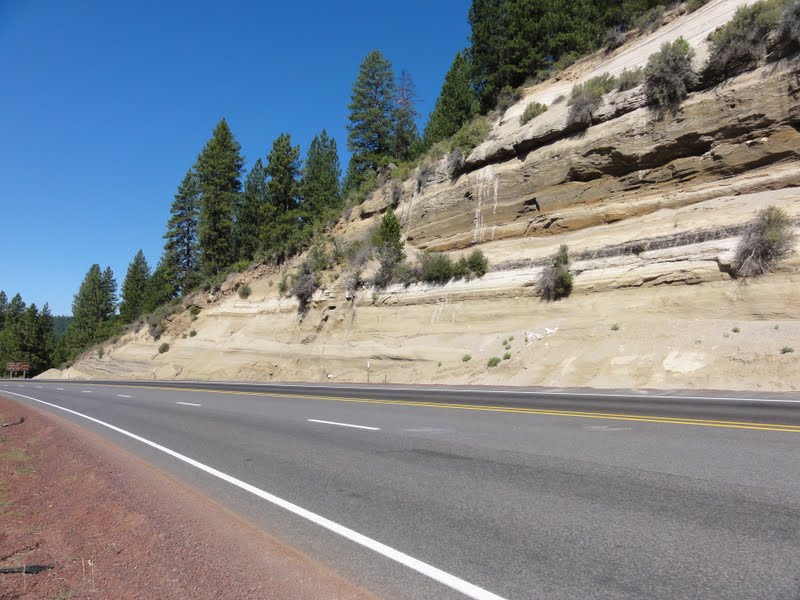 |
| Road cut on Highway 97, Oregon |
For AW #37, with love.
Subscribe to:
Posts (Atom)