I fell in love with Steven quite by accident. I was at Bookmans, the most delicious used bookstore I've ever been in this side of Powell's, and I was combing the Buddhism section for some Zen goodness. Behind me stood books on writing, so I turned round for a look. You never know but you might find something of use. And there, fortuitously out of place, was this book called The Language Instinct.
Admittedly, I'm a bit of a sucker for neuroscience, philology, and psychology. This book was all of it. So I clutched it to my bosom and sashayed up to the register to negotiate its release to my custody. Read it. Adored it. Started reading more of his books, and I have to tell you this: few non-fiction authors have made me think as hard or deliciously as Steven Pinker. And I've read a lot of non-fiction authors that made me think hard and deliciously.
The Language Instinct is a book I'd recommend to any aspiring author, especially those who are trying to invent languages of their own. But it's two other books we're quoting from today. First, we have this delight from The Blank Slate:
"Paradoxically, in today's intellectual climate novelists may have a clearer mandate than scientists to speak the truth about human nature."
I've always avowed that fiction is a means for telling truths that are difficult to administer otherwise. It's sad that scientists aren't as well-regarded as they should be, and shat upon by the fuckwits in Congress far too often. Working to change that, in fact. But until their mandate is secure, I'm more than happy to speak the truth about human nature. Well, some truths, anyway - there is no the truth, no one single truth about human nature. It's not only a fun and important thing to do, it makes me feel a little useful.
But it's this second passage, from How the Mind Works, that I wish you to pay closest attention to:
"Geniuses are wonks. The typical genius pays dues for at least ten years before contributing anything of lasting value. (Mozart composed symphonies at eight, but they weren't very good; his first masterwork came in the twelfth year of his career.) During the apprenticeship, geniuses immerse themselves in their genre. They absorb tens of thousands of problems and solutions, so no challenge is completely new and they can draw on a vast repertoire of motifs and strategies. They keep an eye on the competition and a finger to the wind, and are either discriminating or lucky in their choice of problems. (The unlucky ones, however talented, aren't remembered as geniuses.) They are mindful of the esteem of others and of their place in history. (They physicist Richard Feynman wrote two books describing how brilliant, irreverent, and admired he was and called one of them What Do You Care What Other People Think?) They work day and night, and leave us with many works of subgenius. (Wallace spent the end of his career trying to communicate with the dead.) Their interludes away from a problem are helpful not because it ferments in the unconscious but because they are exhausted and need the rest (and possibly so they can forget blind alleys). They do not repress a problem but engage in 'creative worrying,' and the epiphany is not a masterstroke but a tweaking of an earlier attempt. They revise endlessly, gradually closing in on their ideal."
This passage should tell you three things:
It is okay if it takes years for you to develop into the kind of writer that other people believe must have been born with a supreme magical talent, so good are your works. You're not abnormal or useless or not cut out for writing because you can't write a masterwork on the first go.
Being a genius is bloody hard work, and it's not right for everybody.
You're going to have to work your arse off, did I mention?
Reading that passage in that book assuaged many of my doubts. I'd thought there was something wrong with me. Turns out not. And that's what I wish you to take away from this: there's nothing wrong with you, just because you're not finished becoming a genius yet and you obsess over things. Turns out you're just doing what geniuses do.
Now, get on with becoming a genius and telling the truth about human nature, perhaps whilst creating your own language, why don't you?
I'm busy writing a short story that decided it couldn't wait and trying to pre-load meaty posts for this long winter writing season. So I shall foist you off on other, wiser people who had quite good things to say to writers such as ourselves. This is a small collection of quotes I've gathered over some years and meant to turn into a Dojo article someday. They need no help from me: they can stand alone.
"You ask yourself the following question: To what questions in life have I not yet found a satisfactory answer?"
"An American editor worries his hair gray to see that no typographical mistakes appear on the page of his magazine. The Chinese editor is wiser than that. He wants to leave his readers the supreme satisfaction of discovering a few typographical mistakes for themselves."
"There is a curious thing that one feels sometimes. When you are considering a subject, suddenly a whole train of reasoning comes before you like a flash of light. You see it all, yet it takes you perhaps two hours to put on paper all that has occurred to your mind in an instant. Every part of the subject, the bearings of all its parts upon each other, and all the consequences are there before you."
"A writer of fiction, a professional liar, is paradoxically obsessed with what is true..... the unit of truth, at least for a fiction writer, is the human animal, belonging to the species Homo sapiens, unchanged for at least 100,000 years.
"Fiction, in its groping way, is drawn to those moments of discomfort when society asks more than its individual members can, or wish to, provide. Ordinary people experiencing friction on the page is what warms our hands and hearts as we write."
Summer's drawing to a close, and the winter writing season is very nearly upon us. The Muse is back from wherever she spent her summer vacation. It looks like winter will be coming early. There's a sharp chill in the night air, and a certain gleam in her eye that says I'm in for it. She also appears to have acquired a new whip. Dear, oh dear.
So I'm furiously loading up on posts before summer ends in order to clear the decks for some marathon fiction writing. I'll need at least 30 Dojo posts fired up and ready to go in advance. I've got about half that nearing completion, and I'm running a bit low on ideas.
Topics. I require topics. What haven't I covered in the Dojo that you'd like to see covered? Pepper me with questions about all things writing, whether fiction or blogging. Tell me what you struggle with. Are there contentious issues in the wordsmithing world you'd like to see me tackle with nothing more than my wits and perhaps a rock hammer? Get them to me. If you don't want to go public, you can always find dhunterauthor at yahoo. DM me on Twitter. Drop me a line on Google+, only you'd better do that before October, because I've plans to abandon it willy-nilly if it continues to be evil. You can even find me on Facebook: although I tend to neglect that place shamefully, they always notify me by email when something gets messaged or posted.
My heart sister says important things about writing. And you may say to yourself, "Well, of course, Dana would think so - Nicole's the sister she never had." That's true. Yes, I am partial. But there's also another factor: Nicole writes for a living, so when she says things about writing, these important things, it behooves an aspiring author to listen for reasons beyond the fact Dana loves and trusts her.
I have to trust myself as I write these stories. I have feelings about which stories will work and which should probably be included only in my journal. And I have those feelings for a reason. My writer's gut is telling me which direction to go. I just have to trust it.
As writers, it's sometimes easy to trust other people's opinions more than our own. After all, writers are seeking approval of fellow writers, agents and publishers and, ultimately, readers. We want to know that what we're doing is going to be read and enjoyed by people.
But only you know the best way to do your characters justice. Only you know how to write your stories. You have to trust yourself.
She's right. She's right about all of it. And those last lines, particularly, are ones that are now burned into my writer's soul and will not let go, because they are true, and I sometimes need to hear them stated that starkly so that I am reminded of the truth.
But what did I get hung up on? The "writer's gut." What is that? What is this "writer's gut"? Why should I trust it?
I'm not one much for talk of instinct and intuition anymore. I used to be. Then I started hanging round with scientists, who subject their "gut instinct" to rigorous testing. They're so often wrong, these intuitions, these leaps. The writer's gut, you see, is an instinct. It's an intuition. Why should we trust it?
Because those instincts and intuitions are hard-won, my friends. They only happen after we've worked ourselves bloody, after we've been writing for a long time. The writer's gut is different from that first flush of creativity, that alluring idea, that wild self-confidence you feel before you've actually picked up a pen and run up against harsh reality. The writer's gut is developed only after years, perhaps decades, of hard, lonely work.
It's your subconscious writer's mind, the one you acquired after a billion failed drafts and some writing classes and/or workshops and reading countless books on writing and blogs on writing, the one that listened to and absorbed what the experts (i.e., successful authors you worshipped) told you about how to write, watching the story unfold and clearing its throat meaningfully on occasion.
It plugs you in to a high-voltage current and gives you the buzz of your life when you're on to something, when you're working with an idea that will lead to a fantastic story. It takes your brain and gives it a good hard wrench when you've hared off in the wrong damned direction. It can't always articulate what's wrong and what's right. But if you listen just right, you can tell what it means. And when you've learnt to listen to it, it can keep you on a path that everybody says you shouldn't take but turns out to be the right one in the end. It can steer you round stumbling blocks. It can tell you when you've gone badly astray and must backtrack rather than stumble stubbornly ahead.
Is it wrong? I'm sure it sometimes is. But if you've honed it, you can trust it most of the time.
I don't actually think of it as my "writer's gut." I think of it as the story. The story knows better than I do. It always does. It knows what it wants and needs. It knows if I'm the right writer for it. I've got a hard drive full of story ideas, amazing ideas, wonderful ideas that would make fabulous stories, but I know I can't write them. My writer's gut tells me they're not my stories. Perhaps someday I'll be able to give them free to a good home. They should have adoption centers for abandoned story ideas. But there are ideas that look up at me with those big, soulful eyes, and wriggle just a little, and I know they're mine. I know, even if they look ridiculous to other people at first, that I can help them grow into something sleek and beautiful and enchanting. There are stories that are mine to tell, and I recognize them now. They make it easier to regretfully pass the other stories by, leave them for another.
My writer's gut also knows when I've gotten ahead of myself. It knows when a story idea is mine, but I'm not ready for it yet. Then it slows me down to a gentle halt, directs me to do some more work before coming back to that story. I'm manifestly not ready now for some of the ideas I have got. There are plenty of others to work with in the mean time. My writer's gut tells me that this is fine. All of my stories will be better served in the end by writing the ones I'm prepared for first. There are stories I told ten years ago I couldn't tell now, and stories I'm telling now I couldn't have told ten years ago. And eventually, with work and care, they'll be drawn together into a body of work, whole and complete, and ready to make their own way in the world.
You may wonder why I haven't tried publishing those stories. My writer's gut again. It tells me to wait, just now. I write out of order. After long consultation with my writer's gut, it's been determined that this is the proper way for me to write, but not to publish. That's fine. Stories are patient. These stories will be just fine waiting a few more years until their siblings are ready to join them in that grand adventure that is finding an audience.
I can hear the publish-or-perish crowd howling in protest just now, but they shan't overrule my writer's gut. Theirs tells them to push their work out in the world, and they are right - for those works. Not these. I used to beat myself up over not being like them. No more. No, I've learned to listen to that instinct that's telling me it's all right to wait until the stories are ready. Not forever. Not until they're perfect, because nothing ever is, but until they are as right as they need to be.
The thing about this writer's gut is, you know your stories better than anyone else possibly can. You live them. They are inside you. And that's what gives you the instincts you have got. Instinct is just a word for something you know so well you can't articulate it. But it's not that silly intuition that's no better than tossing divining sticks or a pair of gaming dice. It's that intuition that comes from knowing something very, very well.
So, yes, when you've lived with your stories long enough to know them more intimately than you've ever known a lover, emblazon these words upon your wall, so that you will never forget them:
But only you know the best way to do your characters justice. Only you know how to write your stories. You have to trust yourself.
I think most of us who write, no matter how skeptical or non-superstitious we are, have our little rituals to summon the Muse (not that the wretched entity comes when called). Consider this an invitation to regale us with yours.
I'm not picky when it comes to blogging. I've done it in my PJs, but usually sans Cheetos, thus not fully confirming stereotypes. Something arises I wish to pontificate upon, and so pontification occurs. I can blog any time of day or night, in a variety of settings, in various stages of dress or un, with or without prior preparation depending on the subject.
But fiction, that's a different beast. I've successfully written a few times in places outside my home, but that's a rare thing. Generally speaking, in order to summon the storytelling, I have to be ensconced in my comfy chair in my living room, within sight of my Yoshitaka Amano prints of Morpheus. I must be fully dressed. I've never felt comfortable writing fiction in my jammies, although I've managed it a few times when the Muse has rousted me out of bed. I must have music playing, and the music must be agreeable to the characters I'm writing. I've gotten involved with quite a lot of musical genres I had no use for simply because a particular character required them. Strange, perhaps, but there it is.
Some stories require a clean house. Some require sobriety, some a nice mixed drink. It's nice to know these things in advance so that writing can commence.
There must be darkness. I have a terrible time writing in daylight, which is why Seattle winters are such a compliment to my writing and its summers make it nearly impossible. That's fine. A writer needs to get out occasionally, experience life in order to create lifelike worlds, so I just use the summer to accomplish that feat.
I have a special hand soap I use, a very deep floral scent that washes away all traces of the day. I plug in a nice jasmine scented oil. Scent is an important component of emotional states, as science has proved, and those particular scents signal my brain that it's time to shake off the remains of the day and get on with the real work.
Some stories are helped along by particular shows or movies, even if they aren't the same genre or atmosphere as what I'm writing. So I might spend an hour or two watching one, before the real work starts. Then, shot full of adrenaline, I have one final preparatory smoke out on the porch, look at the stars (if the Seattle skies have obliged), and sit me down in the chair to invite further forays into the realm of Carpal Tunnel Syndrome.
It may sound a bit complicated and unnecessary. To non-writers, it probably smacks of madness. But there you are: without at least a handful of those rituals, I sit staring at a blank screen, and words too often refuse to come. I'm sure neuroscience will one day be able to calmly and dispassionately explain all in great detail. It might even come up with ways to persuade the Muse to work even on nights when the rituals have failed, and the brain remains as stubbornly blank as the screen. Until that day, I just stick with what's worked so far, like a pigeon performing a crazy little dance in the belief that this is what makes the food appear.
Creativity is a weird and wonderful thing, innit it?
Comatose from traveling, I'm afraid. However, I have Connie Willis here to delight, surprise, and teach you. She's one of the best SF authors in existence. Also, funny and surprising. Watch!
Don't miss this next one for sheer geeky hilarity. Lord of the Rings has changed a lot of people's lives, but I don't think any of us knew quite how powerful it truly is.
I'm traveling. And before I left, I was preoccupied with traveling. So you shall have a video rather than me babbling. Listen to Kurt Vonnegut babble instead - you'll enjoy it and you might find your Muse tickled, which is very nearly all a writer ever needs.
I've just spent the past two nights taking notes longhand from various books and websites. I've got notebooks full of such scribblings, deep black ink on white paper, handwriting that changes according to mood, caffeine levels, and whether or not the cat wanted attention. It's a dramatically inefficient way to take notes: using a pen takes far longer than typing. I can't shuffle things about in various folders on the desktop; I can't do keyword searches. So why, in this digital age, would anyone choose a pen and put it to paper?
I can't answer for other writers, but I know the answers for myself. It forces me to slow down, pay attention to each word and phrase, rather than skim. When one is struggling to learn alone, to draw disparate bits together and forge them into a coherent whole, make sense of things barely understood, slowing down to that degree is immensely helpful. I've read one of the sections I took notes from several times, but it wasn't until I started copying out the sentences that their meaning became clear. Things began to make sense. What I saw on the page began merging with what I'd seen in the field. And when I add to those notes ones taken from other sources, and can then read them as a unit, matters become even more clear.
I notice things and question things I wouldn't have paid attention to otherwise. In one of the books I'm mining, the authors keep mentioning radioactive dates. Fine, yes, I know how that works, how ages are determined by the decay of radioactive minerals - but which ones? Was this potassium-argon, uranium-lead, something else? Taking notes longhand, walking the slow road, keeps me from missing such subtle omissions, and alerts me to where the gaps in my knowledge are. Not merely the great gaping chasms, mind, but the little cracks. And that prompts me to pay attention when something comes along to fill those cracks in later readings.
There's also the aesthetic sense. There's something sensual about writing longhand. I can feel the words in a way I can't when I'm typing. Forming each letter is a kind of art. The physicality of it, the inability to erase mistakes without a trace, the gleam of fresh wet ink, brings me as close as I'll ever get to more visual arts like painting. It satisfies the need to create something more like a drawing. And trust me when I say you'd much prefer I fulfill that desire in this way: my drawing skillz are teh suck.
Copying out longhand also puts me closer to other writers. I'm not just reading what they've written, but feeling it. I start to notice little quirks each author has, particular habits of word choice, signature turns of phrase. Even the strictest formal prose has an individual mind behind it. When you're merely reading, or cutting and pasting blocks of text, or scribbling out a key concept or two, it's easy to miss those subtleties. Not when you're copying out each sentence word-for-word by hand. At this point, I can just about write a dissertation on David Alt and Donald Hyndman's quirks. That kind of thing can be extremely useful to a writer. Getting a feel for how different writers employ language in prose helps you develop a style of your own. It's another way of learning the good tricks that turn you from apprentice to master wordsmith.
And then there's the purely practical matter of having all of these various bits and pieces collected in one place, in a form that fits easily on the arm of a chair, where they can be referenced without having to switch screens. And those notes stay collected, easy to refer back to for future missives on similar areas or issues.
Some idle thoughts have tickled my mind while I've been doing this. I wonder if kids a few years from now, with their pad devices, will find people like me hopelessly anachronistic. As I form the letters in my own personal mix of cursive and print, I wonder how much longer it would take to write longhand if one had never learned cursive at all, and whether anyone aside from specialists will be able to read cursive letters in the future. I wonder if any pad device with a stylus will ever allow me to do this longhand writing electronically, and convert my scribbles into nice clean lines, and if it would feel as right as this pen gliding across this paper. I wonder if I can ever train a cheap optical character reader to read my handwriting so that the next time I move, my entire collection will fit on a corner of a hard drive rather than taking up several boxes, and so that I can actually organize this crap. I mean, yes, I could scan it, but if I'm going to go that far, I want a program that will turn my notes into things I can search and manipulate, not merely stare at as one monolithic ensemble on the screen. I'd like it turned into neat and clean Times New Roman.
The way technology's going, there's probably something already out there, but I haven't bothered looking for it. I'm enjoying my old-fashioned dead-tree-and-ink methods too much right at the moment. That stack of notebooks beside my chair is a nice physical reminder that yes, I've been working me arse off. And the cat likes them. All reasons enough, I should think, to keep on despite the glaring inefficiencies.
Here's a post I think all writers should read. It's got important concepts and questions we need to keep in mind if we wish to succeed. It takes the economic concept of stock and flow and turns it into a metaphor for writing:
But I actually think stock and flow is the master metaphor for media today. Here’s what I mean:
Flow is the feed. It’s the posts and the tweets. It’s the stream of daily and sub-daily updates that remind people that you exist.
Stock is the durable stuff. It’s the content you produce that’s as interesting in two months (or two years) as it is today. It’s what people discover via search. It’s what spreads slowly but surely, building fans over time.
I feel like flow is ascendant these days, for obvious reasons—but we neglect stock at our own peril. I mean that both in terms of the health of an audience and, like, the health of a soul. Flow is a treadmill, and you can’t spend all of your time running on the treadmill. Well, you can. But then one day you’ll get off and look around and go: Oh man. I’ve got nothing here.
But I’m not saying you should ignore flow! No: this is no time to hole up and work in isolation, emerging after long months or years with your perfectly-polished opus. Everybody will go: huh? Who are you? And even if they don’t—even if your exquisitely-carved marble statue of Boba Fett is the talk of the tumblrs for two whole days—if you don’t have flow to plug your new fans into, you’re suffering a huge (here it is!) opportunity cost. You’ll have to find them all again next time you emerge from your cave.
Now, seriously, go read the whole thing. Then you can come back here and continue the discussion. I'll wait. I'll even put the rest below a fold so you're motivated.
I think my Muse has headed south for the summer. The wretched dominatrix has this infuriating habit of vanishing about the time I need her most, and I get the impression she's in one of those Mexican hotels that's got a bar in its pool and a nice view of the Sea of Cortez, drunk off her ass and laughing at me.
Where My Muse probably is right now
So here I am, left behind, doing the dirty work of cleaning the house and feeding the cat and working ye olde day job, with nary a useful literary thought in my head. Staring at the blank page results in tension headaches and perpetually blank pages. Attempts at research end early and badly, as an overwhelming sense of, "WTF was I thinking? I can't do this any justice!" destroys any bits learned. And it just seems so much easier to give up, go laze about in the sun and do my damnedest to imitate my cat (sans random attempts at homicide).
Almost every writer goes through these phases. Your Muse, in fact, may be partying it up with mine right now. And they're not physical entities, so we can't exactly hop a plane to Mexico (don't we wish!) and haul them back by their scruffs.
What to do?
Well, for one thing, have a blog that you must regularly update. Because then, it won't matter how uninspired you are - you have to post something because you have readers, and your readers expect you to write. Even if you only have one reader, that's still a reader. Don't let that reader be all understanding about your inability to provide content. Advise them when they try that, "It's okay, I understand you're not feeling up to it, blog when you're ready" shit that it's not acceptable. They're supposed to be your cattle prod, not your enabler. So even if they think it's okay for you to slack off, ask them to lie to you and say that it is not. This will force you to come up with some words.
Do some reading while you're stuck. Or watch a movie, or go for a walk, or hang out with friends, or take in a lecture, or just about anything, really. Walk away from the blank screen and get some life experience. Do those things you're not allowed to do when the Muse is standing over you with a whip. Those things will, eventually, feed back in to your writing, and might just spark a little something.
Do something completely random and new, that you have not done before, while you're at it. Novelty may not always be pleasant, but it can shake loose some creativity.
Do creative things other than writing. Edit photos, play with collages, build models, sew, paint, make music, whatever. I've gotten myself through some dry spells by doing that. It takes the pressure off the writing side of your creativity so it can recover, while still building your creative muscle.
Make a little list. Break out the things you must write or do in order to write into manageable chunks, and do them. Force yourself to spend an hour working on said task, no matter how badly you feel you're doing it. Then walk away and do something else. Come back and take on the next thing on the list (or just pick the next thing that looks doable, no matter what order it's in). Lather, rinse, repeat, until hey presto - you've done some writing!
Organize your shit. If you're one of those writers who lets things get chaotic, now's a good time to put your writing house in order.
Read up on the bidness. Plenty of blogs and books out there that talk about everything from the nuts-and-bolts of storytelling to finding agents (if you're going the traditional route) to self-publishing to marketing and all points in between. If you ever want to make a living writing, you've got to keep up with the business side of things. During a bout of writer's block is as good a time as any, even if you feel you'll never ever write a worthwhile word again (you will).
And if you have to, if nothing's working, go do one of those writing exercises that are so often plastered all over popular how-to-write sites.
The Muses will return from Mexico. Eventually. And now you'll have at least a handful of pages to wave in their faces and scream, "While you've been drinking yourself into oblivion in the hotel pool, some of us have been working!"
Some of you in the audience are probably quite a bit like me: mildly OCD. We build up habits and concepts that are terribly difficult to change.
Here's how bad I am: I cannot use any other program than Microsoft Works to write books. I know there are people out there who use and love Word, or use it and hate it but use it because it's the program everybody uses. But I got my start with Works, and nearly had a breakdown when I got my new computer and had a horrible moment thinking that my old copy of Works, the one without the bells and whistles that made it look like that horrible icky Word, would not install properly.
It's not that Works is a fantastic program. It's not bad, but it's no great shakes. It's just that it's what was on my first computer. We've spent a lot of years together. I've got it organized just so. I know its foibles and how to deal with them. I'm not distracted by the way it looks or acts. It allows me to sit down and simply write. Everything else I looked at didn't have enough advantages to outweigh the fact that it looks weird compared to Works. Because of all that, I've been extremely reluctant to try anything else.
Same thing with ebook publishing. Fine for them as wants it, I told myself, but my magnum opuses and I are going the tried-and-true route. We're gonna write the book (eventually), then we're gonna find an agent, and someday a publisher, and it'll be just like we've always dreamed. Unless, of course, something breaks down along the way, i.e., every agent and/or publisher hates it.
But this year's different. This year, I'm doing something I've never done before: writing a non-fiction book. And I decided, seeing as how I've never written a non-fiction book before, I might as well branch out a bit. It's new enough I can use it to play around with other ways of doing things. For a start, I don't plan to shop it out to any agents or publishers. No, we're going to try this new-fangled self-published ebook thingy. Because, frankly, I think it might suit me. However, I refuse to use my magnum opus to beta test this crazy idea, because it's too precious to me to potentially fuck up. My lovely Lingua Lithica is also important, but we haven't spent the last ten or twenty years with each other. If something goes horribly awry, it's okay. The situation can be rescued without seeing my entire writing life burnt to ashes.
That's a very freeing thing. That makes my writerly OCD slink off and sulk in a corner.
And then my coblogger Steamforged told me that Scrivener's now available in a beta version for Windows. I'd heard of it through Ed Yong and other professional writers who sing its praises to the highest heavens, and I'd wanted to try it, but there was no way I was going to drop a few thousand dollars on a Mac just to give it a spin. But a beta version for Windows? Sign me up! I've never beta tested anything in my life, and I'd never ever ever put my magnum opus into a beta version of a program, but Lingua Lithica won't mind the risks. So I've downloaded Scrivener, and aside from not knowing what the hell I'm doing and its distressing tendency to crash every few minutes when I'm editing a line of Japanese text, I love it. So what if it's got some weird foibles and it's completely unfamiliar? It's beta. So is Lingua Lithica. By the end of this little experiment, the full version will be out, writing Lingua Lithica in it will have given me the confidence to dump my magnum opus in and continue on with a far superior writing program, and things should be all unicorns and rainbows, with a possibility of champagne and roses. Unless it's not, in which case we'll have an amicable divorce.
The point is this: a project completely outside your usual fare is not only a good way to build up your writing muscles, but an excellent way to give yourself some freedom to explore. You go into the thing knowing it's an experiment and knowing it might fail, and so the stress level is quite low. It gives you the chance to try all those things you've wanted to try but couldn't because you are, when it comes to your precious baby of a writing project, too risk-averse to so much as step a toe outside of your well-worn rut.
You may never want to, and that's okay. As my coblogger told me when I shame-facedly admitted to still using Works, "Also, it's not silly to use old stuff if it's what you know and what works. Even when upgrading to a 'better' program, it takes time to adjust to the new workflow and design of it, and that's time spent not writing!" Well, exactly. So not experimenting with an established project is perfectly valid, and like she said, it's not silly to use your old stuff. But when you've got a brand-new type of project that's an experiment to begin with, and you're going to be adjusting to a new workflow anyway, you'll never have a better opportunity to say, "Oh, what the hell," and download something potentially better.
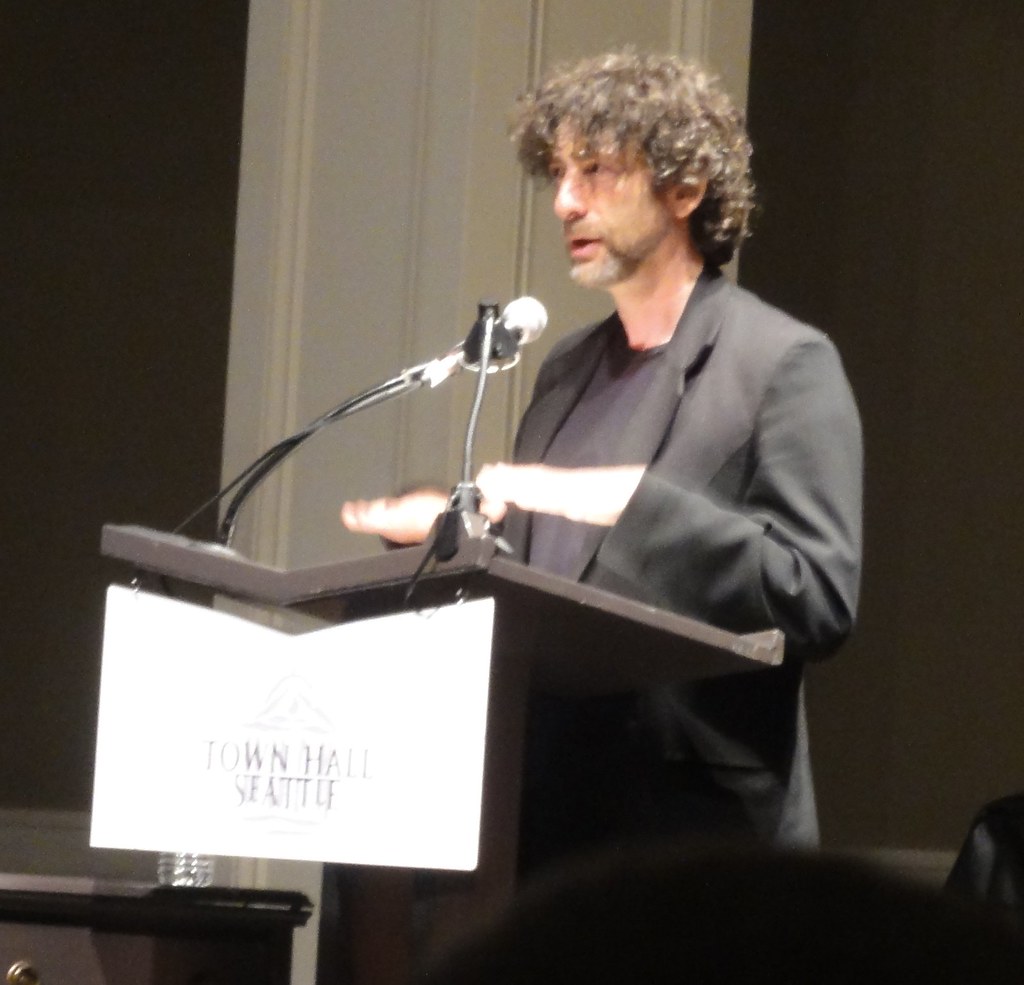
During Neil Gaiman's appearance at Seattle Town Hall, Neil mentioned a discussion he'd had with Tim Minchin the night before. Tim wanted to know why, since Neil was a rational sort of person, everything he wrote was fantasy.
Neil made a suitably witty reply, which I shall not attempt to transcribe as the audio was teh suck at that point and big portions of it are unintelligible. But it got me to thinking. It's a good question, actually: why would otherwise rational people write fantasy? Terry Pratchett is a rational man, Douglas Adams was; SF is filled with atheists running around writing about myths and gods and so forth.
Why not write about the real world instead?
I know my gut reaction to Tim's question was, "Are you kidding? Why wouldn't he write fantasy? He's bloody brilliant at it." I'm sure he'd have been very good writing about really real things and doing very realistic fiction and such like, but no way that could have had the power of Sandman, say, or American Gods. Myth is enormously powerful. And you can use it to say real things that may be a little too real.
I've never met Tim Minchin. Possibly never will. But let's imagine, for a moment, that after I have achieved some modest success and have some SF books out that don't suck, Tim Minchin and I sit down to dinner under some very odd circumstances, and he asks me that very question. "Dana, you're a rational woman. You've written non-fiction and you're good at it. Why are you writing fantasy?"
Because I love it. That's first and foremost: I love speculative fiction. I love science fiction, and I love fantasy, and I love mythic stories, and I love creating worlds. I love my story people and want to do them justice. That's the first thing.
The second is this: the stories I want to tell are human stories, but they can't be told here on Earth. That's just the way it is. I can't force my characters into an earthly skin; they wouldn't fit. I don't want to write stories about the real world. If I'm doing that, I might as well write non-fiction and be done with it. But the real world deeply informs my imaginary worlds, and there's the turn. There's the prestige. You see, I'm working a little bit of magic, here.
Because I realized something long ago: people sometimes need imaginary things to help them see what's real. We're surrounded by real things all the time and very much want to escape sometimes. I do. When I pick up a novel, I'm not looking for a perfect reflection of the real world. I don't want to read about ordinary lives. I want a mirror held up, but not just any mirror: it must be one that doesn't reflect reality faithfully, but twists it around a bit. And I know there are a lot of people like me. They want something fantastic. They want something imaginary and weird and wonderful.
But we only think we're escaping reality. That's the turn, you see. The little magician's trick to make us think we're getting something we're actually not. But reality slips in, sometimes very difficult reality. I could go through each and every fantasy novel I own, the ones with staying power, and I could point out to you a place or two or several where very difficult truths got told. I can show you where something I had no interest in became interesting. Things I wouldn't have touched in a non-fiction book or looked in to on my own because I thought they were too boring, or too grim, or irrelevant, or I simply didn't know exist. They are things that made me think about very difficult issues, like prejudice, or torture, or morality, or politics. They are things that introduced me to science. I would not be sitting here with you, an atheist with a passion for science, if I hadn't read fantasy first and started dreaming of other worlds, which in turn led me to explore this one. I didn't know it was going to do that, but that's what the very best fantasy does: it changes your perspective. It makes you think, and it makes you wonder, and it makes you explore.
Let's take my peculiar passion. If I write a book about geology, people who are interested in geology will read it. And there the matter will rest. But if I write a fantasy novel that has got geology in it, people who thought geology was just dull old rocks, people who never would have in a billion trillion years picked up a book about geology, will find themselves reading about geology. They may not realize that. It's just part of the milieu of that novel, and what they're reading about is characters in very interesting situations. But they're getting exposed to geology in the process. And some of them, perhaps a lot of them, will find themselves intrigued enough by the geology bits to go out and explore on their own. Same thing with the biology and the chemistry and the physics I slip in there. Same thing with the other things: myths and legends and religions and atheism. Same thing with the politics and the psychology and the moral dilemmas and - well, I could continue the list, but I think you're getting the point about now, so I'll stop.
Because it's fantasy I'm writing, I can get away with a lot of things that might have sent readers away screaming if they'd been in a more realistic work. That's the beauty of fantasy: people expect something strange and different in it, so they're not much fussed when I expose them to strange and different things. Things that would've had them howling, "Oh, for fuck's sake, you're not going on about that?" if I'd presented it in another format.
We need fantasy. We get very comfortable seeing the world in certain ways, and it all becomes very ordinary. What fantasy does is changes our perspective. We can use it to explore things from a different angle, perhaps an angle we'd never considered before. It invites us to turn things around and upside down and inside out. And when we do that, we may notice things we'd never noticed before. It makes us think in ways we're not used to thinking. That can lead to all sorts of things. That's how discoveries are made. That's how the world is changed.
And that's the prestige.
Haven't you heard those terms before? What we fantasy authors are doing is a kind of magic, so let me explain. Actually, let me let someone else do it and save myself the work:
The Pledge: wherein a magician shows you something ordinary, but it probably isn't. The Turn: where the magician makes the ordinary object do something extraordinary. The Prestige: where you see something shocking you've never seen before.
That's really what fantasy is, in the end. That's what it comes down to. The ordinary, extraordinary. Something shocking you've never seen or thought before. All in the form of entertainment, because even those of us realists most passionate about reality like a bit of entertainment now and then.
The real world is phenomenal. It is brilliant and beautiful and endlessly fascinating (as well as awful and terrifying and ugly, let's not sugarcoat), but sometimes we have to get out of it a while so we can approach it afresh. Fantasy takes us far, far away. We go on a journey, and we see incredible things, and then we come back with our imaginations refreshed. We can see the world with new eyes and new minds. Fantasy can help us gain perspective, one we never would have had without. That's its power and its glory.
So that's the speech I'd give. The bugger then might turn around and ask me why I'm not writing pure science fiction, then, but that's an imaginary question and reply we'll leave for another day.
A brief intro for those who have been a) living under a rock, b) out pounding on rocks (hey, most of my friends are geologists, so it's distinctly possible) or c) brand new to the cantina: Neil Gaiman is the writer I place at the head of my personal pantheon of writers. He gives outstanding writerly advice, which writers of fantasy and literary fiction and even non-fiction science stuff shall find very useful indeed. And he was at Town Hall Seattle on Sunday night, wherein much wisdom was shared and laughter flowed freely.
I hereby pass along his wisdom, and maybe a few of the laughs.
Writers get this impossible question, "Where do you get your ideas?" And maybe you're a writer already and now have that "oshit how do I answer that/I hate that question!" face, the one where everything twists up like you've just stuck a whole and very sour lemon in your mouth. Or, perhaps, you want to be a writer, and you're thinking, "ZOMG please tell me where do they come from?!" In that case, you've got that please-please-ooo-pick-meeee! puppy-in-the-window face on. Either way, Neil Gaiman can answer that question.
Here's where the idea for American Gods came from: "And it was a scene, I didn't know what it meant, which is often the best place to start any story, is with something that you don't actually understand." He saw a fragment merely: a man on an airplane, who'd gotten there via a crazy sequence of seemingly random events, sitting down at last next to a man he couldn't possibly know, who then turns to him and says, "You're late." Neil didn't know who they were. But he found out, and a lot of other things, random and scattered things, bits and pieces from previous works and various experiences with the weirdness that is America and sleeplessness in Reykjavik and so much else besides, came together and became something magical.
Remember that, when you're beginning a story or novel or any other project: you do not in any way have to understand what it is just yet. There's just this something making your mind itch. You write to find out why it's making your mind itch. Because if your mind is itching, it's quite possible the readers' minds will itch, too, and they'll need to scratch just as much as you did.
Or perhaps your story will come from somewhere else. Neverwhere and Stardust, for Neil, were both books about homesickness. He'd just come to America from England, and these books were ways back for him. He loved re-imagining them, he said. And that is an exile's tale. Perhaps there's something in you trying to get back to, a place you knew well and deeply miss. Perhaps you'll faithfully reproduce it, or, perhaps, like Neil, you'll imagine the way it never was, but could have been. Fertile ground, that.
Neverwhere also emerged from a board game of the London Underground he'd known as a child. He'd look at the stations and try to figure out what they were like from the names: were there knights in Knightsbridge? These are other places ideas come from: childhood imaginings revisited and remembered, familiar things seen through new eyes, taking things literally that aren't meant to be literal and figuratively when they're meant to be actual.
"The point of fiction for me," Neil said, "is that it allows you - not necessarily intentionally, you shouldn't start out going 'I'll take a metaphor and make it real' - but it allows you to do that. And it allows you to do that with power and passion and talk true things.
"Imaginary things are often the most powerful."
You know that. You've felt that. It's why you love fiction. You've felt those characters live, you've immersed yourselves in their lives and their worlds, and hasn't it at times seemed like those people and places are far more real than the ones you know? Even if you're writing non-fiction, if you're a scientist doing science and you plan to write about it someday, it's imagination that drives you. Imagining what things may have been like back in deep time, imagining how atoms behave, imaginings that arise out of data points and mathematics and, in one famous case, the image of a snake biting its tail. Imagination drive stories, and discoveries, and stories about discoveries. That power is yours.
Whether fact or fantasy, you're telling a story. And as for storytelling, "[I]t's always about magic," Neil said. "It's always about the way you take reality and you turn it forty-five degrees so that you could show people things that they're very, very familiar with, and show them these things in a way that they're not familiar with; you show them things that they've seen a thousand times and show them to them for the thousand and first time, if you can."
Do you see why I want all of you, fiction and non-fiction writers alike, to pay heed? Because that's the essence of telling a story. Take the familiar and show it to your readers again for the very first time.
As for research, there's always this ongoing debate as to how much or how little an author should do. For a non-fiction work, of course, research is essential. What about fiction? What research did Neil do for American Gods, for instance? He had his research assistant find out populations of various towns (this was before the intertoobz could provide those answers in an instant). He drove around and looked at stuff. Remembered stuff. He must remember a hell of a lot, because the only gods he did much research on for this particular book were the Slavic ones. He couldn't find much: only about three pages' worth of useful material. So he resorted to making stuff up. For instance, he added Zorya Polunochnaya to the other two Zorya known in Slavic mythology, just made her right up. He says he felt faintly guilty about that, but thought, "Who's gonna know?"
I can see three lessons here. First, when you're writing fiction, and your research has gaps in, you can indeed make stuff up. That's rather the point of it being fiction, am I right? Don't be afraid to add the odd goddess or non-existent city or what have you, if the story calls for it and everything hangs together as a whole. Second, if you're doing research for, oh, say, a book on mythology, don't use a fiction novel as an authoritative source. And lesson the third: check the copyright date on the sources Wikipedia cites, to see if maybe the only mythology book to mention a third Zorya came out after American Gods did.
Toward the end, Maria Dahvana Headley asked Neil for his advice to young people who want to write fantasy. Let's rephrase that a bit, because it applies to all writers who are at the beginning of their careers: what is his advice to people who want to write fantasy?
He started with general advice for all aspiring authors: write, and finish what you write. He said people stare at him like he's withholding some big secret, but that really is the secret to a successful writing career. You must write, and finish what you write, or you won't get anywhere at all.
"But if the question is, 'What would I tell a young fantasy author,' I'd tell you a bunch of things," Neil said. "I'd tell you, 'Stop reading fantasy,' or at least, not to derive inspiration from fantasy.... Fantasy's wonderful and you should know what else is going on in your genre, but you should read everything else. That's Number One: read everything else.
"Number Two is read primary sources.... Go for primary sources wherever you can. Go for as primary as you can possibly get. And read everything, read outside your comfort level....
"And then, write. Tell the stories. Don't do that thing of going, 'I really like Lord of the Rings, I will write Lord of the Rings.' Somebody else has already written Lord of the Rings, and has done it better than you ever could. So, when you're writing, try and tell the stories that only you can tell. That's the one thing that you have as a writer: any young writer has this special thing, which is you're not anybody else. Nobody else has had your life, nobody else sees the world from the place that you see things. And, as a writer, the only thing that you have - there will always be better writers than you, there may be better plotters than you, there may be people who put a sentence better together than you - but there's nobody else who can tell your stories better than you. So the quicker you move from writing other people's stories - and every young writer starting out starts out writing other people's stories - and the quicker you write your own stories, the better.
"And that is the piece of advice I would give to any young writer of fantasy."
All of those things are important. All of those things are true. And they're useful for any genre: just adjust the terms a bit. So, if you want to be a writer, if you want to tell stories, the very best stories you can, listen. I'll even embed the video I shot of that bit so you can listen.
Okay. So you've written the book. You've re-written, and re-re-written, and written the book again. Let's say you've done all that, and actually got it published. Now what? Promotion, of course! And this is where Maria Dahvana Headley really brought the house down, because she announced the idea of the Author Sex Tape. Alas, the audience was laughing so loud and so long through her subsequent explanation that the audio's mostly unintelligible, and I was laughing so hard I can't remember half of what she said. But it's a genius idea. Drum up interest by leaking a sex tape. There's something very important said sex tapes must have: a catch phrase. George R.R. Martin, she said, has a catch phrase: "Winter is coming." She waited for us to finish laughing our lungs out, and then asked Neil, with an amazingly straight face under the circumstances, what his catch phrase was.
"You're asking somebody who's written something out there on the table next to you that the end of Chapter One [next bit unclear due to audience hysterics] a gentleman disappears inside a prostitute," Neil said.
And Maria, without missing a beat, shot back, "You could shout 'American God'!"
If laughter is the best medicine, the audience is likely immortal.
Neil is a writer who can (and has) written very nearly everything: fiction and non, screenplays, comics, children's books, articles - he's a writer well worth listening to. Never mind that he's a bit skeptical about the whole "Author Sex Tape" idea. We writers who want to achieve great things with our writing learn from those who came before, those who have already mastered the art, and Neil Gaiman is one of those authors who will never let you down. So listen. Then write.
And absolutely do not ever miss the opportunity to see him live if you can.
I've probably gone on about this subject before, but it bears repeating: with a few incredibly rare exceptions, a written work does not emerge whole and complete and beautiful on the first go. We writers are not Zeus, and our stories are not Athena, sprung fully-formed from our foreheads.
This can be hard to remember when staring at a blank page with your Inner Editor screaming "You must be instantly perfect!" in the background.
Allow me to allow you to eavesdrop on just such a conversation I had the other night with my own Inner Editor, whose sadism is second only to that of my Muse:
Me: [staring at blank page] I wonder how this scene should start.
Inner Editor: [shouting] You've already started with landings too many times! The story must move! There should be action! If you screw this up, no reader will read anything by you ever again in the whole of eternity!
Me: Dude, that's not helping.
Inner Editor: [still shouting] Where is this scene going? What is its purpose? What is its dramatic tension?
Me: [looking up pictures of Mediterranean trees and pretty vugs in limestone on the intertoobz] HellifIknow. I just started the damned scene, you jackass. Actually, I haven't started the damned scene, because you won't STFU.
Inner Editor: [screaming] There must be a hook! There must be a reason! Why are you wasting your time on trees and vugs which will only have to be cut out later?!
Me: [looking up sphalerite on Wikipedia] Because I need a good feel for this place, and because I'm hoping you'll get bored and go away.
(Eventually, the scene starts. There is a lingering in a grove, and a lizard, and a nice vug in limestone, with trees looming overhead.)
Inner Editor: [flecks of spittle flying] No one will want to read this! It's boring! It has no tension, no action, it does nothing to further the story!
Me: [looking up calcite on Wikipedia and then chasing after scalenohedra] Yes, well, I'm writing my way in, aren't I?
Inner Editor: [tearing out handfuls of hair] No one will even know what scalenohedra means!
Me: So? I do. Now. And isn't this the bit you're insisting we'll have to cut later anyway?
Inner Editor: [apoplexy imminent] That is no excuse for writing badly!
Me: Dude, it's fan fiction. The whole point of writing fan fiction was to get you off my back while I have a good romp through my world and poke in a bunch of crannies. It's never going to be revised, much less published, much less even shown to anyone except Garrett and he'll think the techonobabble fits the character anyway. So go the fuck away so I can get everybody out of this copse of trees and on to the action.
Inner Editor: [veins in neck exploding] But - but- but -
Me: Fan. Fiction.
Inner Editor: ....
Only mostly dead, alas, but at least we got some brief peace. And I went on to enjoy the company of a sexually-confused lizard, wander through a lovely little valley and vineyard, and find out about one of the most badass women in Xtalean history. I can't wait to introduce my readers to her.
Is what I wrote that night perfect? No. Not even close. But the point is, it doesn't have to be. It's words on a page that I didn't have before, a person and a place I didn't know until now. Time and rewrites (although not of this particular work) will take care of teh suck. That goes for academic writing as well.
So, when faced with that blank page, give yourself permission to suck. Not only that, give yourself permission to suck so badly that you'll be contacting a computer consultant to wipe all traces of the first draft off your computer. Invest in duct tape for your Inner Editor, and, should that not work, engage in a little justifiable homicide. And then just get on with it. Get sidetracked, go off on tangents, let the story lead you around like a very confused, easily distracted, yet very enthusiastic small child. Because, and this is the important thing, there will always be a gem among the dross, and there will always be some way of fixing it, if not on the second go, then on Rewrite #42. Even if you throw very nearly every word away, you've at least had the pleasurable experience of telling your dread Inner Editor to go suck it.
This was supposed to be a comment on Dana's latest Dojo post below, but it was too long so I decided to make it a post of its own. Because, you know, why cut my word count short? That doesn't make any sense.
Without further ado...
Dana, I was going to speak to you at length about this (and I still would like to) but I thought I'd throw my two pennies into the pile
Per Nicole's comment, I think that writers might deal with the full depth of the philosophy more than the average person, or at least on a larger scale than most. We can decide the fates of individual lives, whole civilizations, and the fact that it doesn't exist doesn't change that we have to make it happen in that world. We have to actively choose to write it like that.
However, as real as writing is, and I'm all about the voices in our head Nicole, I also work closely with police officers and dispatchers who have to make these kinds of life choices regularly. If the choice to kill off billions of fictional people is this hard for us, but knowing that perhaps our story will make a difference and thus, that may be our justification, where does that leave those who make those choices every day?
In my home town, officers faced off against a young man who was charging, downhill, holding a knife, and shouting "shoot me". What do you do? They are faced not just with the 'criminal underworld', but with people who are mentally or chemically unstable, possibly not in control of their own actions. How do they justify theirs?
What about politics? How do you justify your orders in a time of war? In a documentary about WWII, it is estimated that about 75% of the fighter pilots never saw the end of their campaign of 25 missions. Yet when the brass digs in their heels, when they look at the scene at hand and declare, "Hold this line, at all costs", and countless lives are lost in the name of country soil, they declare success at the end of the day. The mission was "Successful".
Wait, what?
Take the scenario: You are tasked with the choice of killing a man, or not. If you do not, a man in a suit presses a button and 10 people die. You know none of the individuals involved. Now, because I'm a writer too, I understand the arguments (and the loopholes - we're not trying to think outside the box in this case. Sabotaging the button is not an option). That said, two of my characters would like to explain their sides.
Amara: It is morally wrong to kill a another human being, end of story. The ends never justify the means. If the suit pushes the button, he is making that choice to do so, and the blood is on his hands. I won't justify my actions like that.
Meg: At the end of the day, it's no comfort to the victims who's hands are stained. The husbands, wives, children and friends of the 10 people you killed will not forgive you for not choosing, because you don't think its your fault. Proving a murderer's guilt or innocence has no impact on the fact that someone was killed. Ignoring inequality among the individuals, if each of these 11 lives are to be held equally, I would kill one to save 10. Because when the day is over, it doesn't matter who feels guilty, or if my conscience is heavy. The point is that when the sun rises tomorrow, 10 people will get to wake up to see it that wouldn't have otherwise.
Who's right? I don't know. How do you weigh one life against another? These are the very questions we seek to answer.
To touch on an earlier topic, of reducing these lives to nameless numbers, that's what we have to do every day of our lives just to get by. When you see a man on the street, cold and hungry and alone and hope only to rustle up a warm meal, we have to emotionally detach ourselves. Or justify it to ourselves. "I won't give money to them because they'll just buy booze" "They're abusing the system" whatever you want to say. But we survive by putting ourself on another level from them. Dana, if you walked down that same street tomorrow, and you saw one of those special people you were thinking about up there? Your mom, your intrepid companion, maybe me. Could you still say those same things? Could you still go about your day? We're not only socially but genetically wired to want to help our kin.
These are the questions we, as writers, readers, as politicians, as teachers, as students, as fathers and mothers, these are the questions we must ask.
Fair warning: there are no "answers" in this session, just some pondering and a lot of questions. Of course, every Dojo session is mostly that: nothing should ever be taken for Writing Law. As Captain Barbossa so famously said, what's said here is "more what you'd call 'guidelines' than actual rules."
With that caveat emptor in place, let us proceed.
I find myself struggling quite often with morality in my writing and the morality of my writing. If I'm very, very lucky, what I write will have some impact on a reader or two. And the last thing I want is for them to come away from the story believing war is glorious or that killing is always justified or that it's perfectly all right to be a sociopathic son of a bastard as long as you're on the side of the angels.
But. I have to tell a good story, and a difficult story, and if I reduce everything down to bright lines and paint it all in stark black and white and never, ever made the reader confront shades of gray, I won't be doing a very good job. So there's a cutting edge to walk, every time I put fingers to keys. It's hard. It should be hard. We'd like to reduce things down to simple matters of right and wrong, but it's almost never that simple.
And it's not simple for my characters, either, even when they pretend it is.
Right now, I'm confronting the morality of killing two billion people. Think about that number for a minute. 2,000,000,000. If each of those people had one page in a biography, and each biography was five hundred pages, that would be four million books. If it took you one minute to read each page, and you read continuously, it would take you nearly four thousand years to read all of those biographies.
We have to reduce them to numbers, not faces, to think about them, but something important should be remembered. Each of those people meant something to someone. Each of those people had a story. Those are not trivial lives. They're not just numbers, to be shuffled about and added and subtracted without care or concern.
Put a face to a few of them. Plug in friends and family and coworkers and people you don't know personally but quite like and have had some impact on your life. Turn the number 2,000,000,000 into a representative sample of names, faces, personalities, and life's works. Make sure you include some children in there, because that number doesn't reflect just adults, people who can be said to have lived their lives. There are infants and toddlers and tweens and teenagers. There are young folk who never had a chance to get started with discovering who they are and who they'd be when they grew up, and there are young folk who were just embarking on that journey, and never got a chance to get underway. Think of people in your life who fit that bill, and slot them in. It's hard, but do it, because they're standing in for two billion people, so they've got to stand out, clear and whole in your mind.
(Even now, I'm shying away from it. Let me just force myself to make a little list: my mom, who took me on adventures and takes care of my senile old grandad, who made me the beautiful wooden box I still have on my shelf. My dad, who turned me into a survivor when I might have been a victim. My stepmom, who became mother to my adult self when my own mother was too bipolar for the task. Nicole, who is not only one of my best writer friends but has two beautiful young children, a toddler boy and a baby girl. Suzanne, who rescued us when we were stranded, posts gorgeous sunsets and wonderful words and has a brand new granddaughter. Kaden, my coblogger, who's just barely out of high school, working in a job where he takes calls from frantic people and gets help to them, and is working on a book that's been evolving since he was fifteen. My intrepid companion, who accompanies me on all sorts of zany adventures and introduced me to the Doctor and has been there to rescue the hard drive that included my life's work. George, who always knows just the right thing to say and sent me his rock hammer. And now all of the people I know, all of the people I love, old friends and lost loves and my geotweeps and crazy coworkers and the Seattle Skeptics and my dad's brothers and my aunt and cousins and so many people, so many I can't keep up, come crowding into my mind. That doesn't even address people I admire but don't regularly converse with: Dawkins and Myers and Greta Christina and Jen McCreight and Eric MacDonald and every blogger and writer and activist and producer and actor/actress and this enormous expanding cloud of people who have touched my life. All right. So I have them clear in my mind. There are a lot of people in this world I cherish. More than I could name and do any justice to even if I gave over the rest of my life to telling their stories and why they matter.)
I have them in my mind, now. Do you have yours? Good.
Now ask yourself: what could possibly justify killing two billion such people?
How could anyone forgive you for doing it?
How could you forgive yourself?
These are not easy questions, and there are no easy answers. There shouldn't be. My characters have to face hard choices, and I won't let them retreat into easy justifications: "Well, if I hadn't done that, everybody would've died!" That may well be true. Still can't be taken for granted. Still doesn't make it easier to bear. It just makes it possible.
And you know something? These are things I didn't struggle with before I became an atheist. Because now I can't just say "Someone like unto a god did this, and therefore it was moral. QED." Being an atheist has forced me to face the fact that these individuals with individual biographies are dead, and there's no great and glorious afterlife waiting for them. Their lives ended. There isn't another one. And that makes you dramatically more careful with life. That makes you consider really carefully before pointing to anything that could end that one life they've got and calling it the right thing to do.
Ultimately, there may be no answers. Just the question, and imperfect solutions, and doing the best you can.
I spend a lot of time worrying about making things as realistic and accurate as possible. Tear my hair out about the science I don't know and the science that directly contradicts the direction the story wants to go.
It was never about how accurate the science was in science fiction.
It’s about the wonder and excitement of the unknown. It’s about the attitude of characters like Spock and Data, how they attacked problems head on and came up with creative solutions. It’s even about building a interdimensional portal in your basement. That’s what inspired me to want to become a scientist. And maybe this means we’ll never have warp drive or transporters like they have on the Enterprise. But we’ll create something better.
And no, that's not a writer apologizing for being a complete ignoramus who just can't be bothered to get the science right. It's written by a scientist in a post entitled "How Science Fiction Made Me Want to Be a Scientist."
So how did a lot of dreadfully inaccurate science lead a kid to grow up to be a really real scientist?
Because science fiction isn't just about science. It's about possibilities, no matter how far-fetched. It's about characters using the science of their story worlds (even the science the writers just made up on the spot) to discover, to overcome, to do really awesome shit. Science fiction doesn't need 100% accurate science to work. It needs internal consistency, and an enormous sense of wonder, and strange new worlds (or strange this world, for that matter). It's about asking "what if?" and spinning out the implications. It's not afraid to hit the really hard issues head-on. Creatively, even. It's about doing impossible things.
And it's about people. At core, they're what matter. You can have the most deplorable sciency-sounding sillyness going on, and it won't matter as long as the people in the story are interesting and facing attention-grabbing situations.
Science is gorgeous, and I want to get as much as possible right. A lot of science is far more fascinating than anything my imagination can dream up. But I can't know everything. I can't be an expert in every discipline. There will be times when I'll have to fudge it or fake it. There will be times when I'll have to say, "Look, that sort of thing doesn't happen in our universe, but it happens in theirs, m'kay?" Times when I'll have to say, "It's only a story, and you should really just relax." Times when I'll have to quote that essential line above: "It was never about how accurate the science was in science fiction."
All I have to do is write a ripping good tale with enough science to make it all work. Just enough science to spark imagination, and get people exploring on their own, and make them wonder, and make them want to know, and inspire them, and fire them up and fire them off to a life they otherwise wouldn't have had. Not all of my readers will become scientists, but I hope most of them will put the books down with a greater appreciation for it. I hope they come away seeing the world through new eyes. I hope at least a few, possibly many, wonder "What if...?" and go on to make advances in science that wouldn't have otherwise have happened, all because they wanted to find out what would happen if they tried to make my made-up science work in the real world. I hope I inspire some folks to careers in science that have nothing to do with anything in my books, except for the fact they fell in love with science there.
No, it doesn't have to be accurate, not completely. It just has to tell a ripping good tale.
And a good thing, too, because otherwise it would be impossible to write this stuff in the course of one human lifetime...
So, for almost three months now, I've been writing like mad. I've often compared writing to volcanoes: there are times when the magma chamber's empty, then over a period of time it fills, you get your basic harmonic tremors, and then an eruption that lasts days, weeks or months, depending. That's how it's been for these past many weeks: one sustained eruption that's disrupted the airspace over this blog and rained ash all over my relationships. Even the cat's been deprived of premium cuddle time. I am Busy Writing Fiction, by the gods, and there is nothing that can pull me away from it for long.
I'm up to 169 pages over the past 12 weeks, and that's not counting over 100 pages of writing journal and various handwritten scribbles.
With all that, by now, my Wise Readers are saying, "Well, then, Dana: where are the damned excerpts?"
There's a good reason I haven't posted a single word of all this mad, frantic fiction on ye olde writing blogge for your reading pleasure (or displeasure, depending). That's because it'sfanfiction.
In fact, I've just published a study that shows that almost all Nobel laureates in the sciences are actively engaged in arts as adults. They are twenty-five times as likely as average scientist to sing, dance, or act; seventeen times as likely to be an artist; twelve times more likely to write poetry and literature; eight times more likely to do woodworking or some other craft; four times as likely to be a musician; and twice as likely to be a photographer. Many connect their art with their scientific creativity.
Go read the whole thing. And the next time you doubt the utility of creativity, or someone tells you to stop dreaming, read it again.
Without creativity, we'd still be scratching out a meager living as naked apes alone in the wild. Remember that. And dream.
Amanda Palmer recently entered a recording studio with Neil Gaiman, Ben Folds, and Damian Kulash to do eight songs in eight hours. From scratch. Using Twitter for song ideas. Brilliant! Turbo Ocho just got pwnd.
Only some people apparently didn't think that way, and started kvetching before the session even started, and, well, everyone thinks they're a critic. To which Amanda said:
catch 22: every artist and musician has to deal with this paradox of “demands” from different folks and the only answer has always been (in my humble opinion) to stick to your OWN personal schedule, make what YOU feel like making WHEN you feel like making it and let everyone sort out their own shit.
you’re NEVER, ever ever going to make everybody (or anybody) else truly happy. you can try. it’ll bite you in the ass.at the end of the day, you only really answer to yourself.
This is important, people.
If you only ever do what other people want and expect you to do, you're going to get pulled in a thousand different directions. Because everybody wants something a little different from you. No two people are going to agree on what you could do that would make them Perfectly Satisfied. Hell, you talk to the same person on different days, you'll get different responses as to what they'd really like to see you do.
So, while it's important to keep the readers (or listeners or what have you) in mind while you're creating your various works of art, you can't let them dictate what you do. You just can't. You've got only one person you can truly please, and that's you. You probably won't even please yourself, to be honest, but you'll have better luck following your own bliss rather than trying to follow somebody else's.
Do what feels right. No matter how crazy the project sounds. If you love it, if this is what you truly want to do, go for it. Because you won't know until you've tried if it'll turn out to be one of those things that's utter genius and has (nearly) everyone fainting at how Awesome and Original you are. At the very least, you'll entertain yourself. You'll have tried something that fulfilled you. If others end up not liking it, if it doesn't work, shrug and move on.
And remember that plenty of art didn't get appreciated until after the artist was gone. Look at van Gogh, for crying out loud. Rummage around any bin of classics, in any type of medium, and you're bound to find plenty of things that nobody liked when it first came out. But the artist didn't listen to the critics. The artist did what the artist felt compelled to do, and created Art, and if it takes a while to catch on, even if it never does, at least said artist was busy creating rather than pandering.
Please yourself. Then hope that your tastes aren't so bizarre that nobody else is pleased, but if they are, oh, well.
And don't let people dictate to you what a writer is. If you don't feel like writing every day, if that makes you miserable, don't do it. You may never become a published author if you don't put the daily grind in, but maybe you will. Write what you can, when you can, and the way you want it, and at least you'll have pleased the person you have to face in the mirror every day.
If you don't write with the goal of publication in mind, if you write only for yourself, you're still a writer. That's what'll go in the literature books if some relation digs your musty old manuscripts out of your desk drawer and publishes them after you're gone and you end up selling commercially. Writers write. Nothing in the rules says you're only a writer if you're writing for publication.
Take risks. Break rules. Do things you want to do, and don't mind those who tell you it'll never work. One never knows. You don't know until you try.
Listen to Amanda Palmer. She of the Vegimite song and the exquisite taste in husbands: she knows her shit. She knows there's nothing crazy about doing crazy shit.
That's what artists do, damn it. So shut out the chorus of complaints and do what interests you.
I've got a well-stocked bar of political snark, science news and views, blazing social commentary, and bonus outtakes from the writing life. Belly up, pour yourself a shot, and enjoy your stay!