|
| Darwin's Birthday Party |
12 February, 2011
Happy Birthday, Charles!


Cantina Quote o' The Week: Xenophon
Excess of grief for the dead is madness; for it is an injury to the living, and the dead know it not.
-Xenophon
You know what, forget Plato. Xenophon was a much better writer, and reading his Memorabilia was a sheer joy. He lived an interesting life, which included palling around with Socrates, being a mercenary, and getting his ass exiled from Athens likely for both of the above (Athens, it seems, didn't appreciate mercenaries if they weren't fighting for Athens). Most people turn to Plato for their Socrates fix, but Xenophon knew him too, so if you're tired of pompous assery, go Xenophon.
The quote above strikes me as a soldier's quote. It's good advice for us all. Remember it when my time comes: I want the cantina flowing with drink, laughter and love. None of this maudlin sendoff stuff, m'kay?
11 February, 2011
Los Links 2/11
That'll learn me. I didn't build Los Links throughout the week, instead choosing to throw links into a scattered heap and sort them out later. Wot a mess. And I feel I've missed some important things, but I haven't got the faintest idea what they are. My wetware is nonfunctional, people. I'm in the midst of reading three books, one of which is warping my brain severely, one which is stretching it, and one that is making me want to throttle Simon Winchester for his inordinate fondness for cliffhangers. This is all by way of apology to those I've shamefully neglected this week.
We're in need of a good guffaw, methinks. Which is why we're leading off with Neil & His Magnificent Oracular Journal. Seriously, people. Click the link. Read the warning. Shake the Oracle. It's hysterical.
The Brewing Kristol, Beck Feud...: "In the case of U.S. policy towards Egypt, the dynamic is well beyond left vs. right. Instead we're seeing (a) those in the U.S. who support the protesters, their calls for sweeping democratic reforms, and Mubarak's ouster; (b) those who support Mubarak and fear his unknown replacement; and (c) those who believe caliphates run by zombie Islamists, the Illuminati, and the Loch Ness Monster are coming to steal your car." (The Washington Monthly)
Mosses That Move and the Rocks They Reveal: "This further explains why geologists flock to newly blasted road cuts like flies to honey, and further why they carry around rock hammers* for splitting rocks to see what they truly look like. It also explains why I get nervous around them when they get that glimmer in their eyes suggesting that if they could napalm the countryside in their research area, they would." (The Artful Amoeba)
An Abbreviated Numerical History of the Great New Madrid Earthquakes: "750,000,000: Years ago, approximately, when the supercontinent Rodinia began to break up, during which the New Madrid Seismic Zone is thought to have formed. The NMSZ is a reactivated fault system that was initially formed when what is now North America began to split apart, or rift. The rift failed, although the NMSZ provides a lasting reminder." (+/- Science)
The myth buster: "In 1953, Evelyn Hooker, PhD, applied for a National Institute of Mental Health (NIMH) grant to conduct research on 'normal homosexuals.' During this period of American history, Sen. Joseph McCarthy was seeking out communists wherever he suspected they might be lurking; homosexual acts were a crime; bomb shelters were springing up in backyards; and the term 'normal' homosexual was thought to be an oxymoron. A variety of medical and psychological treatments to “cure” homosexuality were employed, including ice pick lobotomies, electroshock, chemical castration with hormonal treatment or aversive conditioning. Gay parties were raided by the police, particularly in election years when a crackdown on 'sexual perversion' was seen as a positive step in the fight on crime." (Monitor on Psychology)
Bullseye: "It is also clear to me that the so-called ‘skeptics’ are allowed to make up whatever they want at will without consequence, and create a large but ill-thought out laundry list, and that we must play this game or else we’re being ‘dogmatic.’ If a climate scientist make one mistake, or a date gets screwed up in the middle of a 1000 page document about glaciers, it will receive international attention. However, if ‘skeptics’ toss out 8 conspiracy theories, 10 logical fallacies, and 17 arguments with ZERO thought put into them, then it is a good thing that we get to hear all sides. Then, when one item on the bucket list is knocked down, they can just jump tot he next item. In the meantime, they are just as valid as everyone else’s idea, since the criteria for acceptance is 101% certaintly in everything." (Open Mind)
Pondering Landscapes: A Chat with BLDGBLOG Author Geoff Manaugh: "A few years ago I stumbled upon the fantastic web site BLDGBLOG and have been following it closely ever since. BLDGBLOG is curated by writer Geoff Manaugh and is wonderfully difficult to describe. Geoff explores ideas of the interaction of our designed/built environments with landscapes and natural processes. Geoff kindly took time out of his schedule to sit down and ponder a few questions I had about his work. I hope you enjoy it." (Clastic Detritus)
Best of the Ice Caves, Mt. Erebus, Antarctica: "Descending into and exploring the ice caves on Mount Erebus has to have been the most surreal experience of my entire trip to Antarctica this past field season. Now that I’m back from the ice, I’ve had time to sift through all of my photos and those of my colleagues, and I’ve picked out the very best of the ice cave photos from Erebus Expedition 2010-2011." (Science Friday)
Of Bad Odors and Good Yarns: "I was sitting in on a class at Harvard the other day, taught somewhere in the ancient warrens of the Museum of Comparative Zoology, listening to a lecture on molecular evolution. The professor, a tenured Harvard biologist and museum curator, was talking about a particular group of genes in Drosophila. But first he said something surprising: he never liked biology as a kid. 'It was always about Drosophila,' he told the class. 'I just couldn’t get excited about flies.'” (Tooth & Claw)
The New Atheism: "But this, quite evidently, simply will not do. We still go back and back, and when we get to the end of a chain of traditions, we find someone with a pen! A human being, just like you and me! So the church, just like the Muslim authorities, took some human writings, no matter how fenced round with sanctity, and then elevated these writings to a stature they simply do not and cannot possess." (Choice in Dying)
Pakistan floods: Predictable or predicted, but a disaster nonetheless: "So the Pakistani government did forecast the flood – at least four days out – in plenty of time to get people in northern Pakistan’s valleys out of the way. The problem was not with the meteorological and hydrologic science either internationally or in Pakistan. Instead, disaster was ensured when flood warnings were not taken sufficiently seriously by regional authorities, media, and residents." (Highly Allochthonous)
Friday Fault Photos: Fault Scarp at Fairview Peak, Nevada: "On that same gray day in early December that MOH and I found flow-banded rhyolite, brecciated rhyolite, tuff, fossils, and Earthscope, we made our way up the wide, gravelled, but unmarked road to the fault scarp on Fairview Peak." (Looking for Detachment)
Stand Back! "Ah, rocks. How I love pounding on you." (Outside the Interzone)
A Look at the Marcus Landslide in the McDowell Mountains of Arizona: "For those aware of the special appeal in 'seeing' long-gone events and the power of geologic observation in resurrecting such events, the Marcus landslide is a truly wonderful story." (Earthly Musings)
We're in need of a good guffaw, methinks. Which is why we're leading off with Neil & His Magnificent Oracular Journal. Seriously, people. Click the link. Read the warning. Shake the Oracle. It's hysterical.
The Brewing Kristol, Beck Feud...: "In the case of U.S. policy towards Egypt, the dynamic is well beyond left vs. right. Instead we're seeing (a) those in the U.S. who support the protesters, their calls for sweeping democratic reforms, and Mubarak's ouster; (b) those who support Mubarak and fear his unknown replacement; and (c) those who believe caliphates run by zombie Islamists, the Illuminati, and the Loch Ness Monster are coming to steal your car." (The Washington Monthly)
Mosses That Move and the Rocks They Reveal: "This further explains why geologists flock to newly blasted road cuts like flies to honey, and further why they carry around rock hammers* for splitting rocks to see what they truly look like. It also explains why I get nervous around them when they get that glimmer in their eyes suggesting that if they could napalm the countryside in their research area, they would." (The Artful Amoeba)
An Abbreviated Numerical History of the Great New Madrid Earthquakes: "750,000,000: Years ago, approximately, when the supercontinent Rodinia began to break up, during which the New Madrid Seismic Zone is thought to have formed. The NMSZ is a reactivated fault system that was initially formed when what is now North America began to split apart, or rift. The rift failed, although the NMSZ provides a lasting reminder." (+/- Science)
The myth buster: "In 1953, Evelyn Hooker, PhD, applied for a National Institute of Mental Health (NIMH) grant to conduct research on 'normal homosexuals.' During this period of American history, Sen. Joseph McCarthy was seeking out communists wherever he suspected they might be lurking; homosexual acts were a crime; bomb shelters were springing up in backyards; and the term 'normal' homosexual was thought to be an oxymoron. A variety of medical and psychological treatments to “cure” homosexuality were employed, including ice pick lobotomies, electroshock, chemical castration with hormonal treatment or aversive conditioning. Gay parties were raided by the police, particularly in election years when a crackdown on 'sexual perversion' was seen as a positive step in the fight on crime." (Monitor on Psychology)
Bullseye: "It is also clear to me that the so-called ‘skeptics’ are allowed to make up whatever they want at will without consequence, and create a large but ill-thought out laundry list, and that we must play this game or else we’re being ‘dogmatic.’ If a climate scientist make one mistake, or a date gets screwed up in the middle of a 1000 page document about glaciers, it will receive international attention. However, if ‘skeptics’ toss out 8 conspiracy theories, 10 logical fallacies, and 17 arguments with ZERO thought put into them, then it is a good thing that we get to hear all sides. Then, when one item on the bucket list is knocked down, they can just jump tot he next item. In the meantime, they are just as valid as everyone else’s idea, since the criteria for acceptance is 101% certaintly in everything." (Open Mind)
Pondering Landscapes: A Chat with BLDGBLOG Author Geoff Manaugh: "A few years ago I stumbled upon the fantastic web site BLDGBLOG and have been following it closely ever since. BLDGBLOG is curated by writer Geoff Manaugh and is wonderfully difficult to describe. Geoff explores ideas of the interaction of our designed/built environments with landscapes and natural processes. Geoff kindly took time out of his schedule to sit down and ponder a few questions I had about his work. I hope you enjoy it." (Clastic Detritus)
Best of the Ice Caves, Mt. Erebus, Antarctica: "Descending into and exploring the ice caves on Mount Erebus has to have been the most surreal experience of my entire trip to Antarctica this past field season. Now that I’m back from the ice, I’ve had time to sift through all of my photos and those of my colleagues, and I’ve picked out the very best of the ice cave photos from Erebus Expedition 2010-2011." (Science Friday)
Of Bad Odors and Good Yarns: "I was sitting in on a class at Harvard the other day, taught somewhere in the ancient warrens of the Museum of Comparative Zoology, listening to a lecture on molecular evolution. The professor, a tenured Harvard biologist and museum curator, was talking about a particular group of genes in Drosophila. But first he said something surprising: he never liked biology as a kid. 'It was always about Drosophila,' he told the class. 'I just couldn’t get excited about flies.'” (Tooth & Claw)
The New Atheism: "But this, quite evidently, simply will not do. We still go back and back, and when we get to the end of a chain of traditions, we find someone with a pen! A human being, just like you and me! So the church, just like the Muslim authorities, took some human writings, no matter how fenced round with sanctity, and then elevated these writings to a stature they simply do not and cannot possess." (Choice in Dying)
Pakistan floods: Predictable or predicted, but a disaster nonetheless: "So the Pakistani government did forecast the flood – at least four days out – in plenty of time to get people in northern Pakistan’s valleys out of the way. The problem was not with the meteorological and hydrologic science either internationally or in Pakistan. Instead, disaster was ensured when flood warnings were not taken sufficiently seriously by regional authorities, media, and residents." (Highly Allochthonous)
Friday Fault Photos: Fault Scarp at Fairview Peak, Nevada: "On that same gray day in early December that MOH and I found flow-banded rhyolite, brecciated rhyolite, tuff, fossils, and Earthscope, we made our way up the wide, gravelled, but unmarked road to the fault scarp on Fairview Peak." (Looking for Detachment)
Stand Back! "Ah, rocks. How I love pounding on you." (Outside the Interzone)
A Look at the Marcus Landslide in the McDowell Mountains of Arizona: "For those aware of the special appeal in 'seeing' long-gone events and the power of geologic observation in resurrecting such events, the Marcus landslide is a truly wonderful story." (Earthly Musings)
10 February, 2011
Confessions of a Female Misogynist Vol. 1: So Wrong About Writers
So, ScienceOnline 11 sparked a small revolution. I first noticed a small rumbling: celebration that over 50% of the participants were women. Then the rumbling turned into an eruption, as women and allied men started going "Well, then, why are the women so invisible WTF?!" For a selection of links on that topic, see here.
And then, along comes this study (h/t) showing that while women mix it up, men overwhelmingly read fiction by men.
This has forced me to examine my own history of misogyny.
And then, along comes this study (h/t) showing that while women mix it up, men overwhelmingly read fiction by men.
This has forced me to examine my own history of misogyny.
09 February, 2011
Oregon Geology Parte the Seventh: There's a Light...
So far, we've devoured delightful geology at Astoria, Ecola State Park, Hug Point north and south, the world's shortest river, and the Three Capes Scenic Loop. Truly a six-course meal! Now, 'tis time for dessert. Herein, we see the light and discover that water is a right bastard.
We've arrived, my darlings, at Cape Meares, and it's only fitting that we look back upon where we've been.
Click to embiggen, and savor the view a moment before we dig in. The closest bit is Maxwell Point, and in the far distance, you can see the long, jutting finger of Cape Lookout. Cape Kiwanda is tucked in between the two, out of sight but certainly not out of mind.
You are standing on yet more Columbia River Basalt. Do try to contain your surprise.
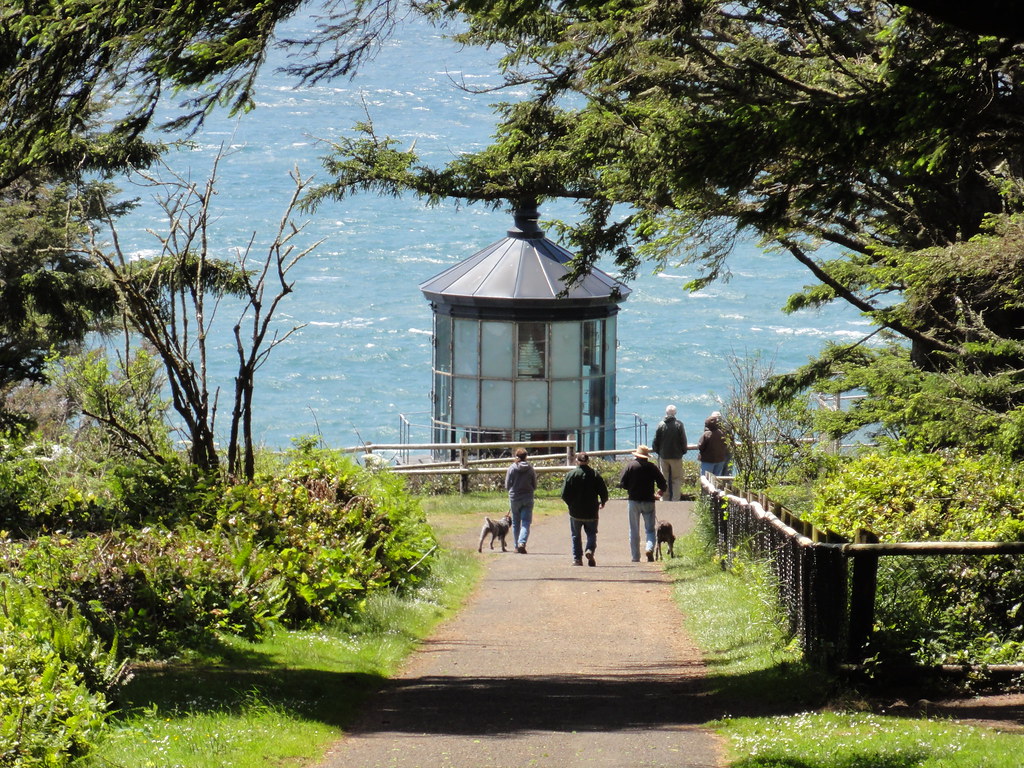
Right, then. Let's have a look around. "Why do we have to look at more basalt, Dana?" you may wail, and I shall answer you: Not only are the views outstanding, but there's a bloody fantastic lighthouse here, one that stares you in the face as you walk down the path:
I cannot tell you how awesome it is to get that sort of view of a lighthouse. It just doesn't happen very often. But that's not all! Water does all sorts of interesting things round here. Did I mention the upside-down waterfall?
We've arrived, my darlings, at Cape Meares, and it's only fitting that we look back upon where we've been.
 |
| Looking Back |
You are standing on yet more Columbia River Basalt. Do try to contain your surprise.
Right, then. Let's have a look around. "Why do we have to look at more basalt, Dana?" you may wail, and I shall answer you: Not only are the views outstanding, but there's a bloody fantastic lighthouse here, one that stares you in the face as you walk down the path:
 |
| Eye-to-Eye With a Lighthouse |
08 February, 2011
Dana's Dojo: Authors as Anglers
Today in the Dojo: Making that first sentence/paragraph/page hook the reader and reel them in.
Readers are like fish: they're always nibbling, but if you want to catch one you've got to use the right bait, and you've got to have a hook in it. Without a hook (or if you use a weak hook), the best bait in the world won't help you. Readers will nibble a bit, spit out your bait, and move on to the next guy who's using one of those really nasty barbed hooks that go in but have to be cut out with a filleting knife. It's no use complaining that your bait is steak while his is Spam. Readers don't care. If they're not hooked, you can't reel them in no matter what kind of delicacies you dangle in front of them.
Equally useless is the hook that's attached to a weak line. Your hook's only as good as the line that holds it. So we're going to take a look at both elements here: the hook that jerks the reader out of their quiet browse and makes them come along, and the line that ensures they can't break away from you with only a really clever hook as an annoying memento.
I feel like I just grabbed a big juicy worm with a right sharp hook in the middle of it.
-Lyndon B. Johnson
Readers are like fish: they're always nibbling, but if you want to catch one you've got to use the right bait, and you've got to have a hook in it. Without a hook (or if you use a weak hook), the best bait in the world won't help you. Readers will nibble a bit, spit out your bait, and move on to the next guy who's using one of those really nasty barbed hooks that go in but have to be cut out with a filleting knife. It's no use complaining that your bait is steak while his is Spam. Readers don't care. If they're not hooked, you can't reel them in no matter what kind of delicacies you dangle in front of them.
Equally useless is the hook that's attached to a weak line. Your hook's only as good as the line that holds it. So we're going to take a look at both elements here: the hook that jerks the reader out of their quiet browse and makes them come along, and the line that ensures they can't break away from you with only a really clever hook as an annoying memento.
07 February, 2011
No, I KNOW I'm Odd
I don't think there are many call-center workers whose main rave about their new computer is the fact that it can pull up 5 pdfs at once without breaking a sweat. There's probably only a small subset of laypeople who would get so excited about finding a treasure trove of papers on the South China Sea Summer Monsoon that they have to get up from their computers and do a victory dance.
Yeah, I'm that weird.
I get asked at least once a month if I'm in college, because I'm either hauling in a ton of tomes to take notes from or babbling about some aspect of science that just captured my imagination. "Nope," I have to answer. "Just research." Whether for a blog post or a bit of the book I'm writing doesn't really matter. Fact is, I do this shit for fun. And I love it. If I didn't, I could blog about bullshit and I'd just make shit up willy-nilly for the novel. Other authors have done it before, with some measure of success.
People frequently don't believe me when I tell them I don't want to go out because I'm looking forward to delving into something dense, technical, and sometimes containing equations. The only other folks who understand are usually in grad school or headed that way.
We got into a brief conversation about television at work recently. One of my coworkers told me 30 Rock was a great show. I had to admit I didn't know what 30 Rock is. He proceeded to explain, and then told me I should watch all these other sitcoms. "Haven't got the time," I said. He told me I could make the time. Sure, I could. I could get even further behind on my science-blog reading than I already am (too much great stuff!). I could set the novel aside at the height of the winter writing season. I could put the papers down, shelve the books, and sit in front of the boob toob to catch up on pop culture.
Yeah, and I can quit smoking any time I want, too. My cat could stop randomly trying to kill people. And we could have a winter without rain in Seattle. Yup.
We're all odd in our own special ways, but there are moments when I realize how out of step with the general herd I am. It's not easy to notice sometimes. You, my darlings, my dearest online friends, you're usually raving about the same things I do. You start drooling the moment Callan Bentley posts his Friday Fold, you can't wait for Seafloor Sunday, you laugh your arses off at astrology. Data delights you. You wax enthusiastic over various and sundry science papers and you get your geek on. Among you, I don't stand out so much. No, it's more like jogging behind, trying to keep up with your science geek awesomeness. And those of my readers who aren't scientists at least appreciate the beauty of it, enjoy reading up on how the world works, and can spend a few hours lost in more than the latest pop culture phenom.
That's why it's such a rude awakening when I get to work and these conversations are going on wherein I'm reminded that no, not everybody's a geek. In fact, the vast majority of us aren't.
And I'm just not sure how to talk to people like that. So I don't, usually. I have a more nefarious scheme. I'm going to write a novel that's salted through with science-y goodness, and the readers might not even notice it at first because they'll (hopefully) be so caught up in the characters. I'm hoping to hook them. I'm hoping to lure them. And then when they burble something about how realistic this bit was or how did I possibly imagine this other bit, then I'll pounce. A-HA! SCIENCE! Yes, Victoria, there is such a thing on Earth as a solution valley. Yes, there are more things in heaven and earth than are dreamt of in our imaginations, but fortunately, science has discovered quite a lot of them. That's what I hope to get across: the universe is a fascinating place without me having to make up a lot of shit.
(And I just found another pdf that has me drooling while I looked for a good link for solution valleys. ZOMG.)
The corollary is that finding this fascinating shit out is fun. It is rewarding. And it's a far better use of one's short time on Earth than obsessing over Survivor. Although if that's your bliss, fine, follow it. Not all of us can be geeks.
But, y'know, I'm odd, so I think I'll just go curl up with some improving book and get my geek on, thanks ever so much.
Yeah, I'm that weird.
I get asked at least once a month if I'm in college, because I'm either hauling in a ton of tomes to take notes from or babbling about some aspect of science that just captured my imagination. "Nope," I have to answer. "Just research." Whether for a blog post or a bit of the book I'm writing doesn't really matter. Fact is, I do this shit for fun. And I love it. If I didn't, I could blog about bullshit and I'd just make shit up willy-nilly for the novel. Other authors have done it before, with some measure of success.
People frequently don't believe me when I tell them I don't want to go out because I'm looking forward to delving into something dense, technical, and sometimes containing equations. The only other folks who understand are usually in grad school or headed that way.
We got into a brief conversation about television at work recently. One of my coworkers told me 30 Rock was a great show. I had to admit I didn't know what 30 Rock is. He proceeded to explain, and then told me I should watch all these other sitcoms. "Haven't got the time," I said. He told me I could make the time. Sure, I could. I could get even further behind on my science-blog reading than I already am (too much great stuff!). I could set the novel aside at the height of the winter writing season. I could put the papers down, shelve the books, and sit in front of the boob toob to catch up on pop culture.
Yeah, and I can quit smoking any time I want, too. My cat could stop randomly trying to kill people. And we could have a winter without rain in Seattle. Yup.
We're all odd in our own special ways, but there are moments when I realize how out of step with the general herd I am. It's not easy to notice sometimes. You, my darlings, my dearest online friends, you're usually raving about the same things I do. You start drooling the moment Callan Bentley posts his Friday Fold, you can't wait for Seafloor Sunday, you laugh your arses off at astrology. Data delights you. You wax enthusiastic over various and sundry science papers and you get your geek on. Among you, I don't stand out so much. No, it's more like jogging behind, trying to keep up with your science geek awesomeness. And those of my readers who aren't scientists at least appreciate the beauty of it, enjoy reading up on how the world works, and can spend a few hours lost in more than the latest pop culture phenom.
That's why it's such a rude awakening when I get to work and these conversations are going on wherein I'm reminded that no, not everybody's a geek. In fact, the vast majority of us aren't.
And I'm just not sure how to talk to people like that. So I don't, usually. I have a more nefarious scheme. I'm going to write a novel that's salted through with science-y goodness, and the readers might not even notice it at first because they'll (hopefully) be so caught up in the characters. I'm hoping to hook them. I'm hoping to lure them. And then when they burble something about how realistic this bit was or how did I possibly imagine this other bit, then I'll pounce. A-HA! SCIENCE! Yes, Victoria, there is such a thing on Earth as a solution valley. Yes, there are more things in heaven and earth than are dreamt of in our imaginations, but fortunately, science has discovered quite a lot of them. That's what I hope to get across: the universe is a fascinating place without me having to make up a lot of shit.
(And I just found another pdf that has me drooling while I looked for a good link for solution valleys. ZOMG.)
The corollary is that finding this fascinating shit out is fun. It is rewarding. And it's a far better use of one's short time on Earth than obsessing over Survivor. Although if that's your bliss, fine, follow it. Not all of us can be geeks.
But, y'know, I'm odd, so I think I'll just go curl up with some improving book and get my geek on, thanks ever so much.
06 February, 2011
Tomes 2011: Inaugural Edition
Those of you who've been with me for a bit know I started a project last year wherein I report upon the books I've recently read. It's been upsetting to some, as it causes unplanned additions to reading lists. I do feel your pain, believe me. But I can't not talk about books, so the suffering shall continue.
Tomes 2010 has of course been retired. Time now for the maiden voyage of Tomes 2011. Without further ado, then:
Mountain Geomorphology
This is not the type of book you buy for a casual perusal. It's written by experts for experts. It doesn't make concessions for laypeople. That said, if you've done some extensive reading of the popular literature and cut your teeth on science blogs, you'll understand at least 40% of this book.
It's got everything: from defining what a mountain is to how they evolve, functional and applied mountain geomorphology, and global environmental change. I learned things from this book that changed many of my perspectives on mountains, and the information in it comes trickling back at odd times to inform something else I'm reading. I'll be reading this book again in a year or so, when I'll understand more, and referring to it more than once in the future. If you want to know how mountains work, and aren't afraid of actual science, this is an excellent resource.
Krakatoa
Never actually wanted to read this one. I know the story of Krakatoa: big boom, no volcano. Seen a program on it, hadn't I? Read up on it in other books about volcanoes, even so. Then I read this bit about the book by Suvrat Kher and decided I'd better read it after all.
It's a rich read: full of history, geography, economics, and all sorts of interesting cultural bits. Only problem is, you know this nice, quiet, pretty island volcano is about to explode spectacularly and kill a great many thousands of people, and it seems to take forever getting there, and then when it does it seems like it should've taken longer. I think Simon didn't linger for ages over every single detail of the eruption because it's been covered elsewhere, but I wouldn't have minded a wee bit more detail. That's not to say there wasn't quite a bit - there was. I'm just being nitpicky.
Aside from my impatience with getting to the big boom, though, it was an excellent read. It's definitely the kind of thing I plan to chuck at people who don't know and don't think they'd like to know geology, but are easily sucked in by big flashy volcanic eruptions and all of the other bits. "Oh," I'll say innocently, "you'd like to read about big explodey things?" Or, "Hey, there's this great book about colonialism/Java/natural disasters/whatever," and then slip them a copy and run away sniggering, because by the end of it they'll have had an education in plate tectonics they won't soon forget.
And really, there's just something utterly remarkable about the thought that an island over 2000 feet high and several miles in diameter could simply vanish over the course of a morning. That the sound of it blowing itself apart could be heard clearly almost 3,000 miles away. We've been lucky, we modern humans, that we haven't witnessed many events so huge in historical memory. Krakatoa is an uncomfortable reminder of the enormity of such things.
In short: if you haven't already, just read the damned book.
The Alps: Europe's Mountain Heart
I bought this book because it's desperately difficult to find anything affordable on Alpine geology in this country. It's got a whole chapter devoted to the geology of the Alps.
Was rather a bit shocked to discover the authors were deceased. They died before the book came out. This led me to speculations about all sorts of alpine accidents and so forth, but Nicholas, at least, died of a perfectly ordinary tumor at age 81, and Nina (though I can't find an obit for her) seems to have lived to a good age as well. So this book becomes a memorial to lives well lived, and it's clear from all they say about the Alps that they lived very full lives indeed. They loved these mountains. They loved everything about them, and that love comes through very clearly.
You'll learn loads more than geology. There's biology and climate, and there's whole chapters devoted to humans and history. You'll find a new way of looking at the Mona Lisa, you'll come away with a deeper appreciation for all of the folks (including women!) who looked at big pointy bits and said, "Hmm, bet I can climb that," and you'll discover all sorts of things you may not have known before. Such as, Mark Twain didn't much like the Alps. And too many people have intruded too much war into them.
I wanted more geology, so I got a bit impatient with the rest, but I feel my appreciation for the rest growing. It's good to know things about places and people. And while it's not written in the most poetic prose on the planet (whereas the Introduction was), it's clear and simple and at times unexpectedly intimate. A good read, indeed.
Western Islamic Architecture
This is perhaps a bit too concise an introduction. The book is all of 38 pages of text if you don't count the introduction. It covers several countries and over a thousand years of architecture, with a rather heavy emphasis on mosques and palaces. And the author has a distressing tendency not to define terms very well. There turns out to be a glossary, but as it's one page sandwiched between the notes and the bibliography, I didn't find it until after I'd finished the book.
Those flaws can be overlooked. But what I have a rather harder time forgiving is the fact that the accompanying images are all squashed in at the back, so when the text refers to this or that figure, you have to go hunting for it. By the time you've found it, you've rather forgotten what the text had to say about it. This may not have been as much of a problem if this wasn't my bathroom book, but it still would have been annoying if I'd been reading straight through. Having to constantly interrupt the flow in order to reference something that could just as easily have been printed on the facing page didn't help me enjoy the experience.
Those flaws in mind, it's not a bad introduction to Islamic architecture. It's just that there's probably better. So unless you, like me, find this on a clearance shelf for a couple of bucks, don't bother.
The Graveyard Book
As obsessed as I am with Neil Gaiman, you would've thought I'd read this book when it first came out. But alas, I did not. I kept meaning to, but other things always got in the way. But then I read Livia Blackburne's series of posts using The Graveyard Book to illustrate various writing techniques (and remind us all that Neil Gaiman is a genius), and I decided it was time.
I began the book at 2:15am. I put it down a couple of times to smoke and pee. I finished it at 6:45am. And promptly did not fall asleep for most of the rest of the morning.
Let me admit something: I like Neil's non-kids stuff better. But this was a perfectly excellent read. You'll get a great sense of it from reading Livia's posts, and I haven't much to add to those except to say, once again, Neil Gaiman is a genius. The characters, the setting, the scenes, the beautifully fluid narration, the turns of phrase, the delights, the horrors, all of combining into the kind of book that made me turn the clock face away so I could forget, just for a little while, that I was supposed to be sleeping at some point. It wasn't what I expected. It was far more.
And Dave McKean's illustrations are the cherry on top.
It's rather a mistake thinking this book is a children's book, incidentally. British authors, even expat British authors, have this idea that kids are tough enough to take the tough stuff. Which means, of course, that at times you, dear adult, will wince, because he's just hit you in the jaw with a haymaker, and he did nothing to pull the punch. There was a point at which I actually looked at the back for the recommended reading age, because I thought the Newberry Medal embossed on the front might have been a strange practical joke. But Harper assures me it's meant for readers 10 & up, so maybe American publishers have finally decided kids aren't such delicate flowers. Or maybe it's just because Neil Gaiman said so.
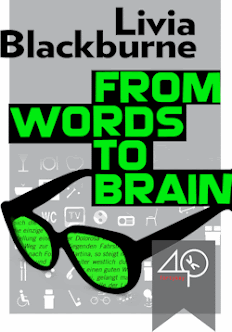
From Words to Brain
This is my first-ever Kindle purchase. It's horrible. Not the book, the fact ebooks are this easy to download. It took me all of a minute or so to download Kindle for my PC, and then something on the order of 30 seconds or so to download the book, and then I'd already read the damned thing in an hour and a half.
It's a good thing so many ebooks are cheap, because this is going to become an unfortunate habit.
Anyway, about the book... Writers in the audience should go purchase and read it forthwith. It's three bucks, it's a quick read, and it's got neurocience related to storytelling by an actual neuroscientist who's a storyteller. You think all those how-to-write books are necessary? Well, this one's more necessary than most. Go. Download. Read.
And if you think you can't because it's neuroscience and you're no scientist, you don't know Livia Blackburne, then, do you? You won't run into a bunch of incomprehensible jargon. You'll get the gist no matter what, so don't worry about it. What you need to know is how brains react to stories. How else are you going to write a story brains will react to? By slogging through a thousand books on how to write when you could just read this one? Puh-leeze.
If you're not a writer, it's still a good read, because you're a reader. Don't you want to know what your brain's up to while you're immersed in a good tale? Yes, you do. You'll know more about that after this book.
Research is ongoing, and if we're lucky, Livia will expand on this book for us and really dig in. This is a good introduction to the field, true, but it's like one slice of cheesecake. It's hard to stop at one slice. One would, in fact, like a whole cheesecake all to oneself.
Right, then. That's enough to be getting started with. I have several more very nearly finished, and I've just downloaded my first Kindle book, so tell your wish list to let its belt out a bit. Otherwise, it might become very uncomfortable indeed.
Tomes 2010 has of course been retired. Time now for the maiden voyage of Tomes 2011. Without further ado, then:
 |
| Image Source |
This is not the type of book you buy for a casual perusal. It's written by experts for experts. It doesn't make concessions for laypeople. That said, if you've done some extensive reading of the popular literature and cut your teeth on science blogs, you'll understand at least 40% of this book.
It's got everything: from defining what a mountain is to how they evolve, functional and applied mountain geomorphology, and global environmental change. I learned things from this book that changed many of my perspectives on mountains, and the information in it comes trickling back at odd times to inform something else I'm reading. I'll be reading this book again in a year or so, when I'll understand more, and referring to it more than once in the future. If you want to know how mountains work, and aren't afraid of actual science, this is an excellent resource.
 |
| Image Source |
Krakatoa
Never actually wanted to read this one. I know the story of Krakatoa: big boom, no volcano. Seen a program on it, hadn't I? Read up on it in other books about volcanoes, even so. Then I read this bit about the book by Suvrat Kher and decided I'd better read it after all.
It's a rich read: full of history, geography, economics, and all sorts of interesting cultural bits. Only problem is, you know this nice, quiet, pretty island volcano is about to explode spectacularly and kill a great many thousands of people, and it seems to take forever getting there, and then when it does it seems like it should've taken longer. I think Simon didn't linger for ages over every single detail of the eruption because it's been covered elsewhere, but I wouldn't have minded a wee bit more detail. That's not to say there wasn't quite a bit - there was. I'm just being nitpicky.
Aside from my impatience with getting to the big boom, though, it was an excellent read. It's definitely the kind of thing I plan to chuck at people who don't know and don't think they'd like to know geology, but are easily sucked in by big flashy volcanic eruptions and all of the other bits. "Oh," I'll say innocently, "you'd like to read about big explodey things?" Or, "Hey, there's this great book about colonialism/Java/natural disasters/whatever," and then slip them a copy and run away sniggering, because by the end of it they'll have had an education in plate tectonics they won't soon forget.
And really, there's just something utterly remarkable about the thought that an island over 2000 feet high and several miles in diameter could simply vanish over the course of a morning. That the sound of it blowing itself apart could be heard clearly almost 3,000 miles away. We've been lucky, we modern humans, that we haven't witnessed many events so huge in historical memory. Krakatoa is an uncomfortable reminder of the enormity of such things.
In short: if you haven't already, just read the damned book.
 |
| Image Source |
The Alps: Europe's Mountain Heart
I bought this book because it's desperately difficult to find anything affordable on Alpine geology in this country. It's got a whole chapter devoted to the geology of the Alps.
Was rather a bit shocked to discover the authors were deceased. They died before the book came out. This led me to speculations about all sorts of alpine accidents and so forth, but Nicholas, at least, died of a perfectly ordinary tumor at age 81, and Nina (though I can't find an obit for her) seems to have lived to a good age as well. So this book becomes a memorial to lives well lived, and it's clear from all they say about the Alps that they lived very full lives indeed. They loved these mountains. They loved everything about them, and that love comes through very clearly.
You'll learn loads more than geology. There's biology and climate, and there's whole chapters devoted to humans and history. You'll find a new way of looking at the Mona Lisa, you'll come away with a deeper appreciation for all of the folks (including women!) who looked at big pointy bits and said, "Hmm, bet I can climb that," and you'll discover all sorts of things you may not have known before. Such as, Mark Twain didn't much like the Alps. And too many people have intruded too much war into them.
I wanted more geology, so I got a bit impatient with the rest, but I feel my appreciation for the rest growing. It's good to know things about places and people. And while it's not written in the most poetic prose on the planet (whereas the Introduction was), it's clear and simple and at times unexpectedly intimate. A good read, indeed.
 |
| Image Source |
This is perhaps a bit too concise an introduction. The book is all of 38 pages of text if you don't count the introduction. It covers several countries and over a thousand years of architecture, with a rather heavy emphasis on mosques and palaces. And the author has a distressing tendency not to define terms very well. There turns out to be a glossary, but as it's one page sandwiched between the notes and the bibliography, I didn't find it until after I'd finished the book.
Those flaws can be overlooked. But what I have a rather harder time forgiving is the fact that the accompanying images are all squashed in at the back, so when the text refers to this or that figure, you have to go hunting for it. By the time you've found it, you've rather forgotten what the text had to say about it. This may not have been as much of a problem if this wasn't my bathroom book, but it still would have been annoying if I'd been reading straight through. Having to constantly interrupt the flow in order to reference something that could just as easily have been printed on the facing page didn't help me enjoy the experience.
Those flaws in mind, it's not a bad introduction to Islamic architecture. It's just that there's probably better. So unless you, like me, find this on a clearance shelf for a couple of bucks, don't bother.
 |
| Image Source |
As obsessed as I am with Neil Gaiman, you would've thought I'd read this book when it first came out. But alas, I did not. I kept meaning to, but other things always got in the way. But then I read Livia Blackburne's series of posts using The Graveyard Book to illustrate various writing techniques (and remind us all that Neil Gaiman is a genius), and I decided it was time.
I began the book at 2:15am. I put it down a couple of times to smoke and pee. I finished it at 6:45am. And promptly did not fall asleep for most of the rest of the morning.
Let me admit something: I like Neil's non-kids stuff better. But this was a perfectly excellent read. You'll get a great sense of it from reading Livia's posts, and I haven't much to add to those except to say, once again, Neil Gaiman is a genius. The characters, the setting, the scenes, the beautifully fluid narration, the turns of phrase, the delights, the horrors, all of combining into the kind of book that made me turn the clock face away so I could forget, just for a little while, that I was supposed to be sleeping at some point. It wasn't what I expected. It was far more.
And Dave McKean's illustrations are the cherry on top.
It's rather a mistake thinking this book is a children's book, incidentally. British authors, even expat British authors, have this idea that kids are tough enough to take the tough stuff. Which means, of course, that at times you, dear adult, will wince, because he's just hit you in the jaw with a haymaker, and he did nothing to pull the punch. There was a point at which I actually looked at the back for the recommended reading age, because I thought the Newberry Medal embossed on the front might have been a strange practical joke. But Harper assures me it's meant for readers 10 & up, so maybe American publishers have finally decided kids aren't such delicate flowers. Or maybe it's just because Neil Gaiman said so.
 |
| Image Source |
This is my first-ever Kindle purchase. It's horrible. Not the book, the fact ebooks are this easy to download. It took me all of a minute or so to download Kindle for my PC, and then something on the order of 30 seconds or so to download the book, and then I'd already read the damned thing in an hour and a half.
It's a good thing so many ebooks are cheap, because this is going to become an unfortunate habit.
Anyway, about the book... Writers in the audience should go purchase and read it forthwith. It's three bucks, it's a quick read, and it's got neurocience related to storytelling by an actual neuroscientist who's a storyteller. You think all those how-to-write books are necessary? Well, this one's more necessary than most. Go. Download. Read.
And if you think you can't because it's neuroscience and you're no scientist, you don't know Livia Blackburne, then, do you? You won't run into a bunch of incomprehensible jargon. You'll get the gist no matter what, so don't worry about it. What you need to know is how brains react to stories. How else are you going to write a story brains will react to? By slogging through a thousand books on how to write when you could just read this one? Puh-leeze.
If you're not a writer, it's still a good read, because you're a reader. Don't you want to know what your brain's up to while you're immersed in a good tale? Yes, you do. You'll know more about that after this book.
Research is ongoing, and if we're lucky, Livia will expand on this book for us and really dig in. This is a good introduction to the field, true, but it's like one slice of cheesecake. It's hard to stop at one slice. One would, in fact, like a whole cheesecake all to oneself.
Right, then. That's enough to be getting started with. I have several more very nearly finished, and I've just downloaded my first Kindle book, so tell your wish list to let its belt out a bit. Otherwise, it might become very uncomfortable indeed.
05 February, 2011
It's a Matter of Life and Death
Neil Gaiman tweeted a link to this article recently. It's about a young woman who died, alone and in pain, of a heart attack, because she didn't have health insurance.
As imperfect as the Affordable Care Act is, it's a step closer to ensuring that people like Melissa don't die so needlessly. And I'd rather see us take that step forward than make no move at all. I'd rather see us make progress toward the day when there are no more tragedies like this. We need to start somewhere.
It's a matter of life and death.
As imperfect as the Affordable Care Act is, it's a step closer to ensuring that people like Melissa don't die so needlessly. And I'd rather see us take that step forward than make no move at all. I'd rather see us make progress toward the day when there are no more tragedies like this. We need to start somewhere.
It's a matter of life and death.
Cantina Quote o' The Week: Jean-Paul Sartre
Life begins on the other side of despair.
-Jean-Paul Sarte
If you've never read Sartre, don't do so unless you're ready for a head trip. The Existentialists aren't an easy read on the best of days, and Sartre was a master of the philosophy, which means you'll walk away feeling as though your brain has been pounded, stretched, stomped on, and pureed by many large men in spiked boots. However, there are many truths in Sartre's existentialist worldview, including the fact that hell is other people - and spending an eternity with them in a room filled with Second Empire furniture.
I highly recommend No Exit. Then, if your brain isn't suitably pummeled, try Herman Hesse's Steppenwolf. Then consider that I read both of these when I was still in high school, by my own choice, and you might begin to understand why I'm a little weird.
04 February, 2011
Los Links 2/4
Ye gods, what a week. The GOP's dropping the "forcible" from in front of "rape" in front of its noxious little bill, but I'm posting the links I collected regarding that for two reasons: to remind people what these fucktards think about women, and to make sure everyone knows that what's left of the bill is no better. What they've left intact eviscerates Roe vs. Wade. Everything we fought for, they're trying to take away by force. And I have to tell you something: I think far more highly of my rapist than I do of these misogynist asshats. I'm not joking even a little.
So please, ladies and those who respect us, make sure your representatives know that attempts to take our choice away are unacceptable. We'll not give up the fight simply because they took out the most outrage-inducing bit. The whole thing is an outrageous attack on women, and it's not to be stood for.
Happier links follow. There was a hell of a lot of great stuff this week. Everybody at my regular haunts included, so do avail yourselves of the geoblogs in the Blog Roll! This week, I kept the focus (mostly) on folks I don't link to as much.
Shorter GOP: Tax breaks for everyone, except those pregnant teenage rape victims, the dirty whores: "Functionally, there is no rape exception when there’s a 'rape exception'. If you’re raped, and abortion is restricted to people of your class, rape exceptions are meaningless. You could define rape as broadly as you wanted, and still the number of women who’d get past the exception would be virtually none. The only real result of narrowing the definition of 'rape' to exclude women who were asleep, drugged, cornered with little chance of escape, minor children, and basically anyone who didn’t fight within an inch of her life is mostly symbolic, and what it symbolizes is support for rape culture and hatred of women, particularly rape victims. It’s the GOP (and some anti-choice Democrats) signing off on the idea that you asked for it. And because you’re a bad girl who asks for it, you should be punished further with forced childbirth. Even if you’re a child." (Pandagon)
House GOP: Not All Rape Victims Were Really Raped, So They Should Bear Their Rapist’s Child: "So merely being forced to have sex without your consent isn’t the same as being raped as far as access to health care is concerned? Can we stop hearing about the Deep Moral Principles of anti-abortion fanatics now? And even more so, can we please stop hearing about how criminalizing abortion is really about protecting women? Can anybody deny that opposition to legal abortion is deeply intertwined with sexism and reactionary beliefs about sexuality at this point?" (Lawyers, Guns and Money)
Redefining Rape--A list of resources related to the #DearJohn campaign: "Sady Doyle of Tiger Beatdown and #MooreandMe fame has begun another Twitter campaign to draw attention to this sick state of affairs. People are posting a lot of useful links, and I wanted to gather them together." (Chunky Monkey Mind)
#DearJohn: More Links From the Trenches: "Meanwhile, at bill at least as heinous is H.R. 217, the Title X Abortion Provider Prohibition Act, the brainchild of Rep. Mike Pence (R-IN). H.R. 217 prevents federal funding from going to any health care provider that provides abortion services, EVEN THOUGH those providers do not use federal funds to actually pay for abortion services or anything involved in them (like equipment or nurse’s salaries or what have you). Shakesville has a rundown of the bills." (Smart Angry Women)
So please, ladies and those who respect us, make sure your representatives know that attempts to take our choice away are unacceptable. We'll not give up the fight simply because they took out the most outrage-inducing bit. The whole thing is an outrageous attack on women, and it's not to be stood for.
Happier links follow. There was a hell of a lot of great stuff this week. Everybody at my regular haunts included, so do avail yourselves of the geoblogs in the Blog Roll! This week, I kept the focus (mostly) on folks I don't link to as much.
Shorter GOP: Tax breaks for everyone, except those pregnant teenage rape victims, the dirty whores: "Functionally, there is no rape exception when there’s a 'rape exception'. If you’re raped, and abortion is restricted to people of your class, rape exceptions are meaningless. You could define rape as broadly as you wanted, and still the number of women who’d get past the exception would be virtually none. The only real result of narrowing the definition of 'rape' to exclude women who were asleep, drugged, cornered with little chance of escape, minor children, and basically anyone who didn’t fight within an inch of her life is mostly symbolic, and what it symbolizes is support for rape culture and hatred of women, particularly rape victims. It’s the GOP (and some anti-choice Democrats) signing off on the idea that you asked for it. And because you’re a bad girl who asks for it, you should be punished further with forced childbirth. Even if you’re a child." (Pandagon)
House GOP: Not All Rape Victims Were Really Raped, So They Should Bear Their Rapist’s Child: "So merely being forced to have sex without your consent isn’t the same as being raped as far as access to health care is concerned? Can we stop hearing about the Deep Moral Principles of anti-abortion fanatics now? And even more so, can we please stop hearing about how criminalizing abortion is really about protecting women? Can anybody deny that opposition to legal abortion is deeply intertwined with sexism and reactionary beliefs about sexuality at this point?" (Lawyers, Guns and Money)
Redefining Rape--A list of resources related to the #DearJohn campaign: "Sady Doyle of Tiger Beatdown and #MooreandMe fame has begun another Twitter campaign to draw attention to this sick state of affairs. People are posting a lot of useful links, and I wanted to gather them together." (Chunky Monkey Mind)
#DearJohn: More Links From the Trenches: "Meanwhile, at bill at least as heinous is H.R. 217, the Title X Abortion Provider Prohibition Act, the brainchild of Rep. Mike Pence (R-IN). H.R. 217 prevents federal funding from going to any health care provider that provides abortion services, EVEN THOUGH those providers do not use federal funds to actually pay for abortion services or anything involved in them (like equipment or nurse’s salaries or what have you). Shakesville has a rundown of the bills." (Smart Angry Women)
GA State Rep.: There’s No Such Thing as a Rape Victim: "Georgia Republican state Rep. Bobby Franklin (of gold-standard-wannabe fame) has introduced a bill to change the state’s criminal codes so that in 'criminal law and criminal procedure' (read: in court), victims of rape, stalking, and family violence could only be referred to as 'accusers' until the defendant has been convicted.
"Burglary victims are still victims. Assault victims are still victims. Fraud victims are still victims. But if you have the misfortune to suffer a rape, or if you are beaten by a domestic partner, or if you are stalked, Rep. Franklin doesn’t think you’ve been victimized. He says you’re an accuser until the courts have determined otherwise." (DLCC)
Democrats and Allies Missing the Big Picture on “Rape Redefinition” Bill: " Obviously changing the definition of rape is horrific and astonishing, but fighting the bill on those terms merely gives up the real fight over allowing American women the ability to afford a medical procedure they may choose. With the exchanges about to come on line, and small business subsidies and all the other public money sloshing around in the health care system, passing this bill would stop all private insurance companies from covering abortion services in their plans, not to mention setting in statute the ban on abortion services through Medicaid, TriCARE, the Indian Health Service, federal prisoners, women in the Peace Corps and even Washington DC residents." (Firedoglake)
Democrats and Allies Missing the Big Picture on “Rape Redefinition” Bill: " Obviously changing the definition of rape is horrific and astonishing, but fighting the bill on those terms merely gives up the real fight over allowing American women the ability to afford a medical procedure they may choose. With the exchanges about to come on line, and small business subsidies and all the other public money sloshing around in the health care system, passing this bill would stop all private insurance companies from covering abortion services in their plans, not to mention setting in statute the ban on abortion services through Medicaid, TriCARE, the Indian Health Service, federal prisoners, women in the Peace Corps and even Washington DC residents." (Firedoglake)
Science Online 2011: Underrepresentation hurts us all: "Second, you know the isolation we talk about as women scientists and science writers? Multiply that times a million and you probably have the isolation of being a person of color in the sciences. There are some different ways in which sexism and racism play out in the public sphere, at least in the US: people might be a bit more willing to make sexist comments than racist ones. However, the impact of racism is at least as harmful, probably more harmful in most ways, because it leads to social disparities in education, health, salaries, living conditions." (Context and Variation)
Sex, gender, and gender identity: "It's possible that I could identify as a homosexual male of the non-flamboyant type who spends his time non-flamboyantly in a woman's body. Sure, that's possible. Like I said, it's complicated. What I do know is this: I'm not writing as a Specific Binary Sex Representative in Science, and I bet no other women--or men--who write about science are, either." (The Biology Files)
On women science bloggers, in chronological order #scio11: "The women science bloggers conversation is getting so long and elongated, I thought it would be interesting and, I hope, useful to put all the posts in rough chronological order. By rough I mean that I haven't attempted to order the posts within each day of publication. Perhaps I'll take another pass at the list later on for that." (Confessions of a Science Librarian)
Sex, gender, and gender identity: "It's possible that I could identify as a homosexual male of the non-flamboyant type who spends his time non-flamboyantly in a woman's body. Sure, that's possible. Like I said, it's complicated. What I do know is this: I'm not writing as a Specific Binary Sex Representative in Science, and I bet no other women--or men--who write about science are, either." (The Biology Files)
On women science bloggers, in chronological order #scio11: "The women science bloggers conversation is getting so long and elongated, I thought it would be interesting and, I hope, useful to put all the posts in rough chronological order. By rough I mean that I haven't attempted to order the posts within each day of publication. Perhaps I'll take another pass at the list later on for that." (Confessions of a Science Librarian)
Let’s talk about sex (in science): "Sci has been really thrilled to see so much talk over the past few days on women science bloggers, where they are, and why they appear to fly under the radar. But I’ve noticed that, while female science bloggers and female scientists aren’t big fans of comments on their appearance…most of them have no problem with using some sexy to sell science to the public. What is the difference, and can the two options of trying to get people to ignore looks in favor of content, and using cool and sexy to sell science actually coexist without one harming the other?" (Neurotic Physiology)
The scientific method, in chromo-logical order: "My delight with the paper stems not just from the actual findings -- although they are very cool -- but also with the flow of the piece of work, the 'story'. It's just such a neat and satisfying illustration of how science is done, and why it's so cool." (Punctuated Equilibrium)
Bubbling Up… by Kathy Cashman and Alison Rust: "Gas bubbles (or pore spaces) are a fundamental component of many earth materials, yet processes that control bubble formation and migration are rarely addressed in basic earth science texts. Understanding bubble formation and migration is particularly critical for understanding volcano behavior, where gas expansion provides the primary driving force for volcanic eruptions. However, bubble behavior also affects magma chamber processes and ore deposit formation. The physical properties of bubbles that make them such effective drivers of magma motion are their buoyancy, their volume sensitivity to pressure and temperature, and their deformability, properties that are easily explored in the kitchen." (Earth Science Erratics)
A confab with the faithful: "The destructive nature of faith stems from certainty: certainty that you know God’s will and God’s mind. It’s that certainty that leads to suicide bombing, repression of women and gays, religious wars, the Holocaust, burning of witches, banning of birth control, repression of sex, and so on. The more doubt in a faith, the less likely its adherents are to do harm to others." (Why Evolution Is True)
Bill O'Reilly: tidal bore: "Look, I know. Bill O’Reilly is a far-right ideologue who couldn’t grasp reality with a hundred meters of velcro and a ton of Crazy glue. He’s mean-spirited, loud, and wrong, wrong, wrong. Debunking him is like debunking the Tooth Fairy; so easy and obvious that it’s almost mean on my part to do it.
"Yet here we are." (Bad Astronomy)
Science Through Stories: Allowing The Rediscovery Of Wonder: "Wonder and curiosity. Those two simple words exquisitely describe what drives me in my work, and what keeps me readily tangled in my love affair with research. Wonder and curiosity is what fuels me in my relentless pursuit of answers, hours upon hours of searching, just for the potential reward of finding something out that has yet to be discovered." (The Rogue Neuron)
Teaching Human Evolution at a Public University in Boston: "Though this may go beyond our charge as educators, I think it’s also important to show students that biologists believe that life is beautiful too. Evolution is not bleak nihilism. To me, the fact that the fossil and genetic evidence points to our species’ recent appearance on an ancient planet leaves me feeling awed and inspired, not degraded, at what we can know and how far life has come." (Patrick F. Clarkin, Ph.D)
The Yellowstone Media Storm: We're all gonna die! Oh, well sure, but...: "Is Yellowstone gonna blow? Sure. Will everybody die? Sure, absolutely. But there is pretty much no connection between the first question and the second. Yellowstone caldera will in fact erupt again some day; it's a forty mile wide caldera with a huge magma chamber miles deep in the crust. That's the reason there are geysers there, and all those hot springs. And everyone will die, eventually. That's kind of a rule about living. But worrying about whether I'm gonna die from an eruption at Yellowstone is so far down my list of concerns that I am more worried about being gnawed to death by a pack of angry prairie dogs. It could happen, but it is highly unlikely." (Geotripper)
Less God and more democracy: "Those countries whose population rated God as less important in their lives, were also the countries where democracy is strongest." [ed. note: ha ha, suck it, Cons!] (Epiphenom)
20 Neil Gaiman Facts: "3. If you write 1000 words and Neil Gaiman writes 1000 words, Neil Gaiman has written more than you." (Jim C. Hines)
The scientific method, in chromo-logical order: "My delight with the paper stems not just from the actual findings -- although they are very cool -- but also with the flow of the piece of work, the 'story'. It's just such a neat and satisfying illustration of how science is done, and why it's so cool." (Punctuated Equilibrium)
Bubbling Up… by Kathy Cashman and Alison Rust: "Gas bubbles (or pore spaces) are a fundamental component of many earth materials, yet processes that control bubble formation and migration are rarely addressed in basic earth science texts. Understanding bubble formation and migration is particularly critical for understanding volcano behavior, where gas expansion provides the primary driving force for volcanic eruptions. However, bubble behavior also affects magma chamber processes and ore deposit formation. The physical properties of bubbles that make them such effective drivers of magma motion are their buoyancy, their volume sensitivity to pressure and temperature, and their deformability, properties that are easily explored in the kitchen." (Earth Science Erratics)
A confab with the faithful: "The destructive nature of faith stems from certainty: certainty that you know God’s will and God’s mind. It’s that certainty that leads to suicide bombing, repression of women and gays, religious wars, the Holocaust, burning of witches, banning of birth control, repression of sex, and so on. The more doubt in a faith, the less likely its adherents are to do harm to others." (Why Evolution Is True)
Bill O'Reilly: tidal bore: "Look, I know. Bill O’Reilly is a far-right ideologue who couldn’t grasp reality with a hundred meters of velcro and a ton of Crazy glue. He’s mean-spirited, loud, and wrong, wrong, wrong. Debunking him is like debunking the Tooth Fairy; so easy and obvious that it’s almost mean on my part to do it.
"Yet here we are." (Bad Astronomy)
Science Through Stories: Allowing The Rediscovery Of Wonder: "Wonder and curiosity. Those two simple words exquisitely describe what drives me in my work, and what keeps me readily tangled in my love affair with research. Wonder and curiosity is what fuels me in my relentless pursuit of answers, hours upon hours of searching, just for the potential reward of finding something out that has yet to be discovered." (The Rogue Neuron)
Teaching Human Evolution at a Public University in Boston: "Though this may go beyond our charge as educators, I think it’s also important to show students that biologists believe that life is beautiful too. Evolution is not bleak nihilism. To me, the fact that the fossil and genetic evidence points to our species’ recent appearance on an ancient planet leaves me feeling awed and inspired, not degraded, at what we can know and how far life has come." (Patrick F. Clarkin, Ph.D)
The Yellowstone Media Storm: We're all gonna die! Oh, well sure, but...: "Is Yellowstone gonna blow? Sure. Will everybody die? Sure, absolutely. But there is pretty much no connection between the first question and the second. Yellowstone caldera will in fact erupt again some day; it's a forty mile wide caldera with a huge magma chamber miles deep in the crust. That's the reason there are geysers there, and all those hot springs. And everyone will die, eventually. That's kind of a rule about living. But worrying about whether I'm gonna die from an eruption at Yellowstone is so far down my list of concerns that I am more worried about being gnawed to death by a pack of angry prairie dogs. It could happen, but it is highly unlikely." (Geotripper)
Less God and more democracy: "Those countries whose population rated God as less important in their lives, were also the countries where democracy is strongest." [ed. note: ha ha, suck it, Cons!] (Epiphenom)
20 Neil Gaiman Facts: "3. If you write 1000 words and Neil Gaiman writes 1000 words, Neil Gaiman has written more than you." (Jim C. Hines)
03 February, 2011
Impostor Syndrome
So, there's this thing I've been struggling with for a while, now. Stephanie Zvan left me this comment:
At Ed's? This Ed's? Holy impossible missions, Batwoman!
I went there. I looked at some posts and some comments, and then I fled like a right bloody coward. I mean, you are talking to the woman who freaked out when the geobloggers claimed me for their own. I spent days going to ScienceSeeker.org when they called for blog submissions, reading down the list of member blogs every night, trying to picture myself there and failing miserably. You know why ETEV's up there now? It's because Chris Rowan submitted the All-geo feed, which for some inexplicable reason I am on. It sure as shit wasn't because I took my courage in my hand. Couldn't find it. Maybe never would have.
You see, I'm a layperson. I troubleshoot phones for a living, people. I'm not in college, and when I was, I was a bloody history major. I don't have undergrad or grad student creds, I'm not a scientist, not a professional science writer, and I got my start on the intertoobz as a potty-mouthed political blogger. So when people consider me part of the science blogging universe, I get this feeling like I'm a miniature pony trying to run in the Kentucky Derby.
Yes, my darlings, I am suffering from Impostor Syndrome. Big time.
Couple that with a native dislike of promoting myself to anyone at all for any reason, and you can see why it's a bit difficult for me to do anything so bold as to saunter over to Ed's and say, "Oy, I'm leaving links to two of my totally awesome posts."
What it comes right down to, I think, is that I've got this feeling that it's not for me to judge. I could strut about believing myself to be the greatest writer evah, I could shout from the rooftops how incredibly awesome I am, but that wouldn't make it so. It's not for me to judge. It's up to my readers. They're the only ones qualified to judge the worthiness of my words. And when they deem something of mine worthy of their time and attention, I'm so shocked by it that I just sit paralyzed, wondering "How the fuck did that happen?" It doesn't occur to me to then go forth and shout from the rooftops, "Oy - my readers have deemed me a decent read! Y'all are missing out!"
Then again, if I fall to the ground wailing, "I'm not worthy!" when the geoblogging superstars decide that, despite short legs and a silly-looking forelock, I'm welcome to run with them, that's rather an insult to them, innit? When incredible bloggers like Stephanie Zvan tell me I should go strut some stuff, isn't it a little rude to say, "Um, no"? What a dilemma!
(Makes me worry about what shall happen should I achieve fame and fortune as an SF writer. I'm afraid I'll be hunched down behind the table at book signings suffering from terminal embarrassment.)
And I put this out there not because I'm looking for sympathy and assurance - I'm not that neurotic, and you don't owe me a damned thing. I'm spilling my guts because I know I'm not the only one. I've run into plenty of people suffering Impostor Syndrome, and I know it's desperately difficult to overcome. I haven't done it yet. But the road to recovery begins with listening to your readers. When I, as a reader, leave a comment telling a blogger that something they've written has moved me, I'm not doing it because I'm trying to bolster their self-esteem. I'm saying it because I mean it. When I link to something, it's because I felt it worth linking. And I have to face facts: you guys are probably saying nice things about my writing for the same reason.
So when Stephanie Zvan tells me to go out and do the impossible, when she says "please do me a favor," despite the fact I'm a bloody coward when it comes to self-promotion, there's nothing for it but to sneak over to Ed's and quietly drop in a line saying, "Stephanie Zvan made me do it." Then flee for my life.
And that, for any of you, my darlings, who are suffering the same uncertainty, is what you must do as well. Trust your readers. Trust their judgment, even when you can't bring yourself to believe you are what they say you are. The readers are the final judge of the writer.
Please do me a favor. Take your Sunset Crater post and another one that you love, and go promote yourself at Ed's. His pool needs widening, and it'll be good practice for you. :)
At Ed's? This Ed's? Holy impossible missions, Batwoman!
I went there. I looked at some posts and some comments, and then I fled like a right bloody coward. I mean, you are talking to the woman who freaked out when the geobloggers claimed me for their own. I spent days going to ScienceSeeker.org when they called for blog submissions, reading down the list of member blogs every night, trying to picture myself there and failing miserably. You know why ETEV's up there now? It's because Chris Rowan submitted the All-geo feed, which for some inexplicable reason I am on. It sure as shit wasn't because I took my courage in my hand. Couldn't find it. Maybe never would have.
You see, I'm a layperson. I troubleshoot phones for a living, people. I'm not in college, and when I was, I was a bloody history major. I don't have undergrad or grad student creds, I'm not a scientist, not a professional science writer, and I got my start on the intertoobz as a potty-mouthed political blogger. So when people consider me part of the science blogging universe, I get this feeling like I'm a miniature pony trying to run in the Kentucky Derby.
 |
| Tiny Horse is Tiny |
Couple that with a native dislike of promoting myself to anyone at all for any reason, and you can see why it's a bit difficult for me to do anything so bold as to saunter over to Ed's and say, "Oy, I'm leaving links to two of my totally awesome posts."
What it comes right down to, I think, is that I've got this feeling that it's not for me to judge. I could strut about believing myself to be the greatest writer evah, I could shout from the rooftops how incredibly awesome I am, but that wouldn't make it so. It's not for me to judge. It's up to my readers. They're the only ones qualified to judge the worthiness of my words. And when they deem something of mine worthy of their time and attention, I'm so shocked by it that I just sit paralyzed, wondering "How the fuck did that happen?" It doesn't occur to me to then go forth and shout from the rooftops, "Oy - my readers have deemed me a decent read! Y'all are missing out!"
Then again, if I fall to the ground wailing, "I'm not worthy!" when the geoblogging superstars decide that, despite short legs and a silly-looking forelock, I'm welcome to run with them, that's rather an insult to them, innit? When incredible bloggers like Stephanie Zvan tell me I should go strut some stuff, isn't it a little rude to say, "Um, no"? What a dilemma!
(Makes me worry about what shall happen should I achieve fame and fortune as an SF writer. I'm afraid I'll be hunched down behind the table at book signings suffering from terminal embarrassment.)
And I put this out there not because I'm looking for sympathy and assurance - I'm not that neurotic, and you don't owe me a damned thing. I'm spilling my guts because I know I'm not the only one. I've run into plenty of people suffering Impostor Syndrome, and I know it's desperately difficult to overcome. I haven't done it yet. But the road to recovery begins with listening to your readers. When I, as a reader, leave a comment telling a blogger that something they've written has moved me, I'm not doing it because I'm trying to bolster their self-esteem. I'm saying it because I mean it. When I link to something, it's because I felt it worth linking. And I have to face facts: you guys are probably saying nice things about my writing for the same reason.
So when Stephanie Zvan tells me to go out and do the impossible, when she says "please do me a favor," despite the fact I'm a bloody coward when it comes to self-promotion, there's nothing for it but to sneak over to Ed's and quietly drop in a line saying, "Stephanie Zvan made me do it." Then flee for my life.
And that, for any of you, my darlings, who are suffering the same uncertainty, is what you must do as well. Trust your readers. Trust their judgment, even when you can't bring yourself to believe you are what they say you are. The readers are the final judge of the writer.
02 February, 2011
Attention Wise Readers: Actual Exerpt Up!
I know, I know, it's been so long you'd probably given up hope. And, alas, it's nothing special. But for those who want to subject themselves to it, 'tis here.
Not a Wise Reader yet? Want exclusive access? Email me at dhunterauthor at yahoo dot com to have access granted.
Not a Wise Reader yet? Want exclusive access? Email me at dhunterauthor at yahoo dot com to have access granted.
Oregon Geology Parte the Sixth: Three Capes
In less than twenty-four hours, we'd managed to pack in a lot of geologic yumminess. We'd seen the mouth of the Columbia River, seen the Columbia River Basalts plunge into the ocean at Ecola State Park, hugged our geology at the north and south bits of Hug Point, and I'd just spent the early morning playing at the shortest river in the world. Now, intrepid companion in tow, we headed back up the coast to meet Suzanne for the first time and walk into a lighthouse.
Of course we went the scenic route. The Three Capes Scenic Loop, to be exact.
You can see an astonishing variety of geology in a very short amount of time along this loop, including one of the rarest of sights on the Oregon coast: a sandstone cape. But if you're driving north up the loop, the first thing you'll notice upon reaching Cape Kiwanda State Park is sand. Lots and lots of sand.
After a day of seeing nothing much but basalt alternating with flat sandy beaches, it was rather a shock to see so much sand. You don't get many sand dunes like this along the northern Oregon coast. But sand working its way down from Sand Lake to the north piles up here to spectacular heights. And depths. This is one of the deepest sandy beaches I've ever walked across.
Here, you're catching a glimpse of what the beaches were like fifteen million years ago, before the basalt came. And yet, basalt is the reason it's still here.
Of course we went the scenic route. The Three Capes Scenic Loop, to be exact.
You can see an astonishing variety of geology in a very short amount of time along this loop, including one of the rarest of sights on the Oregon coast: a sandstone cape. But if you're driving north up the loop, the first thing you'll notice upon reaching Cape Kiwanda State Park is sand. Lots and lots of sand.
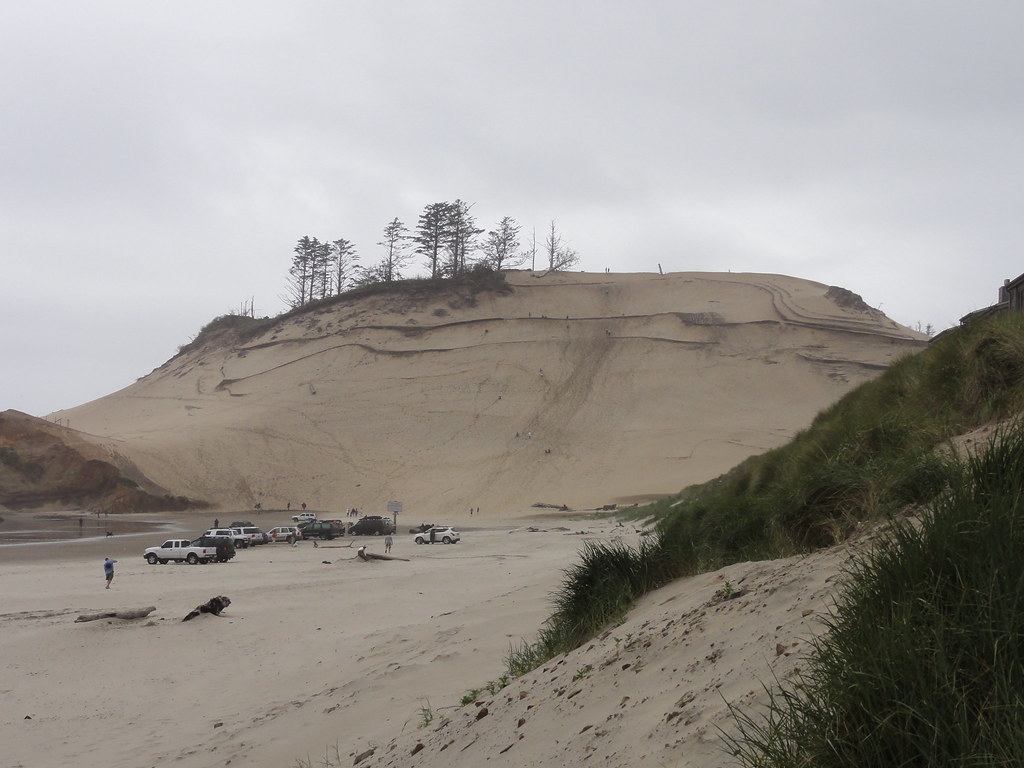 |
| Dunes at Cape Kiwanda |
Here, you're catching a glimpse of what the beaches were like fifteen million years ago, before the basalt came. And yet, basalt is the reason it's still here.
01 February, 2011
Dana's Dojo: The Joye of Research
Today in the Dojo: How does one make research more fun?
Research gets a bad rap. Writers make it sound like work. They seldom see it as an excuse for a Fun Day Out.
There seems to be a perception that work involves pain. If we're not suffering, we're not working. If it doesn't cost us time, money and sweat, it's not work. If we do it with other people, it's not work. Say the word "research", and most writers will envision endless hours spent hunched over dusty tomes in a dimly-lit library somewhere, eyes crossed from fine print, fingers bleeding from over a dozen papercuts, and neck as stiff as if we'd been in a twenty-car pileup on the freeway. And if we're doing research, that means that we're in solitary confinement, with only brief human contact with librarians and other such folk who will only make us read more books with tiny print.
It doesn't have to be that way.
In fact, it shouldn't.
Oh, research will entail a lot of reading. It will also include those horrible slogs through thousands of only vaguely useful search results on Google. But it doesn't have to end that way. And in this age of multi-tasking, we can make research pull double-duty for us.
As I so often do, I'm going to use my own experiences as an example. You'll learn how I went from research-as-chore to research-as-opportunity-for-fun, and hopefully get inspired to go out and play - um, research - in ways you never considered before.
I do a great deal of research - particularly in the apartments of tall blondes.
-Raymond Chandler
Research gets a bad rap. Writers make it sound like work. They seldom see it as an excuse for a Fun Day Out.
There seems to be a perception that work involves pain. If we're not suffering, we're not working. If it doesn't cost us time, money and sweat, it's not work. If we do it with other people, it's not work. Say the word "research", and most writers will envision endless hours spent hunched over dusty tomes in a dimly-lit library somewhere, eyes crossed from fine print, fingers bleeding from over a dozen papercuts, and neck as stiff as if we'd been in a twenty-car pileup on the freeway. And if we're doing research, that means that we're in solitary confinement, with only brief human contact with librarians and other such folk who will only make us read more books with tiny print.
It doesn't have to be that way.
In fact, it shouldn't.
Oh, research will entail a lot of reading. It will also include those horrible slogs through thousands of only vaguely useful search results on Google. But it doesn't have to end that way. And in this age of multi-tasking, we can make research pull double-duty for us.
As I so often do, I'm going to use my own experiences as an example. You'll learn how I went from research-as-chore to research-as-opportunity-for-fun, and hopefully get inspired to go out and play - um, research - in ways you never considered before.
Subscribe to:
Posts (Atom)