27 March, 2011

Some Brief Thoughts on Death and Dying

Diana Wynne Jones, outstanding fantasy writer and Neil Gaiman's friend, died. She lived a long life, and a good life, and left a lot of magic behind.

I found myself standing on the balcony after hearing the news, staring into the sky at the stars, and caught myself thinking, "I hope Death came for her."  Those poor, deprived people who aren't fans of Neil Gaiman won't understand why that's a happy thought.  Maybe this will help:

Death of the Endless
There are worse last sights than a cute, perky Gothic chick taking you on one last adventure.

Of course, I laughed at myself a little for the thought.  Death exists only in the imagination.  There's no actual being who's going to drop by and haul anybody's arse off to the Summer Lands.  There's no afterlife.  There's life, and then there's not.  People seem to think that's terrifying.  They can't face that death is the end, that there's nothing beyond to look forward to.  I get that.  Not as much as I used to, but I understand some people desperately need to believe there's no end to us.

I used to need that.  I used to fear dying quite a lot, actually, and worried about the quality of the afterlife.  But then I read Sandman, and met Death, and thought that while life was preferable to death, there wasn't any real reason to fear Death herself.  I didn't want to meet her too soon, but it wouldn't be so bad.  She put a spring in my step.  She dispelled the shadows.

Still.  I worried.  What if I didn't accomplish everything I'd set out to do?  That'd be me, moping around the Summer Lands, regretting the things I hadn't done.  I'd get what everyone gets: a lifetime.  But would it be enough?

Then I became an atheist, and suddenly, the fear was gone.  Seriously, totally gone.  I no more want to die now than I ever did, I still want to accomplish things and leave something of lasting value behind, but I'm no longer afraid of the fact of death.  Why should I be?  I won't have regrets.  I'll know nothing about it.  There will be no me left to fret or regret.  The end of consciousness used to be a terror, but for some reason, a day came when I could fully accept it.  I think it's because I realized there's no use in fearing it.  And now, I could dedicate all of me to this life.  It's the only one I've got.  No do-overs.  Do I really want to spend it in perpetual panic?  No.  So.  Live a good life, and a full life, as long as I can, and enjoy it.  One day at a time, with no eternity staring me accusingly in the face.

But.

There's a chance that, at the end, I'll see Death.  Near death experience, y'see.  Got to thinking about those tonight.  The last imaginings of the hypoxic brain.  Some people see Jesus.  Some people see - well, whatever their culture's conditioned them to see.  So it's quite possible that the last fitful firings of my synapses will present me with a tunnel, and a cute perky Gothic chick, and with the last instant of consciousness, I'll be able to take her hand and let her walk me off the stage.  It won't matter a bit that it's not real, or that it won't be remembered.  It's still a hell of a nice way to go.

A last instant of happiness.  Don't know.  Could be.  A last, delightful little hallucination as the grand finale. 

I hope that Diana Wynne Jones's brain did that for her.  I hope that the last synapse fired off a happy ending, a fitting tribute to a wonderful life richly lived.

26 March, 2011

Cantina Quote o' The Week: An Old Turkish Saying

Geçmiş olsun.

-A Turkish Saying meaning roughly "May it be over."

This is one of the many tidbits you'll pick up from reading Louis L'Amour's The Walking Drum.  It's very useful for a long day at work.  Thanks to my Turkish coworker, you'll even know how to pronounce it: gesh'mesh ol'soon

Use it well.

25 March, 2011

Los Links 3/25

Reading's still a bit sporadic.  Okay, a lot sporadic.  Creative juices flowing and all that - it's been hard to focus on everything else.  But, thanks to the excellent folks I follow on Twitter, I got a few bits for ye.


Thurs-Demo: The one with the Earthquake Machine: "I named mine 'El Temblor!' I need to find some images of mexican wrestlers to paste on the sides and the brick to liven it up, I think. I designed mine to be easy to watch the brick, simple to construct, and cheap. Sort of a minimalist Earthquake Machine that I then loaded up with electronic sensors to graph some data (it's not SCIENCE until you graph some of the data...)." (Research at a Snail's Pace)

Reverberations of the Honshu tsunami: "Whatever the warning time, the sheer magnitude and force of the tsunami greatly exceeded anything the Japanese people had experienced since modern record keeping began. Approximately, 40% of the Japanese coast is lined with sea walls of varying heights, but as the New York Times describes, these sea walls provided little barrier to the March 11 tsunami. Worse, these seawalls may have lured coastal dwellers into a false sense of security and obscured their views of receding waters in advance of the oncoming tsunami. As a hydrologist, I was struck by the similarity of the problems with sea walls to the ones associated with levees along flood-prone rivers. The combination of under-engineering and complacency is a deadly combination when a major tsunami, flood, or hurricane strikes." (Highly Allochthonous)

Ignoring tsunami records: hubris, complacency, or just human nature?: "The earthquake that struck Japan may have been the largest since historical records began (and the fourth largest ever recorded), but the tsunami had many precedents – bigger ones – in the historical and geological record. The size of a tsunami is related to the displacement of the seafloor, not necessarily the magnitude of the earthquake, and significantly smaller events than the one on March 11th have generated larger tsunamis. This raises two questions: given the size and devastation of past events, why should this have been a surprise and why were 'defences' so woefully inadequate? And, are there, realistically, such things as 'tsunami defences' at all? (Through the Sandglass)

How to (and how not to) talk about earthquake hazards in the media: "This isn’t to say a magnitude 8 earthquake isn’t a very serious future hazard for California. But to argue that it would be more ‘scary’ than what we witnessed a couple of weeks ago is pushing it a bit. To argue that this horror is imminent is borderline irresponsible – there is no scientific basis for stating the risk of a ‘Big One’ in California is any greater than it was a month ago. The same is true of the arguably much more scary Cascadia subduction zone to the north – which can potentially produce a magnitude 9 earthquake, and will produce a tsnuami when it does so. We know that both of these faults will rupture at some point in the future, and people need to be aware of that. But claiming we’re in some period of extra-special risk right now is, to put it bluntly, just making stuff up." (Highly Allochthonous)

Will radiation hormesis protect us from exploding nuclear reactors?: "That reputable scientist, Ann Coulter, recently wrote a genuinely irresponsible and dishonest column on radiation hormesis. She claims we shouldn't worry about the damaged Japanese reactors because they'll make the locals healthier!" [There follows an epic scientific beating.  Pass the popcorn and enjoy!] (Pharyngula)

What A Disaster Really Means: "Disaster management on this scale is rather like being an invading army, minus most of the weaponry. To be successful, an invader has to assume that there will be nothing of use in whatever territory it conquers. The U.S. Army has a whole command dedicated to figuring out the logistics of such things, because, as they put it, prior planning prevents poor performance. They literally figure things down to how much to give a soldier to take with him each day. They have to." (Slobber and Spittle)


A Message From Christchurch On The Value Of User-Generated Content: "In a disaster, UGC is not here for your entertainment. It is not competing with network news for ad dollars. It does not care whether you think it should be pitted against the professionals for a journalism award. It is a way for people experiencing the most significant event of their lives to bear witness, to cry out their pain and their suffering and their need, to connect with people close by who are sharing the experience and with people far away who, but for their voices, might mistake these events for a blockbuster movie filmed on a sound stage. No human can fail to be moved by the horrific tragedy of Japan, made so real by the user-generated content coming from that ravaged coastline -- its very lack of professionalism making it so abundantly clear that there is no difference at all between us and them. In these turbulent times, we cannot afford to distance ourselves from the humanity at the other end of the camera, and from the reality that there but for the grace go we." (Online Spin

Don't forget Evelyn's ongoing interview series with her father, a nuclear engineer, about the damaged nuclear plants causing so much trouble in Japan. 

Why Can’t I Ever Dream Up Scams Like This? "I received an email from a fundie crying that some commie-liberal puppy-raping Jesus-hating atheist doesn’t like the national motto ('In God we trust'). He wants me to sign a petition to Congress to get them to vote yes on some unconstitutional legislation to waste tax dollars promoting his religion." (Bay of Fundie)

Dressing the meat of tomorrow: "The first piece of in vitro meat grown for human consumption was not produced by science or industry, it was produced by art. More specifically, it was created by the artists Oron Catts, Ionat Zurr and Guy Ben Ary in 2003 as part of their ongoing Tissue Culture and Arts project. The meat was cultured from frog cells and was subsequently eaten by a group of invited guests at a gallery in France." (SciAm Guest Blog)

The Physics of the Flower’s Bloom: "Not content to just watch flowers dance in the breeze, Harvard physicists have described for the first time how flowers generate the forces needed to curl open come springtime. In the asiatic lily (Lilium casablanca), this poetic blossoming is driven by skewed growth at the edges of petals, the team reports online March 21 in the Proceedings of the National Academy of Sciences." (Wired Science)

Impacts and Geology: deep peace? "Metamorphic rocks typically come from deep in the earth and form slowly. Simple physics shows that transferring heat into large volumes of rock (a key driver of many types of metamorphism) takes millions of years. Rocks that form the deep crust of stable cratonic areas lead the most placid of lives. They are heated for so long that they become annealed; they have achieved complete chemical, textural and thermodynamic equilibrium, like some sort of silicate-based Buddhist monk.

"Some deep crustal rocks in South Africa were once in granulite nirvana and might still be there, if only they hadn’t been hit by the biggest impact known on earth. The slow and calm world of the deep crust was violently attacked from Outer Space and the shocking results are visible in the a thin-section." (Earth Science Erratics)

Frivolous Research?: "In 1955, a $250,000 grant was awarded to researcher E.F. Knipling to study the sex life of the parasitic screwworm.  Senator William Proxmire (a Democrat) later awarded this study - The Sexual Behavior of the Screw-Worm Fly - his infamous 'Golden Fleece' award which was given to projects he believed were a ridiculous waste of taxpayer dollars.  Proxmire, whose degree was in Business Administration, turned out to be rather poor judge of biological research projects since this project is estimated to have had a payback measured in the billions of dollars." (Hudson Valley Geologist)

Soldier, Dad, Whistleblower: Atheist in a Foxhole Takes on Evangelistic Military Hierarchy: "The big stuff that’s coming down from the top, that’s different. There are existing rules in place that are being violated systematically. For instance, soldiers are very vulnerable when they come out of basic training, and evangelistic organizations take advantage of that to target them. Look at the picture of the five hundred soldiers being converted by the Billy Graham people. It’s 200 here, 150 there on stage in uniform. It’s epidemic, and I find it outrageous. The amount of money being spent by American citizens to support Evangelical proselytizing activities is substantial. The smokescreen about spiritual fitness having nothing to do with proselytizing is just that–smoke." (Truthout)

Hugs From Libyans: "Doubts are reverberating across America about the military intervention in Libya. Those questions are legitimate, and the uncertainties are huge. But let’s not forget that a humanitarian catastrophe has been averted for now and that this intervention looks much less like the 2003 invasion of Iraq than the successful 1991 gulf war to rescue Kuwait from Iraqi military occupation." (Nicholas Kristof, NYT)

News flash: creationists distort science: "What I’m going to do is put up an analysis by a professional systematist of how duplicitious this ICR article is.  Christian creationists won’t, of course, be swayed by scientific counterarguments, but perhaps it will be instructive to see how creationists distort data in a field that’s unfamiliar to most laypeople: systematics." (Why Evolution is True) [And for bonus hilarity, you've absolutely got to watch this video of two corvids getting cats to fight.  This, my darlings, is why I laugh at the people who tell us we should imitate the harmony of nature.)

24 March, 2011

The Difference Between Guys and Gals

I sometimes worry, when writing from male points of view, that I'm getting it all wrong.  Okay, so, granted, I took some BBC quiz thing once that was supposed to measure the relative gender of your brain and came out strongly on the male side.  Spent most of my childhood running wild through the neighborhood with the boys and seemed to hold me own.  But still.  I'm a girl.  Got the parts to prove it.  Got the damned monthly agony to prove it, too, though I wish I didn't.  And I sometimes wonder if my boys are turning out too much like girls.

Livia Blackburne's post On Writing Realistic Male Characters is a bit of a help there.  So is seeing stark yet subtle examples of the differences in the way men and women view the world.

For instance, I've just finished Doctor Who Series Four (for the second time), and something about the end of it was bugging me.  What I'm about to discuss has spoilers, so for those of you who haven't yet seen the show, but plan to, and want their viewing experience to be spoiler-free, I'm putting the rest below the fold.


23 March, 2011

Oregon Geology Bonus Features: Geologic Art Interlude

Did I say last week it was the end of Oregon Geology?  Well, consider this the DVD collection, complete with extras!

We stopped over at Washington Park the morning we were in Portland, and found some delicious geologic art. 

Les AuCoin Plaza
One of the most striking is Les AuCoin Plaza, near the MAX station.  You like light rail, thank former Rep. AuCoin, who was instrumental in making it happen.  This plaza does him total justice.  It's beautiful, for one thing.  The enormous columns of basalt (say high to our old friend the CRB!) are just wonderfully worked in.  You can really get up-close and personal, inspect them, get a feel for how massive they are.

And there's so much more.


22 March, 2011

Dana's Dojo: Mythical Writing Part III

Today in the Dojo: Mythic Structure

The latest incarnation of Oedipus, the continued romance of Beauty and the Beast, stand this afternoon on the corner of 42nd Street and Fifth Avenue, waiting for the traffic light to change.
-Joseph Campbell, The Hero With a Thousand Faces

Joseph Campbell started it.  He identified the archetypical structure of the Hero's Journey in world mythology, wrote a book, and next thing you know the damned Hero's Journey is everywhere.

If you don't believe me, watch Star Wars again.  The good - I mean, original - ones.  George Lucas was heavily influenced by The Hero With a Thousand Faces, and it shows all throughout the first trilogy.  The Lord of the Rings followed that structure, too, only before Joseph Campbell (Tolkien was so steeped in ancient myth that he didn't need a map anymore).  In fact, if you type "mythic structure" into a search engine, you will come up at least one article griping about how everybody and God patterns films after the Hero's Journey these days. 

There's good reason for it, though: mythic structure works.


21 March, 2011

Reader Appreciation Day

Source
It's time to take a moment out of the week's blogging topics and say, "Thank you!"

You, my dear readers, are absolutely brilliant.

I put out a plea for the things that scare you, and you weren't afraid to rise to the challenge.  If I end up with the writing chops to create a truly frightening Big Bad, it will be because you - yes, you - stepped up and delved into your minds and risked nightmares and probably worse to let me know what terrifies you.  Without that, I wouldn't have a clue.  And I wouldn't have the confidence to attempt this.  Incredible.

Then there are all of you who commented on my last, rather lame Oregon Geology post.  You got me the info on benchmarks I'll need for this summer.  You've inspired me to go out and find some benchmarks and make something of them.  And all those kind words!  All I can say in reply is that I'm glad you've enjoyed the series so much, because it's all been for you.  Wouldn't be writing this stuff if you weren't there, you know - what would be the point?  90% of the fun in going out, seeing and doing these things, is in writing them up afterward, hoping I'll have given you a bit o' adventure as well.  I take each and every one of you into the field with me.  I get wonderfully excited, finding things you might like.  So it's a vast relief to know I'm getting the job done.  Thank you for being there.  Thank you for egging me on!

We've got quite a few more adventures coming up.  I've still got bulging folders full of images from other trips waiting for your viewing pleasure.  And this summer, new adventures!  Requests welcome: I'll announce each one, and you can tell me if there's a particular bit you want to see.  You're along for the ride, even if only virtually.

Now, should I ever, say, win the lottery or make bags of money by publishing books people decide to devour, those virtual trips shall become a reality.  You're all invited.  Nothing would please me more than to gather groups of you and get out there and see the world with you.

This world is a better place with all of you in it.  Never doubt that.  You guys rock, and you make me the luckiest woman alive.

20 March, 2011

Two Posts on Religion Everyone Should Read

Back before I got so completely immersed in Doctor Who and the subsequent explosions of ideas that I haven't had time for much else, I was spending quite a lot of time catching up on every post ever written by Eric MacDonald.  His blog, Choice in Dying, is one I can't recommend highly enough for those who need a philosopher's perspective on these thorny issues of religion, atheism, morality, and choices.  He reminds me a bit of Dan Dennett, one of our Four Horsemen.  All I can say is, someone had better saddle that man a horse, because we've got a fifth Horseman.

Two posts from January particularly caught my eye.  In one, Eric talks about the cost of religion:
I do not think the sums have been done. Religion is not a peaceful thing, despite all claims to the contrary. It has been protected, for centuries, just as Islam still protects its holiness, by threats of violence. The English Bible that, for all its glories, is sometimes pedestrian and dull, is regarded with special reverence, in large measure because it had to be fought for, and people died so that they could read the Bible in their own language.
And in this, about the social pathology of religion:
We are becoming so accustomed to religious oppression and pathology that we scarcely dare to talk openly about it, and to call it openly by its name. Governments and large press organisations do a clever soft-shoe shuffle around it every time it becomes too obvious to be simply ignored, but no one is saying that this religious idiocy should end, and that it is intolerable that religions should play this role in the world. It seems to be taken for granted that there is nothing that we can do to moderate these pathologies except to try to insulate them in ghettoes of religious belief, the result of which can only be a mosaic of intolerant communities intolerantly related. If Roman Catholic hospitals want to kill women by refusing them appropriate medical care, well, that is just a peculiar belief system which has nothing to do with the rest of society. And when Roman Catholics or Muslims band together to oppose the practice of contraception in a world bursting at the seams with people, well, that too is just a religious peculiarity, and we must learn to live with these things.
Eric, once an Anglican pastor, has a very clear view of the harm religion can do and does.  He doesn't believe we have to live with it.  He doesn't believe we should stay silent in the face of it, just to spare the feelings of believers or in the interests of a false social harmony.

I wish all of my friends who were still believers would read his blog, start to finish, and really think about what it is they're doing, and what religion truly is.

19 March, 2011

Cantina Quote o' The Week: Lao Tzu

The very bones of those you talk about have turned to dust.  All that remains of them is their words.

-Lao Tzu

Lao Tzu, of course, wrote the Tao Te Ching, and legends have sprung up around him like cats on a tuna can.  But this legendary tale might well be true:


The oldest surviving biography of Lao Tzu can be found in the annals of one of China's greatest historians: Ssu-ma Ch'ien, written nearly 400 years after Lao Tzu died. From him we know that Lao Tzu was born in the state of Ch'u (presently eastern Honan Province). He writes about Lao Tzu's meeting with the philosopher Confucious (K'ung Fu-tzu) — two individuals who represented philosophies that would dominate Chinese culture and society for over 2,000 years. Ssu-ma Ch'ien explained:
"When K'ung Fu-tzu went to Ch'u, he asked Lao Tzu to tutor him in the rites. Lao Tzu replied, "The very bones of those you talk about have turned to dust. All that remains of them is their words. You know that when a noble lives in times which are good, he travels to court in a carriage. But when times are difficult, he goes where the wind blows. Some say that a wise mechant hides his wealth and thus seems poor. Likewise the sage, if he has great internal virtue, seems on the outside to be a fool. Stop being so arrogant — all these demands — your self-importance and your overkeen enthusiasm -- none of this is true to yourself. That is all I have to say to you." 

K'ung left and said to this followers, "I know that a bird can fly; that fishes swim; that animals can run. Things that run can be trapped in nets. What can swim can be caught in traps. Those that fly can be shot down with arrows. But what to do with the dragon, I do not know. It rises on the clouds and the wind. Today I have met Lao Tzu, and he is like the dragon." 
You'd think Chinese kings would've learned...

18 March, 2011

Los Links 3/18

It's been a week.  Top story, of course, was the earthquake in Japan, and the still-unfolding disaster as nuclear power plants failed.

A great many geobloggers have presented excellent posts.  For links to a vast array of information, try Looking for Detachment and Outside the Interzone, where Silver Fox and Lockwood have collected a wide range of sources.  Mountain Beltway was on top of things from the very first morning, and Chris Rowan did one of his typical brilliant assessments, along with a post on the SciAm guest blog.  Evelyn at Georneys has a series of interviews with her dad, a nuclear engineer.  All excellent stuff.

Dan McShane posted a brilliant assessment of how the Japan earthquake should impact policy considerations for those of us in Cascadia.  I think this needs to be thrust into the hands of every politician, city planner, and - oh, fuck it, absolutely everyone in the region.

Rachael Acks at 4.5 Billion Years of Wonder had something very important to say in the aftermath:
There is no meaning to the Sendai earthquake. There is no capricious god, no vast karmic wheel. It is simply a thing that has happened, that we as humans must struggle against, and fight to overcome, and mourn those who have died afterward. Because there is nothing more to it - it's just the summation of physics and time - what we do is so very important. We have only this world, only this life, and only each other.
Truth.

And the NYT asks if we "get" tsunamis yet.  Judging by the fact that so many people ran to the water to have a look at one in this country, I'd say the answer is probably no.  This is an important artiicle, and gets bonus points for quoting Gandalf.  No, really, I mean it.  Go have a look.

Finally, if you missed Callan's post on secondary effects, don't miss it now.

In non-earthquake-and-tsunami news, Rep. Ed Markey went off on a glorious rant about science and the GOP attacks thereon, which is a thing of beauty and should not be missed by anyone.  Also on the political front, read Steve Benen's very important post about power grabs.  There's so much happening you may know nothing about, and if you care about the future of democratic rule in this country, this is stuff you should know:


You might be thinking, "C'mon, that can't be right." I'm afraid it is. Michigan's new Republican governor is cutting funding to municipalities, and if they struggle financially as a consequence, he will have the power to simply take over those municipalities if he believes he should.

And once Snyder does take over these local governments, by virtue of his own whims, he can impose a local dictator -- called an "Emergency Manager" -- who will have the authority to undo collective bargaining agreements, scrap contracts, and even undo the results of elections.

And if that weren't quite enough, the local dictator, at the behest of the new Republican governor or a designated corporate ally, can even "disincorporate or dissolve" an entire municipal government -- effectively making a local government disappear -- without any input from the public whatsoever.

I'm completely serious.

He completely is.  And so is the situation.  Pay attention, people.

No graceful segue is possible from that, so I won't try.  Instead, enjoy the sensation of whiplash as I direct your attention to two posts for those interested in ebook publishing: Michael Stackpole's 9 Must-Have Clauses for Digital Rights Contracts and Joseph Esposito's The Terrible Price of Free.

I'm not sure about the science behind this article on the Large Hadron Collider, as I'm not very well-versed on particle physics, but it gets props from me for quoting one of the greatest Doctor Who lines ever.

And today, Mercury Messenger made it into orbit!  Two things: Lockwood 'splains it all and Callan linked to one of the most remarkable videos I've ever seen.  There's a little something uplifting for ye.

Right?  Right.  I probably missed a ton of stuff, but I'm still busy catching up on a great many lost years of Doctor Who fandom, which I'm back off to now, so adios for now.  Or (and only fans will really understand): Allons-y!

17 March, 2011

Oregon Geology Parte the Tenth: Crown Point

We're at the end of our long journey, which began in Astoria, continued through Ecola State Park, Hug Point north and south, the world's shortest river, Cape Kiwanda, Cape Meares, the Columbia River Gorge, and some truly tremendous waterfalls.

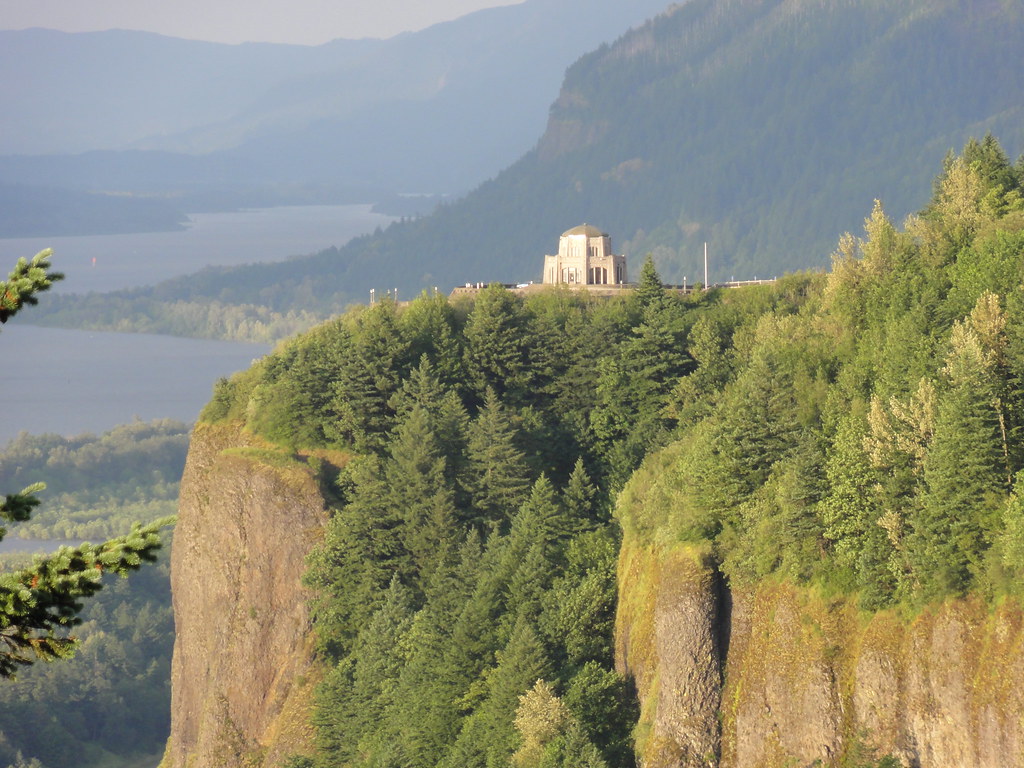
Now here we are at Crown Point, where the Vista House gleams like a jewel in the crown:

View of Crown Point from Chanticleer
And I could do a proper write-up, but I'd mostly just be repeating myself.  We'll have more images than words this time round, I should think.


16 March, 2011

Dana's Dojo: Mythical Writing Part II

Today in the Dojo: Way Beyond the Occident

If the path before you is clear, you're probably on someone else's.
-Joseph Campbell

There's a horrifying tendency for most writers to dig into the stuff they grew up with - Biblical, Egyptian, Greek and Roman mythology - and look no further.  I can testify that back in my school days, I didn't even realize there was more to mythology than that.  It's probably a bit different for school children now, but back then, things were still stuck in the Occident, and to hell with the rest of the world.

It wasn't until I got to college that I realized there was a whole other three-quarters of the world chock full of some really incredible mythology.  It started with the Sumerian stuff.  I remember reading The Epic of Gilgamesh and feeling giddy.  I recognized Enkidu as the panther from Salvatore's books.  And then I started peeling back the Arabian and Oriental myths, and man....

Later, I discovered that in my own back yard, there was some incredible mythology to be had: Navajo creation stories, Hopi kachinas, Kiowa sun stories, an endless list.  My gods, why would I want to limit myself to Greece, Rome, Egypt and Israel with all this other stuff out there?  Why did so many authors tread the mill of Arthurian legends when the Norse had some kick-ass legends of kingship, love and betrayal that hadn't already been picked to the bone? 

I finally figured out the answer: it's safe and easy, that's why.


15 March, 2011

Hypatia Day

Hypatia of Alexandria

So I gets this message from Facebook, y'see - my Pharyngulite friend Cameron Cole inviting me to an event called Hypatia Day.  Brilliant!  A day for remembering one of the most remarkable women in history.  We need more of those.  And it's worth punking off the Dojo till tomorrow for this.

This post is for those who just went, "Hypatia who?"  And for those who just went, "Hypatia - woo-hoo!"

I first got to know Hypatia whilst reading a book called Greek Society.  I'd been quite used to history being full of men, men, and more men.  Oh, and did I mention the men?  Sometimes it really did seem like history was his-story, with just the occasional smattering of, "Oh, and there was this cool female poet once - and did we mention these totally awesome men?"  The only ancient women I really knew were ladies like Cleopatra, and the history I'd learned concentrated more on their looks and their effect on men than on their brains.

Then came Greek Society, and this section of four pages talking about a philosopher, Hypatia of Alexandria.  Four pages, you say.  Big fucking deal.  But in a 223 page book spanning Greek history from Mycenaean civilization to the rise of Rome, four pages dedicated to one woman kinda is.

I'd never heard of her, but by the end of four pages, I was in love with her.  And Mr. Frost didn't even talk about her that much - he spent a lot of his words setting her in context.  But he described her as having an "extravagant intelligence."  There she was - mathematician, philosopher, astronomer - blazing like a supernova from those pages.  A woman pursuing the intellect and rationality in a very male world that at the time was beginning its slide into the Dark Ages.

Students came from all over the Hellenistic world to follow her.  Her father, Theon, a mathematician and last director of the magnificent Museion in Alexandria, admitted she overshadowed him.  Together, they wrote commentaries on such works as Ptolomey's Almagest and Euclid's Elements, works that went on to set the European intellectual world back on fire when they were rediscovered a thousand years later.  Enjoy rational thinking?  Tip a glass to Hypatia:
How important was the survival of Euclid’s Elements to the course of human history?  The Elements was the most influential textbook in history (Boyer, 1991, p.119).  As reformulated by Theon and Hypatia, the Elements became more than just a textbook on geometry.  It became the definitive guide on how to think clearly and reason logically.  The scientists Copernicus, Kepler, Galileo and Newton were all influenced by the Elements.  Newton’s interest in mathematics was awakened when he bought and read a copy of this book (Boyer, 1991, p. 391).  He used the style of the Elements, with formal propositions and rigorous proofs, in his Principia, the book which forms the foundation of modern physics.  All of modern mathematics employs the logical, deductive method that was introduced by the Elements.  In short, modern science and technology rests on the firm foundation laid down by Euclid’s Elements.
Yeah.  She's all that.

All of her rationality and independence and intellect, not to mention her religious affiliation (i.e., not Christian), led a mob of Christians to murder.  Apparently, she was in the way of their brave new world.  So they stripped her naked, dragged her through the streets, and slashed her to death with pottery shards.  And the darkness got that much darker.  Politics and religion killed one of the most brilliant women in history.  Then they killed the city of Alexandria, its great library, and the intellectual genius of the ancient world.  Okay, so barbarians also had a little something to do with all that chaos and destruction, but still: vast majority of it was down to politics and religion.  Science almost didn't survive, at least in the West.

But embers still burned, and got fanned to flame during the Renaissance.  Hypatia was so influential that Raphael wanted to put her front and center in his magnificent School of Athens.  Christianity shat on her again, refusing to allow a smart pagan woman murdered by Christians to have a part in a fresco created for the Pope's personal library.  Raphael sneaked her in there anyway.  And there she is.  Do you see her?  She's that elegant woman in white down towards the left who seems to stand apart from the tumult, for all she's smack in the middle of it:

School of Athens
Someday, I really need to read up on her life.  I know so little about her.  But I know she was extraordinary, an incredible woman who took her place beside the leading intellectual lights of her day, and lead many others in her turn.  We owe it to her to tell her story.

I'm glad someone thought to give her this day.

14 March, 2011

3.14

Pi Sculpture, Temporary Installation, Downtown Seattle
It's Pi Day!  It's a perfect opportunity to have fun with numbers.  In the spirit of things, here's a clip from Doctor Who on mathematics.  Watch it, it's awesome!


Happy Pi Day, everyone!

Fear and Loathing

I'm just going to throw this out there, because I'm stymied: what scares you?

Not in general, in books, I mean.  You see, I'm trying to ensure that my main antagonist, Sha'daal, isn't just some cheesy, generic Big Bad whose soul purpose is to provide a force for the heroes to overcome.  I know Sha'daal's not just that.  There are aspects to that character I can't bring out until later in the series.  In their stead, I have to ensure that when Sha'daal appears, when he's even just mentioned, people freak out.  Or at least break out in a cold sweat.

And this is difficult because we're not talking a human character.  I could create a terrifying human and make him believable.  Probably.  But when it comes to something inhuman, something far beyond human, I'm stymied.  I'm just not afraid of most of the templates.  Satan?  Yawn.  Most everything that's ever appeared in fiction or literature has done nasty things, but never struck terror into my heart.  And when I tried to analyze the things that terrify me, I came to a realization that I'm just not that scared.  Worried sometimes, yeah.  But not shitting myself with fear. 

Forces of nature don't terrify me.  I'm sure I'd be shit-scared in the midst of, oh, say, a volcanic eruption or a megathrust earthquake or watching a tsunami bear down, but it's not like I lie awake nights shivering in terror of them.  They happen, we'll deal or we won't.  I'd survive or I wouldn't.  If I die, I won't care, now, will I?  Dead people don't care.  If I survive, then I've got a job o' work to do putting the pieces back together.  And it's impersonal.  It doesn't mean me, specifically, any harm.  It's just the kind of thing that happens on a geologically active planet.  So I can't draw on the fear of forces of nature.  Haven't got enough.

People don't even scare me that much.  Not after what I've been through in life.  Dictators can be defied (should we ever get one in America, pencil me in for the revolution).  Violent people can be avoided or stopped, and if they can't, I'm either dead (in which case, see "don't care" above) or I've survived (see "job o' work" above).  People concern me a bit more than nature, but only a bit more.  I try to mine myself for terror there and can't find a motherlode.  And it's no good for Sha'daal, anyway.  He has a mind, and a form, but he's not human.  He's not even mortal.

Then I tried going back through books and television and movies, and came up empty.  Everything everyone's ever thrust at me saying, "This will scare you to death!" hasn't.  I watched The Ring and never twitched.  Got bored, actually.  Horror novels make me yawn.  I've not yet encountered one with the power to keep me up past my bedtime.  Certainly haven't given me nightmares.  Hell, I've watched "Blink" twice now, a Doctor Who episode that has one friend of a friend so terrified of stone angels that she screams every time she sees them, and that all of my friends hold up as the scary episode par excellence, and all I got was a brief but delicious case of the creeps.  Next time I see a stone weeping angel, I'll probably thump it and say, "I've got your number, you barstard."  But I won't flee it.

All of this is a long way of saying that soul-deep, gut-wrenching, nightmare-inducing terror is a hard thing for me to achieve.  So I need you lot.  If there's something in a book or show or movie that's terrified you, I'd like to know about it.  Who are your favorite Big Bads?  Who or what genuinely worried you, do you loathe, do you simultaneously love and hate the author for creating?

Temple Grandin once said she feels like an anthropologist on Mars trying to figure people out.  I'm feeling the same way trying to figure out what will truly make Sha'daal a force to be feared.  So thanks for guiding me through, my darlings.  I've never needed you more than now.